
Independent monitor urges delay, transparency if Denver Police adopt 'education‑based discipline'
Get AI-powered insights, summaries, and transcripts
Subscribe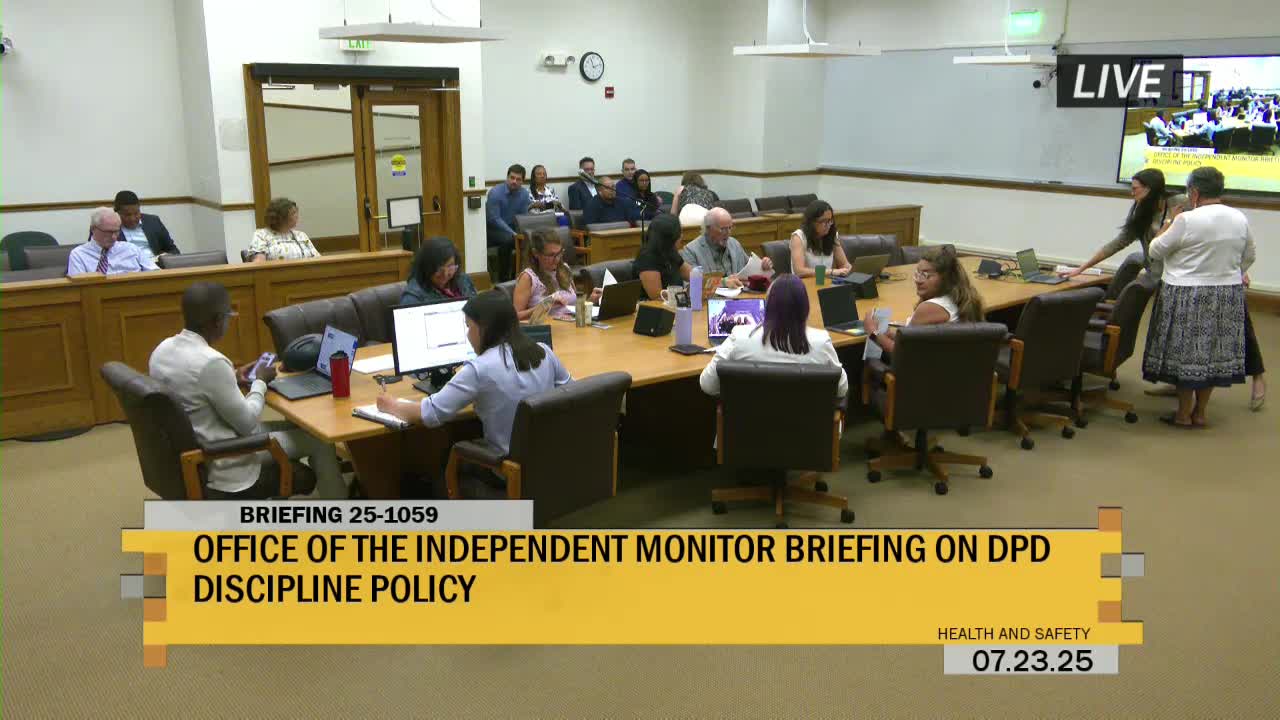
Summary
The Denver independent monitor told the City Council Health and Safety Committee that she does not support DPD’s proposed education‑based discipline approach without public release of the draft policy, OIM review, and safeguards to preserve sustained findings and oversight.
Denver’s independent monitor told the City Council Health and Safety Committee on July 1 that she does not support a proposed change in police discipline known as education‑based discipline, raising concerns that the approach would reduce sustained policy findings, weaken oversight and decrease public accountability unless strict conditions and publicly available draft language are provided.
“The OIM does not support education‑based discipline. We do not agree with the approach or believe it is necessary,” Elizabeth Bettis Castle, Denver’s independent monitor, said during a committee briefing. Castle told council members that while training is appropriate “in addition to discipline penalties,” the proposed approach appears to substitute training for discipline in ways that would remove the sustained findings and prevent prior misconduct from serving to aggravate future discipline.
Why it matters: Castle argued that changes to the department’s disciplinary model would alter the balance between the Denver Police Department (DPD) and the city’s civilian oversight structures, including the Office of the Independent Monitor (OIM) and the Citizen Oversight Board. She said the OIM’s ordinance‑based role includes reviewing law enforcement policies that materially affect oversight and that the OIM was not given adequate advance access to the draft policy for meaningful review.
Scope of objections and requested safeguards
Castle outlined several specific concerns and minimum requirements the OIM would expect if DPD proceeds with an education‑based discipline (EBD) program. She said EBD — a model in which corrective training replaces some disciplinary penalties — has no demonstrated best‑practice evidence of reduced officer recidivism or improved community outcomes from oversight organizations such as the International Association of Chiefs of Police, the Police Executive Research Forum (PERF), or the U.S. Department of Justice.
Castle noted that EBD’s origin is associated with the Los Angeles County Sheriff’s Department under Sheriff Lee Baca and said that experience raised questions about whether the model can be applied without risks to accountability. She also cited DPD’s existing discipline materials, including a matrix adopted in 2008 and a discipline handbook dated February 2022, to argue that current rules are intended to produce fair, consistent and transparent discipline results.
In presenting minimum conditions, Castle recommended that the city:
- Prohibit use of EBD for cases in conduct categories D through F, including allegations involving inappropriate use of force; - Require clear, documented criteria for when a case may qualify for EBD; - Require consensus among the Conduct Review Bureau (CRB), Internal Affairs/Investigations units, and the OIM before a case is placed in an EBD pathway; - Ensure the OIM continues to certify that investigations are thorough and complete; - Require that EBD cases still generate sustained findings so prior misconduct can aggravate subsequent discipline; - Require that complainants be notified if a case is resolved through EBD in lieu of discipline; and - Require scientific evaluation with a deadline to demonstrate positive outcomes before continuing broad use of EBD.
Process, transparency and community engagement
Castle said the OIM first received a PowerPoint description of the proposed model and did not receive a draft policy until Jan. 2, after the department had already announced plans to implement changes. She told the committee that a deliberative‑process privilege claim limited what the OIM could disclose about its recommendations, and that the OIM has been prevented from sharing its draft recommendations with the public while DPD presented PowerPoint summaries to community groups.
Council response and next steps
Several council members expressed concern that DPD leadership was not present for the briefing and urged that the department appear before the committee with the OIM for a joint briefing and public comment. Council Member Amanda Sawyer said the committee should reconvene with DPD in the room and allow public comment; Council Member Jamie Torres asked for an explanation of the charter and ordinance language that governs oversight and discipline. Council Member Kevin Flynn requested the police chief deliver a full presentation to the committee for a data‑driven discussion before forming an opinion.
No formal policy change or committee vote occurred. Committee leadership and the council president indicated they will schedule a full committee session with DPD leadership and asked the chief to present to mayor council next week; the OIM said it will analyze any published policy draft and report to the committee and public.
The briefing closed with a call from the independent monitor for greater transparency and for any significant disciplinary change to undergo public review and OIM certification before implementation.