Get Full Government Meeting Transcripts, Videos, & Alerts Forever!
Get email alerts on the Parking topic
No spam. Unsubscribe anytime.
Fort Collins council hears plan to expand paid on‑street parking, with Oak‑Remington lot usage and revenue questions central to debate
Summary
City staff presented a study recommending paid on‑street parking and other system changes to increase turnover, shift long‑term parkers into garages and shore up parking‑services finances. Council members pressed for more systemwide capacity analysis for Oak‑Remington and asked about impacts on businesses, employees, bike parking and enforcement.
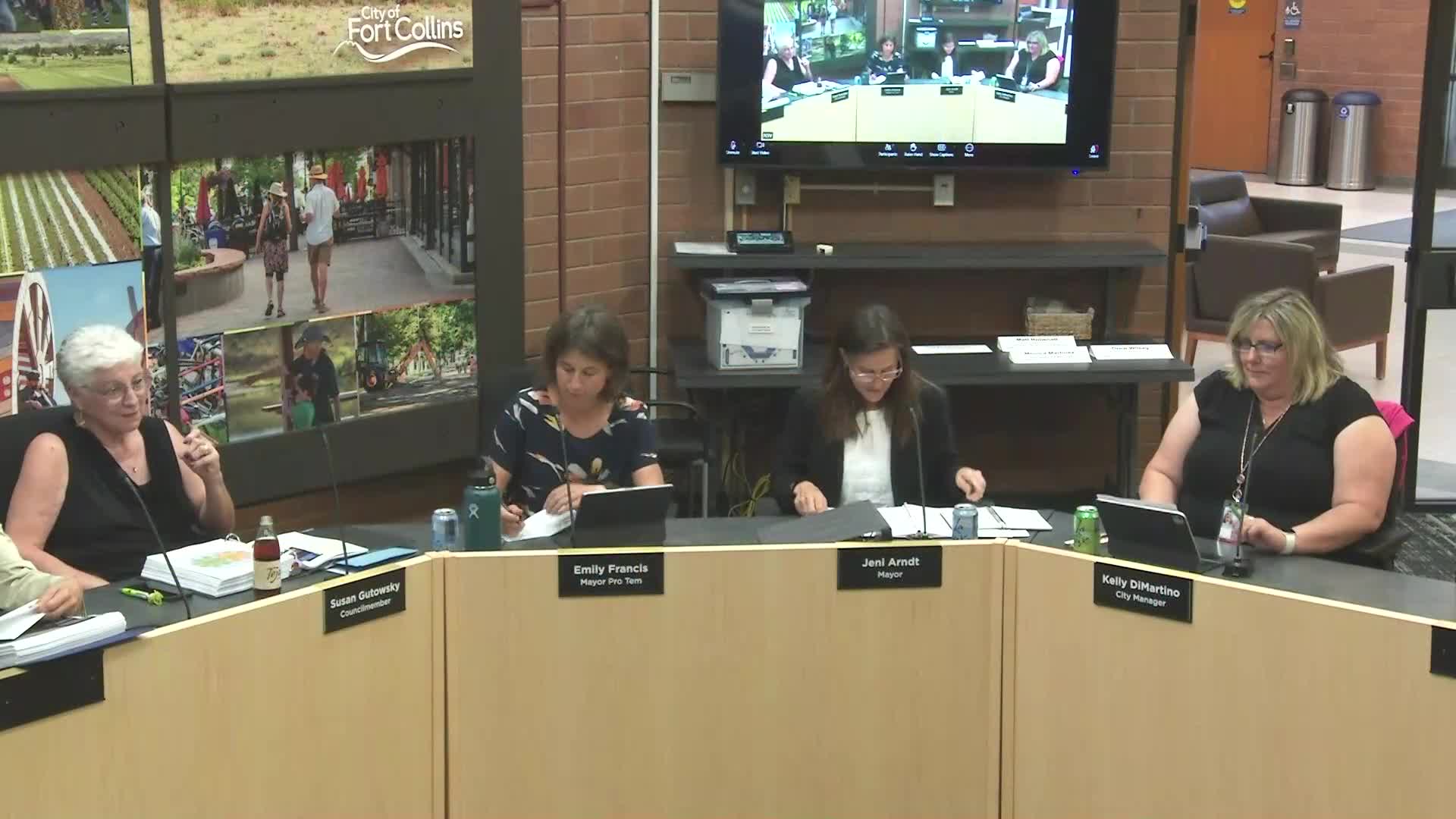
City Manager Kelly opened a work session Tuesday to review a study recommending expansion of paid on‑street parking and other changes intended to better match downtown parking supply with demand and to make the Parking Services operation financially sustainable.
Deputy Director Drew Brooks, Planning, Development and Transportation, told council staff would seek an alignment check during the session and then conduct robust outreach with downtown stakeholders over the next two months ahead of implementation planning targeted for early 2026. "We're looking forward to tonight's conversation about the downtown parking system," Brooks said.
Eric Kesselberg, Parking Services director, laid out three goals: support a vibrant downtown economy, provide customer choice across modes and parking types, and create a parking system that is financially sustainable and aligned with community goals. "We want people to come to the downtown parking system," Kesselberg said, and staff recommended pricing and other tools to move long‑term parkers into underused garages and increase turnover of on‑street spaces.
Staff presented three years of occupancy snapshots from license‑plate recognition scans on 24 block faces (about 945 spaces). The spring 2025 evening sample averaged 89% occupancy across those block faces; 22 of 24 block faces met or exceeded the industry threshold (about 80%–85%) where customers perceive low availability, staff said. Parking structures, by contrast, averaged roughly 40%–50% occupied during those same observations.
Staff noted Oak‑Remington service lot (163 spaces) reaches capacity in evening hours. Using Placer AI cell‑phone visit data (provided by the Downtown Development Authority, the DDA), staff reported roughly 2.1 million visits to the downtown study area in 2024, with an average dwell time of about 117 minutes — roughly two hours — and an estimated 107,000 unique visitors to the Oak‑Remington parcel in 2024 and about 213,000 visits to that geo‑fenced area. Kesselberg said Parking Services issues roughly 40,000 citations a year, with about 25% (roughly 10,000–11,000) for exceeding a two‑hour limit.
Study recommendations staff described as the initial implementation package include: expand paid parking to on‑street blocks and service lots, align time limits and enforcement with paid areas, improve wayfinding signage, develop a menu of employee and commuter permit options, and explore governance options with the DDA and downtown businesses. Staff proposed a simple initial on‑street flat rate (a suggested range of $1.50–$2.00 per hour) and off‑street service lot rates of roughly $1–$2 per hour, while keeping garages priced lower to incentivize garage use.
Estimated upfront implementation costs presented by staff included roughly 118 multispace meters (two per block face) at an estimated $590,000–$944,000; wayfinding and signage at about $150,000; and parking‑structure access control and fixed LPR systems between about $195,000 (gateless LPR) and $500,000 (gated systems). Staff estimated total first‑phase implementation of about $1.0 million to $1.6 million. For recurring revenue, staff said the department's adjusted base revenue figure was about $2.8 million; paid parking could add an estimated $2.4 million to $4.2 million annually depending on rates and uptake, with additional revenue from permit changes and citation fine adjustments pushing the low/high estimates to roughly $2.8 million and $5.5 million respectively in staff scenarios.
Councilmembers asked multiple operational and equity questions. Councilmember Emily (Mayor Pro Tem) and Councilmember Melanie pressed staff for concurrent data on garage utilization and whether the system could absorb the loss of a service lot: staff said structure occupancy was typically well below capacity during observed data collection and that implementation of paid on‑street parking would be expected to increase garage demand, but acknowledged they could not fully model all systemwide shifts until pricing and other changes are phased in. "If we implement this...we are going to increase demand for our parking structures," Deputy Director Brooks said.
Councilmembers also raised concerns about access and equity, including how accessible (ADA) parking would be retained and priced. Kesselberg said ADA provisions would remain in force and not be removed by the proposal. Bike parking and short‑term curb needs (15‑minute pickup, deliveries, app‑based food delivery) drew repeated questions; staff said the governance model and outreach will address flexible curb uses and loading zones.
On process and timeline, staff said outreach steps will include a downtown open house, door‑to‑door business outreach in October and a return to council in December. Staff said they intended to accelerate development of employee and commuter permit options in the short term because downtown businesses have requested immediate relief on employee parking.
Several councilmembers said they supported moving away from the current "upside‑down" model (cheaper distant parking, free or cheaper on‑street prime spaces) but asked for clearer modeling and for sales‑tax trend comparisons to be inflation‑adjusted when staff cites peer cities' post‑implementation tax trends. Staff acknowledged peer comparisons were illustrative (not causative) and said the examples were intended to show that paid on‑street parking did not necessarily cause downtown sales declines.
No formal motion or vote was taken at the work session. Staff sought direction and feedback; councilmembers broadly signaled interest in advancing outreach and more detailed system modeling before formal adoption.
What happens next: staff will proceed with the outreach plan, refine pricing and permit options with downtown stakeholders and the DDA, return with more capacity and revenue modeling in December, and aim to develop an implementation plan for early 2026. "We want to be very intentional about what we do to replace or displace parking," Deputy Director Brooks said.
Ending: The work session closed after about 72 minutes of discussion. Councilmembers asked staff to provide additional detail on garage capacity, employee permit costs and use, bike‑parking siting and design, citation fine history and escalation rules, and to bring inflation‑adjusted peer comparisons when returning with a final implementation plan.