
Preservation board delays adoption of Colorado Springs historic-resources survey plan
Get AI-powered insights, summaries, and transcripts
Subscribe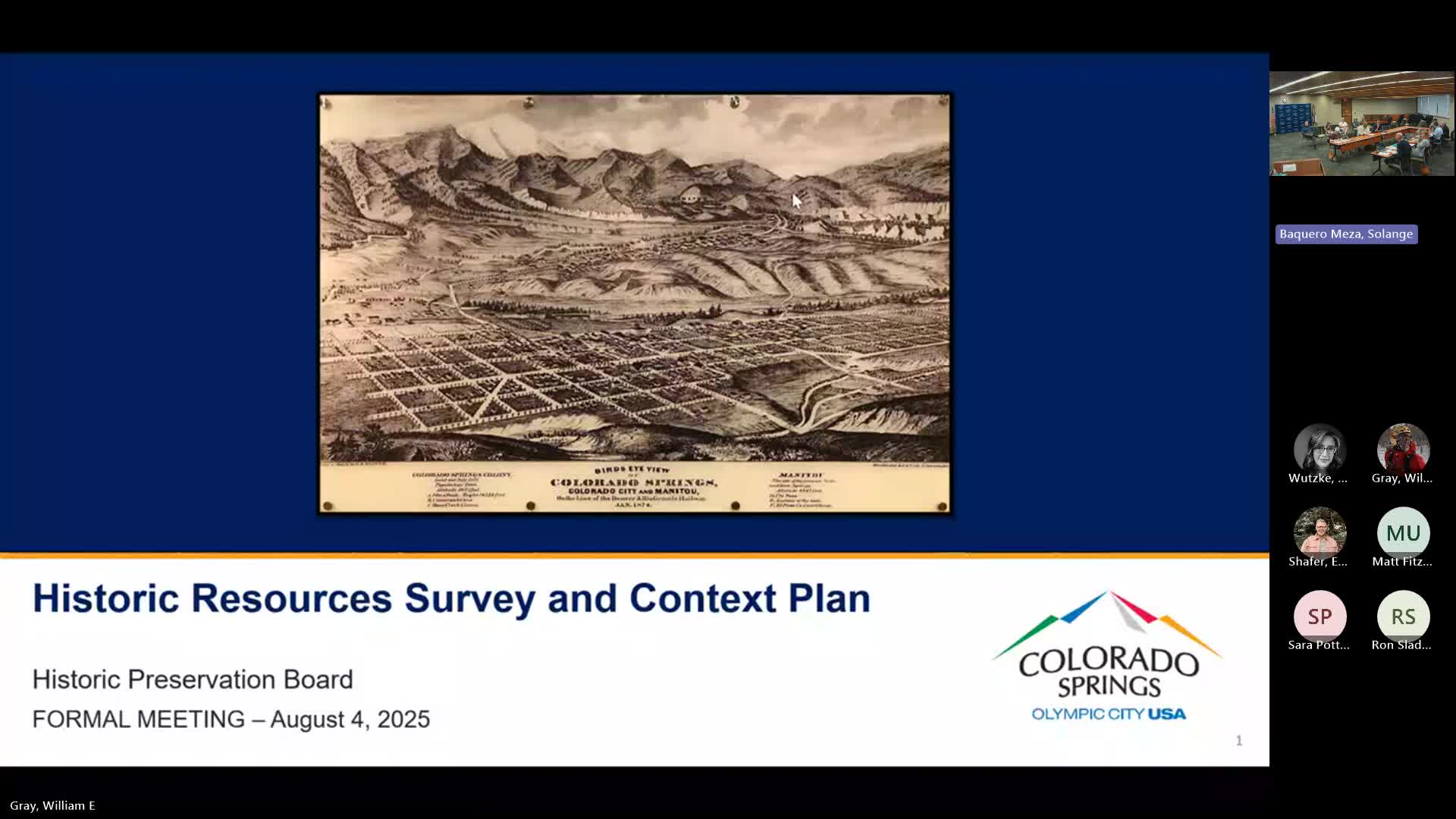
Summary
The Historic Preservation Board voted Aug. 4 to table final adoption of a citywide Historic Resources Survey Context Plan until Sept. 8 so staff and the consultant can incorporate edits and respond to conditions set by the State Historical Fund.
The Colorado Springs Historic Preservation Board voted unanimously Aug. 4 to delay final adoption of a citywide Historic Resources Survey Context Plan until its Sept. 8 meeting so city staff and the project consultant can incorporate edits, respond to conditions from the State Historical Fund and add materials the board requested. The board made the decision after a two-hour presentation and community discussion.
The plan, prepared for the city under a state grant awarded in November 2022 and begun in February 2024, is intended to guide future surveys, document historic context and help the city maintain its Certified Local Government (CLG) status. City staff told the board the project included a $9,000 cash match from the city and that the plan’s first draft was completed in March 2025 with a second draft released in July.
Why it matters: the survey plan establishes priorities and methods the city will use to identify and protect historic properties, and it will inform future grant applications and budgeting for survey work and preservation projects.
Consultant Ron (the project author) and city staff walked the board through the plan’s scope and revisions. Public commenters and local preservation advocates praised the draft. Diane Bridal, representing Historic Neighborhoods Partnership and the Historic Preservation Alliance, told the board, “We feel that at this point that the plan is really well done,” and offered volunteer and organizational support for next steps.
The discussion focused on three practical issues: (1) conditions flagged by the State Historical Fund (SHF), including a staff request to list properties already designated and, where possible, provide estimated costs for reconnaissance and intensive survey work; (2) how to present the survey results and related materials (photographs, maps, previous surveys) online as a single public repository; and (3) funding and staffing limits within the city that will influence which priorities the board and staff can pursue.
SHF conditions prompted detailed debate. The board heard from Ron that providing fixed cost estimates in the plan would be unreliable. He told the board, “I just think it’s unrealistic to build cost estimates into this plan… the numbers I might give you are going to be unreliable six months from now,” because costs vary by scope, property type, travel and who performs the work. Planning Director Kevin Walker told the board the city is preparing its 2026 budget and that available resources “are going to be less than last year’s,” reinforcing a need to narrow near-term priorities and pursue outside funding.
Board members and advocates proposed compromises. Several board members endorsed including accessible, high-level guidance for costs (for example, a dated planning-level range or a three-tier “$–$$$” scale for small, medium and large efforts) rather than fixed consultant fees. They also urged staff to prioritize “easy wins” such as putting survey photographs and an index on the city website and documenting city-owned historic properties first.
City staff agreed to address editorial corrections, add a neighborhoods map and other clarifications, and to discuss SHF conditions with the fund’s reviewer (identified in the packet as Jenny Dykeman). Ron said he would incorporate the edits and follow up with SHF: “Yes… I can get that done in the next few weeks.”
Formal action: after the discussion, a board member moved and another seconded to table final adoption until the September meeting so staff and the consultant could make the agreed edits and return a final draft for adoption. The board voted unanimously to table the plan and directed staff to coordinate with SHF and the city planning department on outstanding items.
Next steps: staff and the consultant will (1) make the board’s editorial and substantive edits, (2) provide clarifications requested by SHF or explain why some items (such as detailed cost estimates) will instead be handled as separate, project-specific budget exercises, and (3) prepare a cover memo highlighting recommended priorities and near-term actions for the board’s Sept. 8 meeting. The board also asked staff to explore a public-facing online repository for the survey photographs, forms and maps so residents can view the results without specialist access.
Background: the survey plan was funded through a state grant (with the $9,000 city match) and is intended to inform future reconnaissance and intensive survey work across Colorado Springs and to support the city’s CLG certification and preservation planning.