
Colorado Springs City Council votes to enter closed session on Melvin lawsuit settlement
Get AI-powered insights, summaries, and transcripts
Subscribe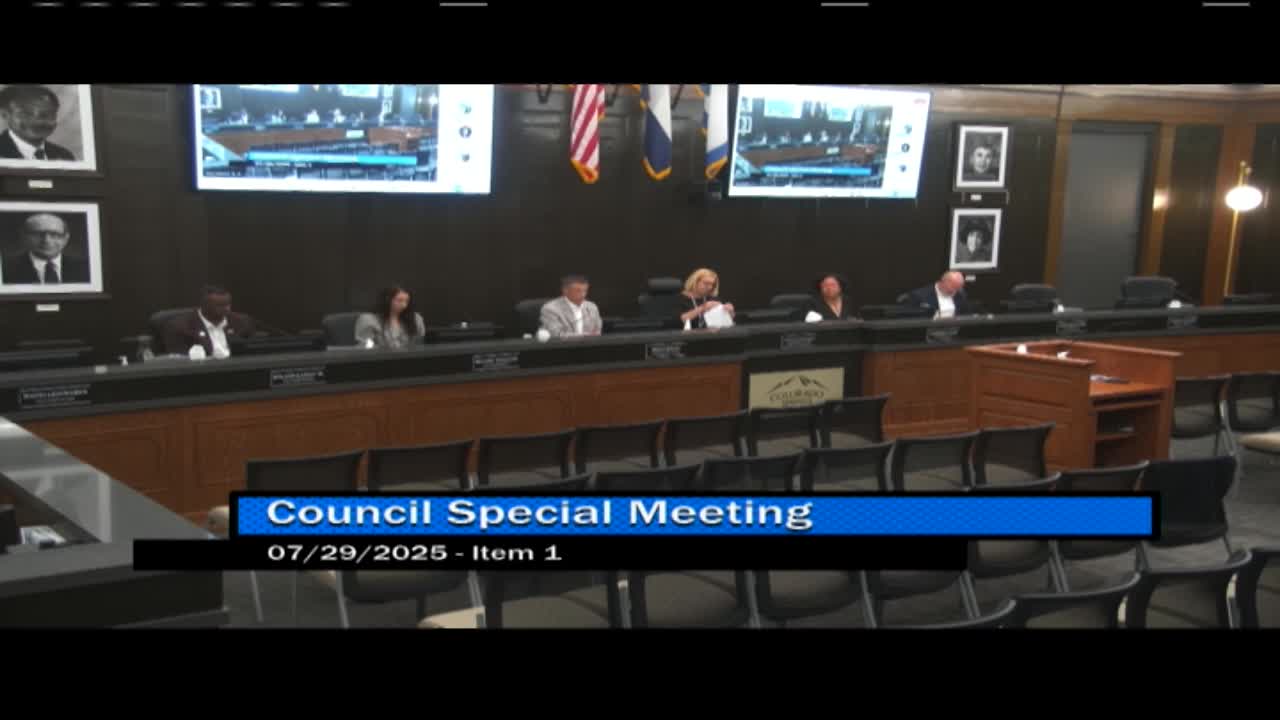
Summary
The City Council voted 6-2 during a July 29 special meeting to hold a closed executive session to consult the city attorney about negotiating a litigation settlement exceeding $200,000 in U.S. District Court case 20-cv-991, Estate of Melvin v. City of Colorado Springs.
The Colorado Springs City Council voted 6-2 on Tuesday, July 29, to enter a closed executive session to consult with the city attorney and determine positions for negotiation of a litigation settlement in excess of $200,000 in U.S. District Court case No. 20-cv-991, Estate of Melvin v. City of Colorado Springs. The vote took place during a brief special meeting called to consider the executive-session request. City Attorney Ben Bollinger read the legal basis for the session before the council voted.
The move matters because Colorado law and the city charter authorize closed sessions for privileged legal consultations and certain settlement negotiations. City Attorney Ben Bollinger told the council that the request was “in accord with City Charter Article 3, section 3-60 D and its incorporated Colorado Open Meetings Act CRS section 24-6-402(4)(b) and (e) and City Code section 1.5 0.506 B,” and that the matter involves “consultation with the city attorney for the purpose of receiving legal advice and determining positions relative to negotiation regarding a litigation settlement in excess of $200,000 in The United States District Court case number 20-cv-991, Estate of Melvin versus City of Colorado Springs.”
Bollinger also said the council must obtain an affirmative two-thirds vote of members present before holding a closed session and, if any member participates electronically, that member must state on the record that no unauthorized person is present or able to hear the discussion. The council proceeded after a motion by Council Member Risley and a second from Council Member Rainey. The motion passed 6 to 2, with Council Members Donaldson and Gold recorded as voting no.
The transcript shows a roll call and brief polling before the formal motion; during that earlier poll some members said “Aye,” and the council president then announced the formal motion and recorded the 6-2 outcome. The transcript also records that Council Member Hynchamp participated online and that the presiding official confirmed she was alone before the closed session. No settlement terms, dollar amounts beyond the statutory threshold, or further substantive details were disclosed in the public record at the meeting.
The meeting adjourned immediately after the vote. The council did not take any other public action or provide additional information about the lawsuit or any expected public disclosures about settlement terms.