
Committee advances Rock Drill rezoning and development agreement including preservation, affordable housing and TIF plans
Get AI-powered insights, summaries, and transcripts
Subscribe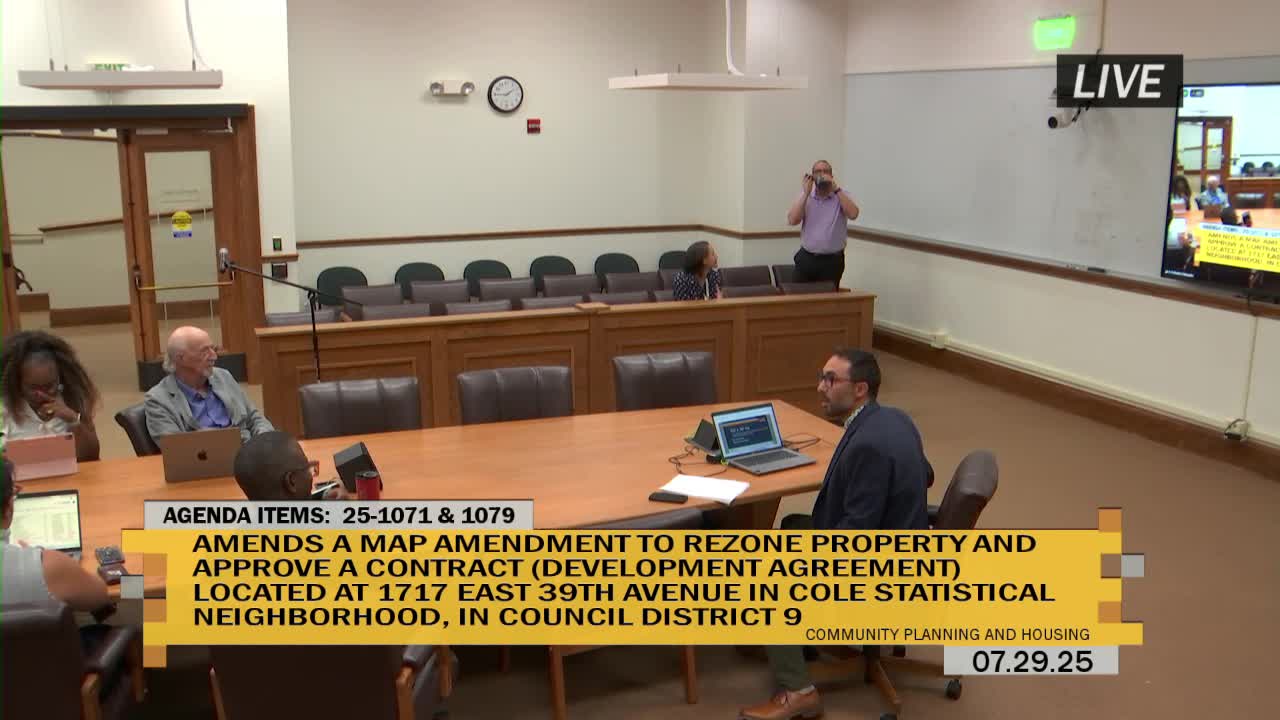
Summary
The Community Planning and Housing Committee of the City and County of Denver on July 23 advanced two related items for 1717 East 30th Avenue — a rezoning to CMX‑12/CMX‑16 and an associated development agreement — that together set conditions for mixed‑use redevelopment and preservation of the former Rock Drill manufacturing site in the Cole neighborhood.
The Community Planning and Housing Committee of the City and County of Denver on July 23 advanced two related items for 1717 East 30th Avenue — a rezoning to CMX‑12/CMX‑16 and an associated development agreement — that together set conditions for a mixed‑use redevelopment of the former Rock Drill manufacturing site in the Cole neighborhood, in Council District 9.
Tony Lechuga of the city’s Community Planning and Development (CPD) told the committee the roughly 6.7‑acre site contains multiple historic industrial buildings and has been underused for more than a decade. The owners, the Weiss family, and a developer team are proposing to map most of the property to CMX‑12 (12‑story incentive height) with a small corner mapped CMX‑16 (16‑story incentive height) and to execute a development agreement linked to an urban renewal/TIF financing plan.
Lechuga said the proposal went through the Large Development Review (LDR) process because the site exceeds five acres and because the project requires coordinated infrastructure, new right‑of‑way and an infrastructure master plan. He told members the Colorado Department of Public Health and Environment’s voluntary cleanup program and Denver’s materials‑management requirements will guide remediation if contaminated soils are found during redevelopment.
Key community benefits and conditions in the proposed development agreement include a high impact development compliance plan tied to the city’s adopted equitable housing affordability (EHA) standards. Lechuga said the applicant intends to provide deeper affordability than the enhanced EHA requirement: rather than enhanced EHA’s typical thresholds, the applicant will commit to providing 10 percent of residential units at a maximum of 50 percent of area median income (AMI). The development agreement also sets minimums for unit sizes: at least 15 percent of the required affordable units must be two‑bedrooms or larger and at least 5 percent must be three‑bedrooms or larger. The applicant also waived the option to pay a fee‑in‑lieu, assuring on‑site construction of the affordable units.
The agreement preserves nearly half of the existing historic structures identified by city landmark staff and requires the applicant to apply for local landmark designation for those buildings prior to issuance of any certificate of occupancy for new construction. Lechuga said the preservation commitment covers buildings and features staff found worthy of local designation and that short‑term alterations during remediation would still need to comply with landmark design guidelines.
Economic conditions in the package include requirements tied to the Denver Urban Renewal Authority (DURA) and proposed TIF: a DURA‑required 1 percent set‑aside for public art within the redevelopment area, participation in a first‑source hiring program giving Denver residents priority for temporary and permanent jobs, a small business enterprise (SBE) plan with a DURA goal near 23 percent of eligible project costs (excluding land) — which CPD estimated could translate to about $124 million in contracts for local small businesses for the project’s underwriting — and prevailing‑wage acknowledgements where city infrastructure would be reimbursed through TIF.
Lechuga said the development agreement includes a 15‑year vesting request that would lock in two items for the owner: the incentive heights associated with the requested CMX districts and the site’s open‑space standard (10 percent of the site under section 10.8 of the zoning code). He said the longer vesting period is appropriate because remediation, landmark designation research and infrastructure work mean substantial construction is not expected in the near term.
Developer representatives said they have engaged the neighborhood for several years, conducted tours and open houses, and plan to finalize a community benefits agreement (CBA) with the Cole neighborhood organization before the package returns to council. The applicant team noted Planning Board unanimously recommended approval on July 16 and that the proposal has three RNO letters of support and additional public letters reflecting support for preservation, affordable housing and mixed‑use amenities.
Committee members asked about details including the timing of the landmark nomination and the use of potential historic tax credits; the feasibility study required for a childcare facility on‑site; DURA’s TIF underwriting and blight study; and the equity analysis CPD used during LDR negotiations. Liah Mitchell from the Department of Housing Stability confirmed that the project would be subject to HOST prioritization policy for buildings with more than 100 units and that roughly 30 percent of the affordable units would be subject to that prioritization requirement.
Councilmembers moved and seconded a motion to advance the rezoning and the development agreement to the full City Council; the committee used a thumbs‑up/voice procedure to forward both items. The rezoning and development agreement will be scheduled for City Council consideration and the related TIF/urban renewal and associated DURA actions will return with their own materials for council review.
Why it matters: The combined rezoning and development agreement would enable high‑density, mixed‑use redevelopment in a region of the city targeted for intensive growth, while attaching legally enforceable commitments for on‑site affordable housing, historic preservation and workforce and small‑business benefit requirements tied to urban renewal financing.
Background and next steps: CPD said the application received an informational notice in July 2024, completed a community information meeting in November 2023, and submitted a large development framework in February 2024. Planning Board recommended approval on July 16. The applicant is pursuing an urban renewal plan, TIF and associated agreements with DURA that will be presented separately to City Council.