
Committee advances rezoning at 2501 South High Street to allow two‑unit housing
Get AI-powered insights, summaries, and transcripts
Subscribe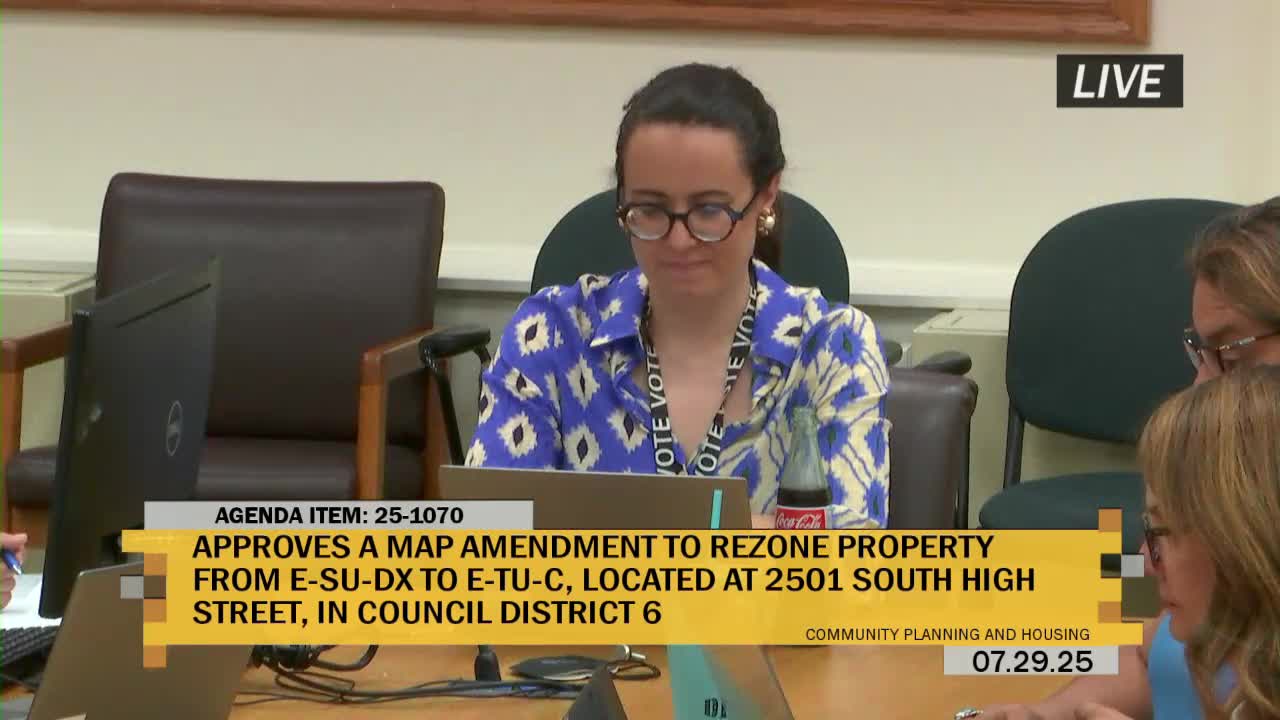
Summary
The Community Planning and Housing Committee voted to advance a rezoning request for 2501 South High Street in Council District 6 that would allow two‑unit housing on a 12,500‑square‑foot site. Staff recommended approval based on citywide plans and neighborhood support; the item will go to full City Council for final action.
The Community Planning and Housing Committee of the City and County of Denver on July 23 advanced a rezoning application for 2501 South High Street that would change the property from an urban‑edge single‑unit zoning to an urban‑edge district allowing two‑unit buildings.
Community Planning and Development planner Will Prince presented the request, saying it is “a request to rezone from ESU DX, urban edge single unit DX to urban edge 2‑unit C” for a 12,500‑square‑foot property described as partly occupied by a house and partly vacant. Prince told the committee the staff recommendation is to move the application forward, finding the project consistent with the Comprehensive Plan 2040 and Blueprint Denver and supported by neighborhood outreach.
The rezoning would allow duplexes or accessory dwelling units in a block where surrounding parcels already include two‑unit housing, Prince said. He told members the proposal implements citywide goals including increasing housing options in an infill location near transit and would extend an existing zoning pattern on the block.
Paul Hoffman, who identified himself as the owner of the house on one of the two parcels at 2501 South High Street, told the committee the site is two separate lots that share one street address. “It's 2 separate lots... but they're both 2501 South High,” Hoffman said. He said his plan is to remain in his home and that the vacant lot would likely be sold to a developer who would build a duplex.
Councilmember Jamie Torres moved to advance the rezoning application to the full City Council; the motion was seconded by Councilmember [Lewis]. The committee used a voice/thumbs‑up procedure to forward the item. The committee did not record a roll‑call tally in the transcript; the item is tentatively scheduled for a City Council hearing.
Why it matters: The change would allow additional small‑scale infill housing in a neighborhood context identified by city plans as suitable for duplexes and accessory units, and it moves a privately initiated project closer to a final decision at City Council.
Background and next steps: The staff report states the application received an informational notice in May, went to Planning Board earlier in the month with a recommendation for approval, and had five neighborhood letters of support submitted with the application. The committee advanced the item to the full City Council for a public hearing and final vote.