Get Full Government Meeting Transcripts, Videos, & Alerts Forever!
Get email alerts on the Stormwater Sewer Infrastructure topic
No spam. Unsubscribe anytime.
Council hears briefing on sewer, stormwater response after heavy July rains
Summary
Princeton officials and department heads told the council the cityresponded to three distinct July rain events, described the role and capacity of a 4,000,000-gallon lagoon, and reviewed a free check-valve program while noting limits on system capacity and EPA permitting.
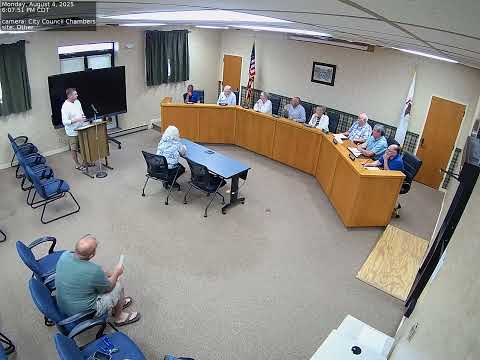
Mayor Mabry called the council meeting to order and led a discussion with department heads about recurring basement flooding and sewer backups after three heavy rain events in July. Tim, the citywater/wastewater department head, said the city lagoon is sized at "4,000,000 gallons, which is what it holds," and that staff actively pumped water back into the treatment system between events to make room for subsequent storms. Tim said the lagoon "served its purpose" and that it "was taking water through all the events," adding that the city did not reach full capacity during those storms.
Nut graf: The council sought explanation of why some properties experienced surface-water flooding and sewage backups during the third storm even though the city has invested in overflow piping and the lagoon. Department heads described how saturated ground, infiltration into old lateral lines, and the geometry of pipes and lift stations can combine to overwhelm parts of the system.
Council members and staff outlined the technical limits and mitigation steps. Tim explained the flow path for sanitary sewage from Thompson Street: a normal flow heads east to Fifth Street, then north to Park Avenue, then east to a lift station at Park Avenue East and Sixth Street; from there the system is pumped and later gravity-fed toward the lagoon near Liberty Village. He noted the system includes a mix of pipe sizes from roughly 6 inches up to a 24-inch main and that there are parallel feeder lines (an 18-inch and a 24-inch) that concentrate flows. Tim said pumps, bends, and lift stations create constraints: "You can't engineer a sewage system based on the worst case scenarios," and EPA permitting and pump-sizing that reflect the number of homes served also limit system upgrades.
Aaron, the citysurface-water lead, and Tim both described infiltration and inflow paths for stormwater and sewage, including groundwater entering cracked service laterals or leaking through foundation joints in older homes.
Staff also reviewed the city's check-valve program. Tim said the city offers 4-inch and 6-inch check valves at no charge to residents provided a licensed plumber installs them; several residents remain unaware of the program. A council member asked whether many homes lack check valves; Tim said "there's quite a few" and that records show many installations over the years but still many eligible homes. On costs, a staff speaker said plumbing installation costs can vary and gave an example range of $4,000 to $6,000 depending on the installation, but the city does not pay plumber fees.
The discussion included system monitoring: the city currently monitors nine of its lift stations electronically and has three left to bring online, equipment that staff said helps prioritize trouble spots. Tim said more lagoons would help but require substantial engineering and funding.
The council did not take formal action on policy or funding at the meeting; the exchange was a staff briefing and council Q&A intended to clarify causes of backups and available homeowner protections.
Ending: Mayor Mabry and staff reminded residents not to route sump pumps into the sanitary sewer system, calling that practice a violation of city policy that can create neighbors' backups. Staff encouraged residents to contact the wastewater department about check valves and to report basement backups so crews can monitor conditions during storms.