Get Full Government Meeting Transcripts, Videos, & Alerts Forever!
Get email alerts on the Court Access And Interpreters topic
No spam. Unsubscribe anytime.
Judge requires court-certified interpreters for remote dockets; Mandarin interpreter request triggers case continuance
Summary
The court confirmed interpreters must be present at every setting and swore a Spanish interpreter; a separate case was continued because a Mandarin interpreter was not yet requested through the court's language-access process.
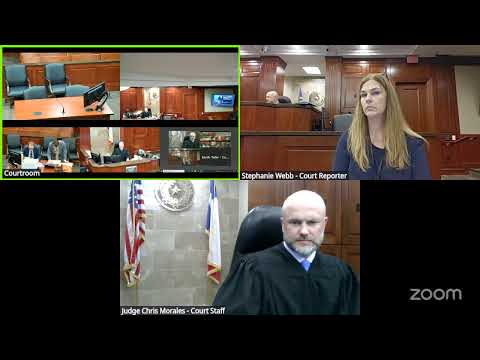
The court ordered that certified interpreters be present at remote docket settings and continued at least one hearing when an interpreter had not been requested. Judge (on the bench) told defense counsel, “No. We have to have a translator at every setting so she has an understanding of what is taking place that is required.”
The requirement was enforced when the court administered the oath to Pamela Pizzuro, who identified herself as a Spanish interpreter and gave her license number, “LCI2431.” Pizzuro responded to the oath, saying, “I do, your honor.” The court then instructed counsel to pause for interpretation at regular intervals when speaking so that translation could be provided.
In a separate case the court continued the hearing because counsel said a Mandarin interpreter was needed but had not been requested through the court's language-access office. The judge told counsel to file an ISR form with Pamela Pizzuro's office (language access) so a Mandarin interpreter would be present at the next setting on October 2 and entered a docket entry confirming the need to ensure client presence that day.
Court staff and counsel treated interpreter needs as case-management matters: where an interpreter was present the hearing proceeded with interpretation; where the language request had not been filed the judge passed the matter to the next status date. The court repeatedly told defense counsel to notify the coordinator if a defendant entered a diversion program so the coordinator could monitor compliance; similarly, counsel were told to submit interpreter requests promptly to avoid continuances.
The court's actions in these matters were procedural: the interpreter was sworn in one case and a future setting was established in the other when the language-request paperwork was to be filed. No substantive plea or disposition was recorded on the interpreter-related docket entries.
The transcript shows the court applied the language-access rule consistently across remote dockets to ensure defendants who need interpretation receive it.
Cases and related procedural directions described here occurred during scheduled docket call and status conferences; the court's orders were limited to ensuring interpreter presence and rescheduling as needed.