
CalPERS to auto‑separate long inactive appointments and add notifications to reduce 'illegal retirements'
Get AI-powered insights, summaries, and transcripts
Subscribe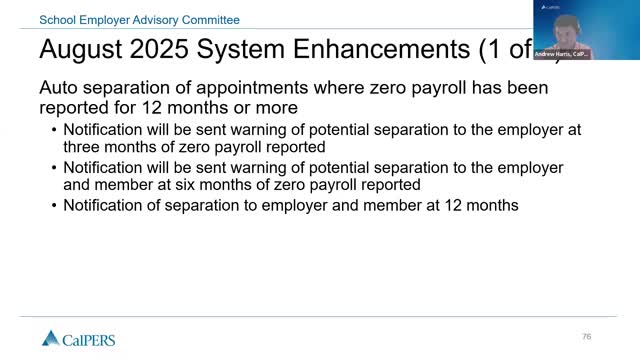
Summary
CalPERS will begin auto-separating appointments that report zero payroll for 12 months and will send staggered notifications to employers and members; the agency will also notify employers when retirees remain active and may suspend benefits if separations are not added.
Andy Harris, manager of CalPERS’ membership analysis team, described two recent system enhancements aimed at improving permanent-separation records and reducing so-called illegal retirements.
Why it matters: incomplete or stale appointment data can prevent members from retiring when intended, produce incorrect formulas or benefit payments, and require members or employers to repay benefits.
Harris described an enhancement that targets appointments with repeated zero payroll reporting. If an active appointment has no payroll for 12 months, the system will auto‑separate that appointment after a notification sequence: an initial notice after three months of zero payroll recommending (1) add a permanent separation date, (2) place the employee on a leave of absence if appropriate, or (3) report service; a second notice at six months if no action is taken; and a final notice at 12 months advising the appointment will be auto‑separated. Employers may remove or edit the separation date if the employee returns to work.
To address illegal retirements — where a member retires without a separation date and thereby remains shown as active — CalPERS added another notification flow tied to retirements: if an appointment remains active two months after the retirement date, CalPERS will notify the employer; if four months pass with no separation added, CalPERS will send another notice and the agency’s benefits team may suspend the member’s benefit until a separation date is applied. Harris asked employers to email the working after retirement inbox with the retiree’s name and CalPERS ID when they find apparent illegal retirements so CalPERS staff can help correct the record.
Harris also noted an improvement that allows members to view all active appointments in their self‑service account and a new system prompt that warns employers of hours already reported for an RA across employers when entering a new appointment.