
Council discussion seeks clearer rules for fences, zoning after RV-park and Robinson disputes
Get AI-powered insights, summaries, and transcripts
Subscribe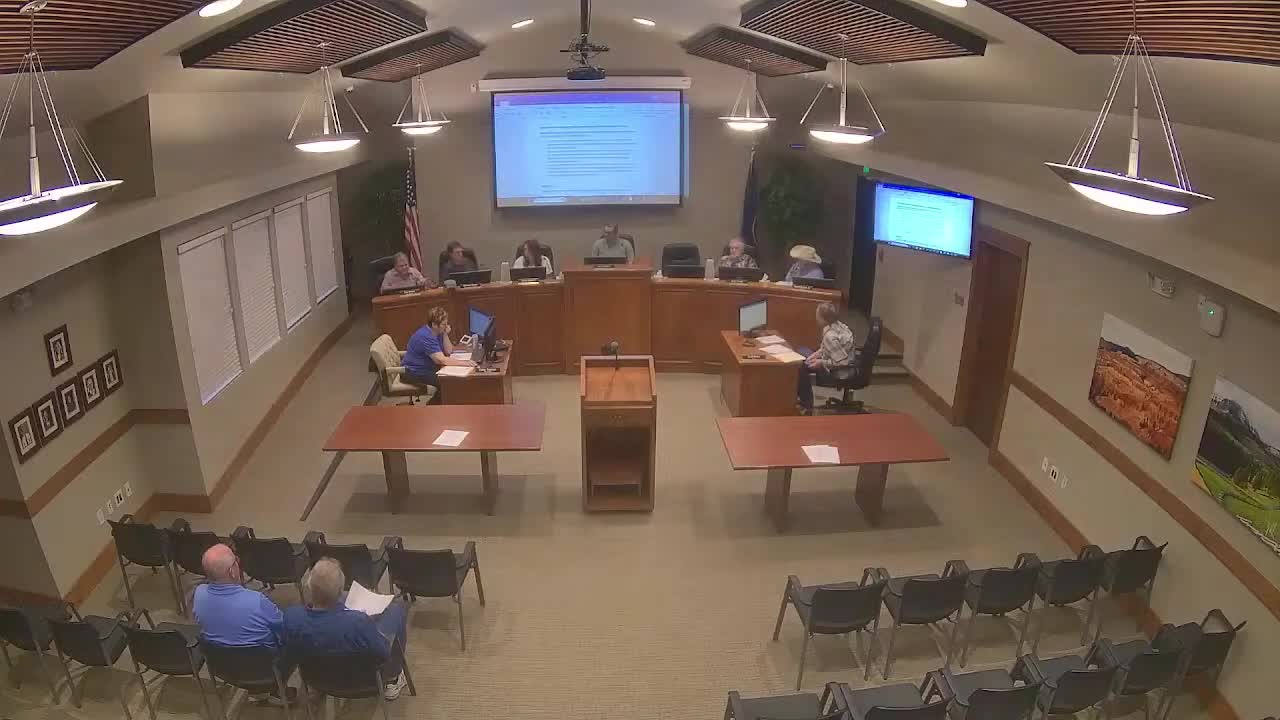
Summary
Council members and staff debated clarifying when adjacent commercial or industrial developments must build site‑obscuring fences, how RV parks are classified, fence height and who pays, and whether conditional-use permits should include written agreements; no formal policy change was adopted.
During a council meeting, members and staff discussed clarifying the municipality's zoning and fencing rules that determine when a commercial or industrial property abutting residential uses must construct site‑obscuring masonry fences and how the rules apply to uses such as RV parks and properties annexed into highway service zones.
The discussion matters because the current language can be read in multiple ways, participants said, producing uncertainty for property owners, homeowners and developers and raising questions about cost, drainage and enforcement.
Council and staff described three recurring problems: ambiguity about whether the standard applies to properties "used for residential purposes" versus those merely "zoned residentially," inconsistent treatment of RV parks, and unclear rules about which party must build a fence when zones or uses change.
"By the way, they maintained that an RV park is a residential use themselves," said Speaker 3 (not identified in the transcript), summarizing how some RV-park operators characterize their property. Speaker 3 and others noted that treating RV parks as residential could create conflicts when officials count them as commercial uses for other regulations.
As an example for possible language, Speaker 3 read from a municipal code used by Cedar City: "On all commercial and industrial developments in areas zoned accordingly, having a common lot line with property used for residential purposes shall require the construction of a 6 foot high site obscuring masonry fence. Or on residential developments, having a common lot line with property used for commercial and industrial purpose shall require the construction of a 6 foot high obscuring fence." The speaker said Cedar City's code also contains a definition of "site obscuring" and caveats for mixed‑use developments and conditional uses.
Speakers debated an appropriate height threshold. "I think it should be 8 foot, not 6 foot," said Speaker 1 (not identified in the transcript). Others suggested 6 feet is too low for privacy but 8 feet may be excessive; one participant proposed a compromise height of 7 feet 4 inches. Cost estimates were discussed informally: "I think they're $90 a linear foot," said Speaker 2 (not identified in the transcript), though members treated that as an estimate rather than a certified figure.
Participants also discussed who should bear the cost of a required wall. Multiple speakers favored a "last to build" rule—i.e., the party that develops after an adjacent property should install the wall—while acknowledging that changing zoning later could leave the party who built a wall disadvantaged.
Practical concerns were raised about drainage and design. One speaker noted a house flooded because a block wall lacked vent blocks and water backed into a basement; members said the code should consider drainage and allow vented blocks or other measures. Speaker 3 noted that a chain‑link fence with fabric can meet a "site obscuring" standard, and quoted a percentage‑based visibility measure (roughly 90–96 percent) used in another code to define site obscuring.
Speakers discussed conditional‑use permits and how fencing could be handled in those cases. The Cedar City example requires a written agreement between adjoining property owners when a commercial use is permitted by conditional use in a residential neighborhood; that agreement must be submitted to the planning commission and council as part of the permit packet, Speaker 3 said.
No formal motion or ordinance revision was adopted during the discussion. Speaker 3 said they would circulate the Cedar City language and the site‑obscuring definition to meeting participants and encouraged members to review municipal codes from other jurisdictions before returning the item for further drafting. "Let everybody think about it. Read through the city code Cedar City code. Maybe look through any others," Speaker 3 said.
The item concluded with members agreeing to research drafting options; a future council agenda item was implied but not scheduled in the transcript.
Ending details: speakers repeatedly emphasized the need to clarify whether requirements apply to land that is merely "slated" for residential use but not yet developed, and to distinguish subdivision‑level requirements from single‑lot building permits. The discussion also raised equity and affordable‑housing concerns, with one speaker observing that mandatory walls on new housing add cost. No votes, amendments or formal directions to staff on drafting specific ordinance language are recorded in the transcript.