
Beavercreek holds public hearing on proposed Grange Hall Road TIF for Wrightwood Springs development
Get AI-powered insights, summaries, and transcripts
Subscribe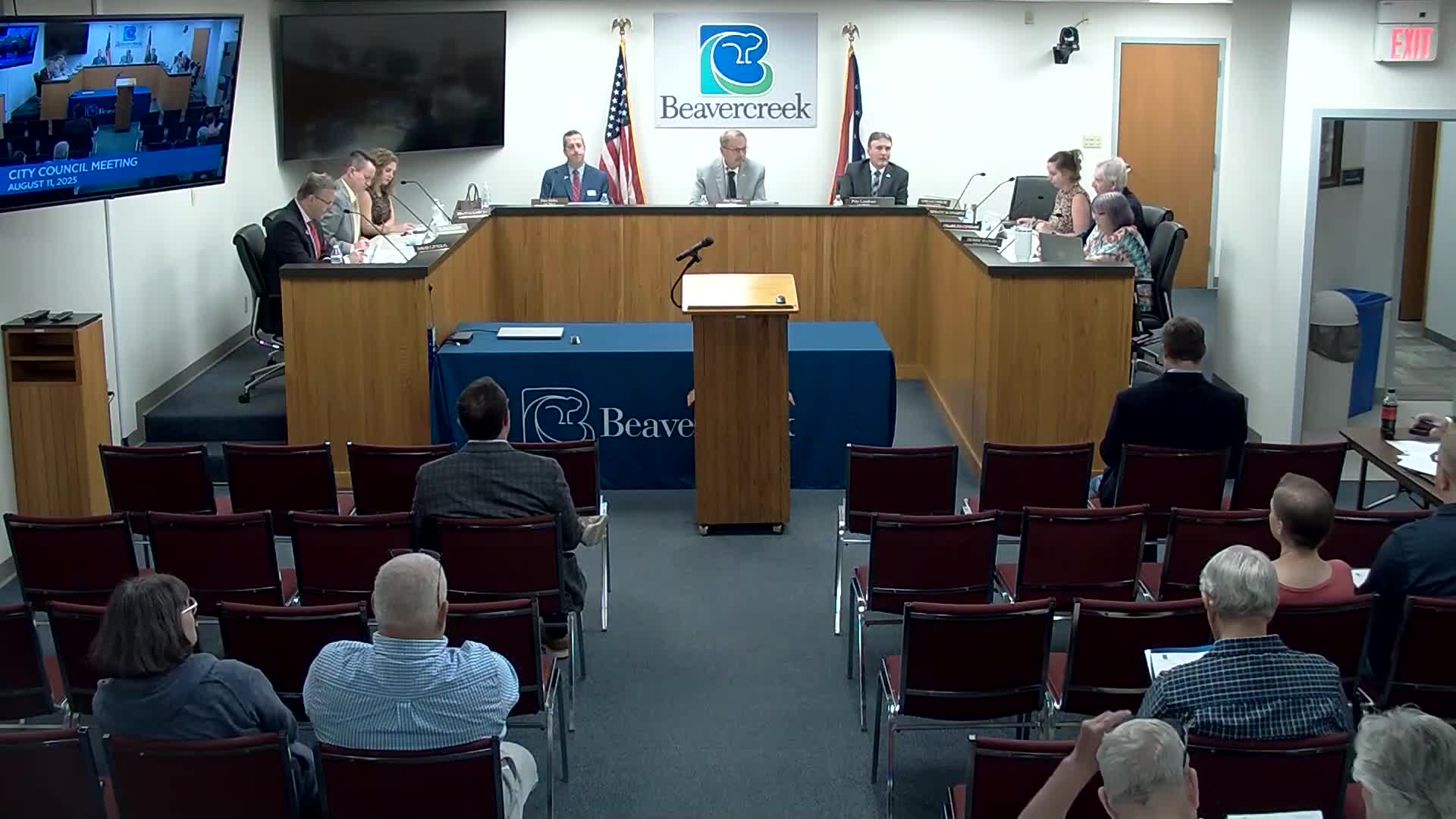
Summary
Beavercreek City Council held a public hearing Aug. 11 on a proposed tax increment financing (TIF) incentive district for a 54-acre housing project called Wrightwood Springs, council members were told. The hearing is a statutory step required under the Ohio Revised Code; no ordinance or vote was taken at the meeting.
Beavercreek City Council held a public hearing Aug. 11 on a proposed tax increment financing (TIF) incentive district for a 54-acre housing project called Wrightwood Springs, council members were told. The hearing is a statutory step required under the Ohio Revised Code; no ordinance or vote was taken at the meeting.
City staff member Lonsbury described TIFs as an economic development tool established through the Ohio Revised Code that redirects payments in lieu of taxes (PILOTs) toward public infrastructure rather than the standard distribution to taxing entities. The proposal discussed at the hearing would split the development into four incentive districts and use a 75% exemption for a rolling five-year period in each district once improvements in that district reach $6.5 million, Lonsbury said. He said a 100%/30-year TIF is possible under state law but the city is proposing the shorter 75%/five-year structure to limit school funding impacts.
Lonsbury gave project figures: the Wrightwood Springs development is roughly 54 acres with 121 homes and an average home value estimated at $550,000, yielding a projected total project value of about $66,550,000 and an estimated 35% taxable value. He said bond counsel estimated roughly $3.4 million in PILOT payments would be available for public infrastructure projects tied to the TIF. The city previously discussed a reimbursement agreement that would return up to $800,000 to Rockford Homes for Grange Hall improvements benefiting the broader city; after that reimbursement Lonsbury said about $2.6 million would remain for infrastructure projects.
Lonsbury emphasized that the TIF does not change what a property owner pays: “The pilot payments that they are making are identical to the tax payments they would be making but for the TIF. The only difference here is where that money goes,” he said. He also noted statutory limits that, if a TIF exceeds 75% or lasts longer than 10 years, would require school board approval; the city’s proposal is intended to avoid that requirement.
Two residents who spoke during the three-minute public-comment period said they opposed the proposed financing structure. Bob Trout of 2187 Bassett Court said he was concerned the TIF would divert revenue that otherwise would help Beavercreek schools and that school funding would be harmed: “That is wrong. That technically is a form of harm that the residents of Beaver Creek will have to incur,” Trout said. He also objected to using TIF funds for improvements he said would support Spring Hill Park, which he said voters had rejected previously.
Ed Malouf of Nettleton Point told council that property taxes generated by new houses should go to the general distribution of taxing entities rather than be diverted to a single-area improvement fund. “Our property tax should be used what everybody else's property tax is going for,” he said, adding he was opposed to diverting revenue for a single section of the city.
City staff clarified the procedural status: the Aug. 11 hearing satisfied the statutory notice and hearing requirement; Lonsbury said the council will consider an ordinance on Sept. 8 that would include the engineer’s certificate and an economic development plan supporting the TIF. Lonsbury and the mayor reiterated that no final decision was being made at the Aug. 11 hearing.
Why it matters: TIFs change where local property-derived funds flow and can affect school districts’ revenue; the proposed five-year rolling structure and the reimbursement agreement for up to $800,000 were specific elements residents and staff focused on during the hearing. The public hearing record will be considered as staff prepares the ordinance and supporting documents for the Sept. 8 council meeting.
What’s next: The council expects a formal ordinance and another public hearing on Sept. 8. If the council proceeds with an ordinance that exceeds statutory thresholds, state law would require school board involvement. Until the ordinance is introduced, no commitment has been made to adopt a TIF or to specific projects the PILOTs would fund.