
Whiteland BZA denies school request to keep goats on high school campus
Get AI-powered insights, summaries, and transcripts
Subscribe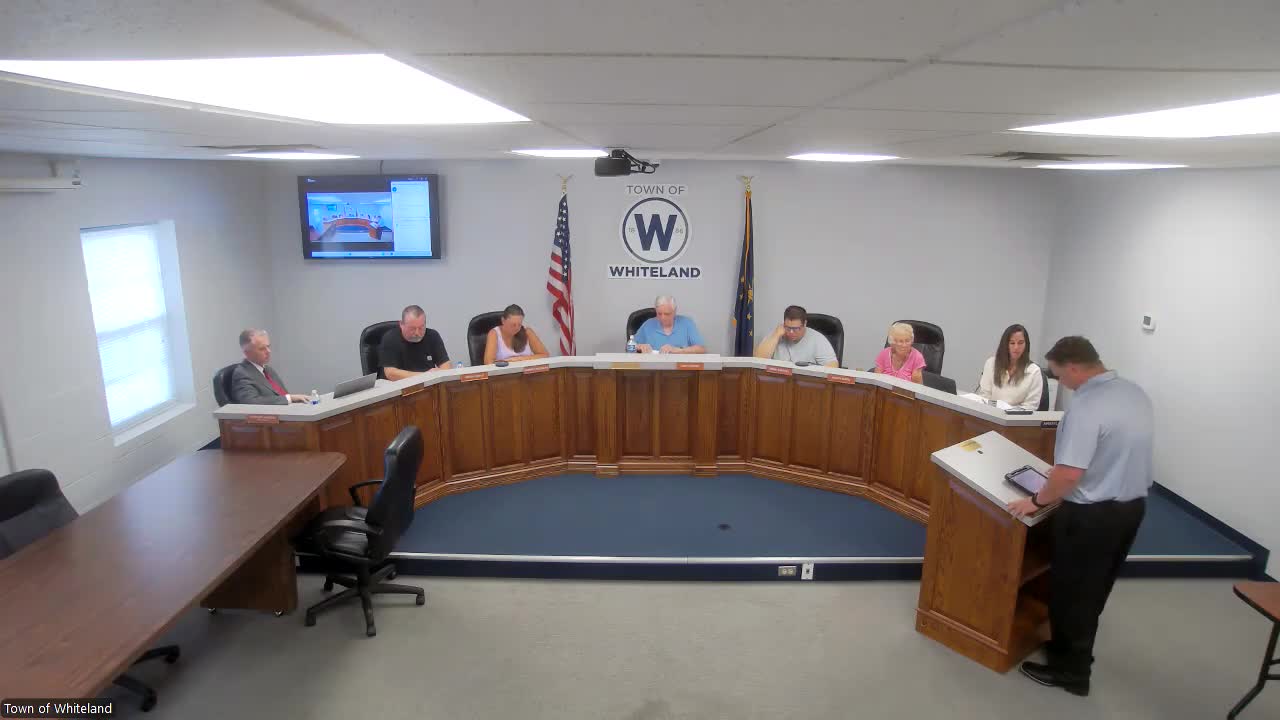
Summary
The Town of Whiteland Board of Zoning Appeals voted 5-0 to deny a use-variance request that would have allowed Whiteland Community High School to keep 5–8 goats on campus for an animal-science program, citing harm to nearby residents and failure to meet statutory variance criteria.
The Town of Whiteland Board of Zoning Appeals voted 5-0 to deny a use-variance request that would have allowed animal husbandry (goats) on the Whiteland Community High School campus at 300 Main Street.
The petition, filed on behalf of the Clark Pleasant Community School Corporation, proposed a small school-run goat operation to provide hands-on animal-husbandry experience for students in the district's agricultural pathway. "My name is Hannah Knight, and I am 1 of the agricultural science teachers and advisers at Whiteland High School," said Hannah Knight, the teacher who presented the proposal. Knight said the program would start with five meat goats and could expand to a maximum of eight; students would care for the animals during the school year, and animals would typically be raised to market weight and sent to market at semester ends.
Town staff recommended denying the variance. The staff report cited Whiteland Municipal Code provisions limiting animals on most parcels (ordinance cited as 91.09) and the permitted uses in the R-1 single-family residential district (ordinance cited as 156.05). Staff concluded the petitioner had not shown how to mitigate impacts to adjacent residential parcels outside school hours, raised concerns about potential odor, noise and increased predator activity, and pointed out several alternative locations on or off campus that would meet a 500-foot separation from residences.
Neighbors told the board the proposed site would sit inches from nearby backyards and would harm quality of life. "The goats are gonna be right in my backyard. And I don't want the smell. I don't want the noise," said David Hawkins, a resident of 329 Christina Drive. Joyce Kennar, who lives next door, told the board: "It will be loud. The smell will be unbearable, and I'm sure that they will, little by little, add other animals over time."
School supporters and petitioners argued the project would expand career and technical education. Cassandra Shipp, who identified herself with the school and said students expressed interest in veterinary and livestock careers, described the plan as a capstone experience that would teach both husbandry and agribusiness skills. Knight said goats were selected because of manageable size, short production cycle (two rounds per school year), and limited landscape damage compared with larger livestock.
The staff report included enrollment figures and site context: 102 students were enrolled in the beginning animal-science course and 35 in the advanced course (a possible combined total of 137 students), the school owns more than 106 acres with about 90 acres already in agricultural use, and staff identified three on-campus green spaces more than 500 feet from residential parcels (approximate distances of 536, 612 and 955 feet). Staff also noted an off-campus alternative at 999 North Front Street, the Clark Pleasant Community School Corporation operations building, which is zoned industrial.
During deliberations board members focused on the statutory variance factors. Board counsel and staff reminded members that a use variance must meet specific state-law factors, including that the variance not be injurious to public health, safety or general welfare and that the strict application of the zoning ordinance cause practical difficulties or an unnecessary hardship. Members said the petition failed to meet those factors as to the immediate neighborhood. One board member summarized the reasons for denial as harm to nearby residents, lack of a demonstrated practical difficulty unique to the property, and insufficient mitigation measures for adjacent properties.
The board voted to deny the petition and later voted to adopt written findings of fact reflecting that conclusion, specifying that factors 1, 2, 3 and 6 from the staff report/statutory list were not satisfied. The denial passed unanimously: Kimberly Blackford, Juanita Emery, Byron Temple, Derek Westfall and Gary Howard voted in favor of denial (5-0). The board also advised the petitioner to consider alternative locations or a revised proposal addressing setback, nuisance control and after-hours care.
Separately, the board continued case 2025-CD-08 to the September meeting for lack of required public notice; that continuance was approved 5-0.
The board invited the school corporation to return with a revised proposal if it can address the proximity concerns, alternative site suggestions, and the variance factors required by state statute.