Get Full Government Meeting Transcripts, Videos, & Alerts Forever!
Get email alerts on the Development Projects topic
No spam. Unsubscribe anytime.
Planning commission approves Village on the Green expansion while neighbors demand engineering proof on flooding and noise
Summary
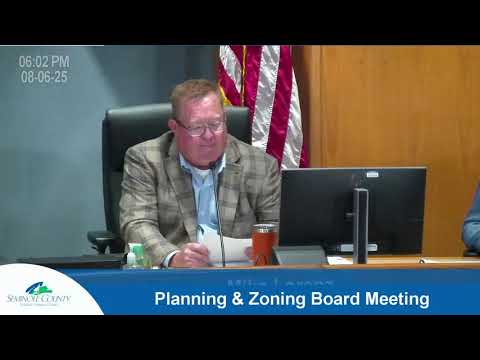
The Planning and Zoning Commission recommended county approval of a small‑scale land‑use amendment and rezone for Village on the Green to add 6.83 acres and 40 independent living units, while residents demanded additional engineering assurances on flooding and noise.
On Aug. 6, 2025, the Planning and Zoning Commission recommended that the Board of County Commissioners approve a small‑scale future land‑use amendment and concurrent rezone to incorporate 6.83 acres (Pod E) into the existing Village on the Green planned development. The project, part of the Sable Point master plan originally approved in 1979, proposes 40 additional independent living units (a mix of duplexes and single‑family units), a roughly 5,500‑square‑foot amenities building and two sport courts, while maintaining a maximum density of 7.09 dwelling units per net buildable acre and a maximum floor‑area ratio of 0.6.
Annie Silaway, development services, summarized the proposal and staff findings: Pod E contains no wetlands or floodplain, the larger Village on the Green includes about 4.8 acres of floodplain on existing parcels, and the site is within the Little Wekiva drainage basin and karst terrain. Staff said the new layout must meet county and Water Management District standards, including on‑site detention to achieve pre versus post‑development volumetric parity for the 25‑year, 24‑hour storm event, maintain 25% open space, and preserve tree canopy where practicable. The county engineer expressed concern about queuing and safety at the proposed new access to Wekiva Springs Road; staff said a right‑turn lane, wider throat, or denial of a gated entrance could be required at final engineering if stacking onto Wekiva Springs Road becomes a safety issue.
The hearing drew broad public opposition focused on drainage, flooding history and noise. Dozens of residents from Fairway Villas, The Springs, Live Oak Village and adjacent streets described repeated flooding during 2022 and 2024 storms, pump discharges they say originated from neighboring developments, and damaged garages and homes. Several speakers — including Kevin Boyle, Alexi Wyatt, Edna Rosen, Sherry Barwick, Asher Waldman and Anthony Renda — provided photos and described water intrusion on Wisteria Drive and Lake Shadowwood. Public commenters said earlier engineers for Village on the Green had recommended a 100‑year retention design; residents said the project’s current proposals reflected a 25‑year pond, and they urged design verification and measures that prevent off‑site discharge to the Springs neighborhood.
Applicant counsel MacGregor Love and project engineer Jeff Swisher (Kimley‑Horn) responded that the existing site contains a large, mostly impervious commercial building (about 67,000 square feet) and parking; they said the redevelopment will substantially reduce impervious surface area, improve on‑site attenuation and treat water to current county and water‑management standards. The engineer said the proposed residential conversion reduces peak‑hour trips compared with the existing commercial use (staff cited a reduction from roughly 119 peak‑hour trips to 20). The project team said they will comply with required stormwater design at final engineering and welcomed follow‑up conditions; the architect said the sports courts location could be adjusted and that the project team planned rain gardens and other on‑site best‑management practices.
Commissioners debated whether to table the matter to allow more community engagement or to recommend approval now and require the applicant to engage neighbors. Several commissioners noted that the community meeting required by code had been held May 8, 2025 (staff said no members of the public attended), and that a later courtesy mailing to a 1,500‑foot radius had generated the larger turnout for tonight’s hearing (the code requires community‑meeting notice to 1,000 feet). The commission ultimately recommended the Board of County Commissioners adopt the land‑use amendment and rezone and approved the associated development order and master development plan, adding a direction that the developer engage with the community on the concerns raised at the hearing before the BCC hearing. The Planning and Zoning Commission passed both motions with all members present voting in favor; the applicant told the commission it will make itself available to meet with residents and can convene virtual meetings prior to the county commission hearing.