Get Full Government Meeting Transcripts, Videos, & Alerts Forever!
Get email alerts on the Road Maintenance topic
No spam. Unsubscribe anytime.
Coffee County Highway Commission reviews summer paving and mowing; approves agenda and minutes
Summary
On Aug. 6 the Coffee County Highway Commission heard updates on summer paving, material costs and mowing delays driven by Johnson grass, discussed shoulder and ditch repairs and a hazardous oil spill, and approved routine procedural items.
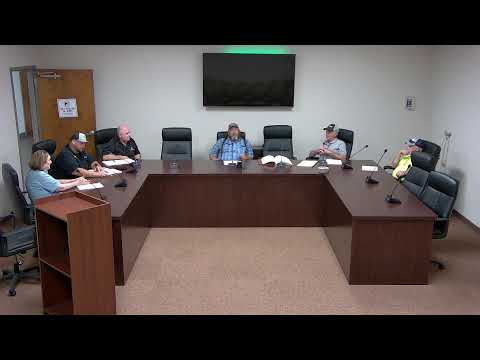
The Coffee County Highway Commission convened Aug. 6 and heard updates from highway staff about summer paving, rising material costs, mowing delays tied to Johnson grass and several roadside safety concerns; the commission also approved its meeting agenda and the minutes from the prior meeting.
Benton, a highway department staff member, told the commission the crew has focused on paving and chip-seal work this summer and that the department has been stockpiling materials after learning contractors’ bids were increasing. Benton said the county paid “a little over a 100,000 to the oil company” used for mix and chip seal and that a payment to Rogers Group was “close to a 140,000” this month. He added the county’s insurance came in near $300,000 at the start of the fiscal year.
Why it matters: the quantity and cost of oil, stone and contractor work determine how many miles the county can chip-seal or overlay this year and influence which roads are prioritized.
Commission discussion and staff details
Benton said the crew had completed about 15 miles of work in recent weeks and noted Fountain Grove alone accounted for roughly eight miles. He said the crew finished work in a Park Creek subdivision and Red Oak Drive and planned to move on to Bonhalla (also referred to in the meeting as Vonhalla) and roads near Tullahoma. Benton said the crew tracked materials during a two-mile tar-and-chip section and estimated chip-seal costs at roughly $9,000–$10,000 per mile. He also reported rock priced at about $21.50 per ton and said a one-and-a-half-inch hot-mix overlay runs about $150,000 per mile.
Benton said the department had used 65,554 gallons of asphalt oil as of July 1 and that the department bought a new side-mower (to replace a tractor with roughly 12,000 hours) through Sourcewell, a cooperative purchasing contract, to help crews catch up on ditch and picnic-area mowing.
Mowing, Johnson grass and staffing
Commissioners and staff spent time on mowing challenges. Benton and others described the seasonal growth of Johnson grass as an ongoing problem that pulls crews off regular routes and leaves some ditches and intersections overgrown. Benton said a newly hired worker this spring “didn’t work out very well,” which also contributed to delays, and that the new side‑mower will be used to help crews catch up.
Ditching, shoulders and road defects
Jojo, a highway department staff member, summarized ditching and shoulder work and identified several locations needing attention, including Hinell Road by Park Creek Estates, spots “down toward the river end” of a local road, and a hole on Duncan Road near Goose Pond. Jojo said crews had already responded quickly to the Duncan Road defect, which he described as roughly a one-foot-diameter hole that will need additional attention once crews have time.
Hazardous material spill
Staff discussed a reported spill of used motor oil that had been tracked by vehicles across both lanes of a road; crews applied two bags of floor dry and notified hazardous‑materials responders. Benton said the department has materials that can break down or absorb oil, but noted that spraying ditches is restricted because of nearby creeks and environmental risk.
Animal carcasses, buzzards and roadside safety
Commissioners discussed procedures for dealing with deer or other wildlife on county roads. Staff said there is no specific law requiring a particular disposal method and that, in practice, crews typically drag carcasses off the road when feasible; the county does not maintain a dedicated disposal site for wild animals, and private animal‑removal services may decline wild carcasses. The meeting also touched on concerns about buzzards (vultures) near roads and livestock; attendees noted permit processes sometimes exist for nuisance situations but described them as limited.
Mailboxes, new development and driveway rock
Commissioners and residents raised safety concerns about new mailboxes, concrete driveways and rock rolling from private driveways onto narrow county roads, especially where new housing developments narrowed travel lanes. Staff and commissioners said postal requirements often place boxes close to the roadway, which can create hazards on two‑lane roads and complicate efforts to widen shoulders.
Votes at a glance
- Agenda approval — motion made and seconded; approved by voice vote. (No individual vote tally recorded in the transcript.) - Approval of last month’s minutes — motion by Harless; seconded by Jeff; approved by voice vote. - Adjournment and scheduling — motion to adjourn carried; the commission discussed setting the next meeting for Sept. 3 (time discussed but not clearly specified in the record).
What’s next
Staff said paving and ditching work will continue while crews also address shoulder repairs and mowing backlogs. The commission did not adopt new policies or ordinances at the meeting; discussion items were operational and prioritized for field crews to address in the coming weeks.
(Reporters: quotes and attributions are drawn directly from the meeting transcript.)