Get Full Government Meeting Transcripts, Videos, & Alerts Forever!
Get email alerts on the Housing Funding And Programs topic
No spam. Unsubscribe anytime.
Panama City reviews housing programs as federal, state and local funding shrinks
Summary
At a Panama City virtual workshop, Housing and Community Services Director Sheila Ware outlined programs funded by NSP, SHIP, HHRP and CDBG, described remaining property holdings and said staffing and strategy have been reduced as allocations tightened. Commissioners pressed for dates, accounting and options to stretch smaller annual allocations.
Sheila Ware, director of Housing and Community Services, told the Panama City Commission at a virtual workshop that the department has reduced staff and is refocusing as federal and state disaster funding has declined.
"Our mission with the housing and community services is to provide and assist families with obtaining safe, suitable, decent, affordable housing through the various programs," Ware said, and noted the office previously had seven full-time employees but "have downsized now and have 4 and a half that work directly with the housing department."
Ware reviewed the department’s major funding sources, including Neighborhood Stabilization Program (NSP) grants, the State Housing Initiatives Partnership (SHIP), hurricane recovery HHRP grants and Community Development Block Grant (CDBG) money. She said the city administered some county NSP and HHRP awards after Hurricane Michael but that Bay County reclaimed administration of some disaster funding in 2021.
Ware said the city and county purchased 31 properties with NSP 1 county funds; 18 were resold to eligible applicants and 13 remain as affordable rentals managed by the city’s housing office. Combining NSP properties the city and county conveyed to the city, Ware said the municipality now owns 25 NSP units and that two of those are eligible for resale by the end of the year. "There is an affordability period that we have to maintain those properties, which were 15 years from the date that they were purchased," she said. The office estimates about $70,000 in annual rental income from those properties.
On Hurricane Housing Recovery Program funds, Ware said the city received $8.4 million under HHRP 1 and assisted 186 households; an additional $2.6 million under HHRP 2 assisted 56 households. She described the purchase-assistance economic impact from those sales as "over $30,000,000," a figure she said represents the value of homes returning to the tax rolls.
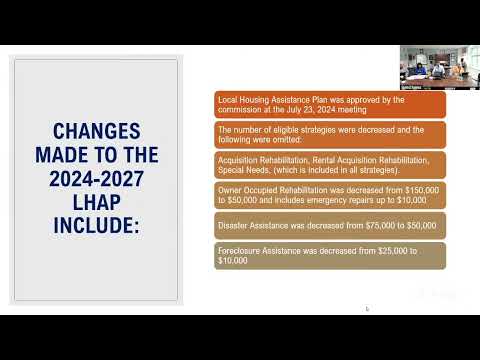
State SHIP funding and local policy changes were a central topic. Ware said the William S. Sadowski Affordable Housing Act (SHIP) requires a local housing assistance plan (LHAP) and set-asides by income. For the current LHAP covering 2024–2027, Ware said the city removed acquisition/rehab and rental acquisition strategies because allocations shrank: owner-occupied rehab and disaster-assistance maximum awards were reduced (owner-occupied rehab reduced from $150,000 to $50,000; disaster assistance from $75,000 to $50,000; foreclosure assistance from $25,000 to $10,000).
Commissioners asked whether any grant funds had to be returned. Commissioner Lucas asked, "Did we, have to give back any money?" Ware replied, "No. No, ma'am," noting required reports were submitted and approved through June 30, 2025.
Discussion at the workshop also addressed administrative costs and monitoring. Commissioner Josh asked whether reported administrative allocations represented reimbursed expenditures or simply allocations; staff said the numbers shown were allocations and that accounting is reconciling expenditures.
City staff and commissioners debated the county’s 2021 decision to take HHRP administration in-house. Jared Jones, city staff, summarized differing approaches: "The county was more interested in getting money out the door as quick as possible," while the city emphasized pre-purchase counseling to reduce later foreclosures. That philosophical difference, Ware and Jones said, helped prompt the county to shift administration.
CDBG funding and projects were also reviewed. Ware said the city’s 2025 CDBG entitlement is $360,009, with HUD caps limiting admin to 20% and public service to 15%; the remainder is programmed for public facilities and infrastructure, including park and paving work carried over from prior allocations.
Several commissioners requested additional detail and follow-up: dates when individual NSP affordability periods end, reconciled administrative expenditures, and a clear multi-year funding strategy to match the smaller recurring SHIP/CDBG allocations now available. Ware said staff would provide supporting documentation after the meeting.
The workshop included no formal votes on housing items; commissioners directed staff to return with requested reconciliations, timelines for property affordability expirations and options to stretch limited annual allocations.
For transparency, legal and program references discussed by staff included the Housing and Economic Recovery Act of 2008 (NSP), the William S. Sadowski Affordable Housing Act (SHIP), HUD housing counseling rules, HHRP disaster recovery grants, and the Housing and Community Development Act of 1974 (CDBG), all of which Ware cited when explaining program rules and constraints.