Get Full Government Meeting Transcripts, Videos, & Alerts Forever!
Get email alerts on the Traffic Safety topic
No spam. Unsubscribe anytime.
Panama City approves speed-detection ordinance for school zones after weeks of debate, 4-1
Summary
The Panama City Commission voted 4-1 to adopt Ordinance 32-75 permitting automated speed-detection systems in school zones. Commissioners and residents debated enforcement hours, vendor control, privacy and how fine revenue will be used.
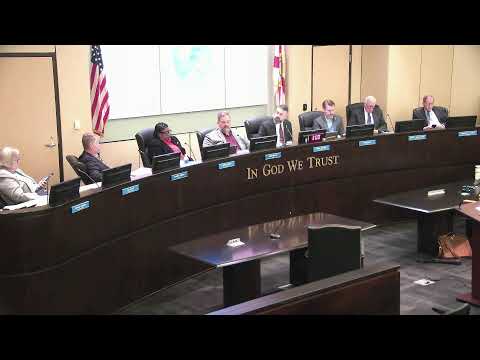
Panama City commissioners voted 4-1 on Aug. 12 to adopt Ordinance 32-75, allowing automated speed-detection systems in school zones and authorizing staff to negotiate vendor contracts to implement the program.
Supporters say the systems will improve safety for children arriving at and leaving school; opponents warned about contractor pressure to expand enforcement hours and about appearance of automated enforcement. The ordinance will allow citations only after a sworn law-enforcement officer reviews incidents identified by the system, and vendors and specific contracts must still be approved by the commission.
City staff told commissioners the measure implements requirements in House Bill 657 (codified as chapter 2023-174, Laws of Florida) and that collected fines are restricted. "The $60 the city retains," a staff presentation noted, "$12 goes to Bay District schools, $5 for school crossing guards, $3 for the criminal justice STC training fund, and $20 to the Department of Revenue general fund," with roughly a $40 net to the city after other distributions and administrative costs. Staff said the city will present a plan showing how the city's share would be invested in public-safety priorities such as crosswalk improvements, flashers, sidewalks and operating capital for enforcement.
A local resident, Ron Dancy of Kings Harbor Road, urged approval during public comment: "Safety first is why I'm here. We need to make sure that we do that," he said, noting high counts of speed violations at specific school corridors.
Commission members pressed staff on operational details they want written into future contracts: a single 30-day citywide warning window when systems begin operation rather than staggered rollouts by school zone; ownership and buyout responsibilities for equipment at contract end; and a three-year sunset provision to allow the commission to evaluate results. Commissioners repeatedly said any vendor contract would return to the commission for approval and that the ordinance itself does not obligate the city to deploy particular equipment or choose a vendor.
City staff presented pilot and vendor data showing jurisdictions that adopt similar systems can see violation counts fall over time; staff cited Alpharetta, Ga., reporting a 97% reduction in violations after multi-year deployment with the vendor suggested in the study. Several commissioners said that decline is expected — and that revenue from early enforcement typically declines after initial months — but they also signaled concern about perceived automation and public resistance to mailed notices that resemble automated tickets.
On the vote, Commissioners Hughes, Lucas and Street and Mayor Allen Branch voted yes; Commissioner Granger voted no. The commission approved the ordinance by voice/roll-call 4 to 1. The commission did not award any contract at the meeting; staff will return with proposed contract terms, a vendor selection path (including an RFP option if the commission requests), and a draft implementation timeline. Staff told the body they would not implement citation issuance until the first school day in January to allow time for installation, public notice and a warning window.
What happens next: the ordinance authorizes staff to pursue contracts and sets the local framework; contracts, sites, and final operational schedules will require later commission action and public information campaigns. Commissioners asked staff to prepare draft contract language addressing hours of enforcement, buyout/ownership of hardware on termination, local-point-of-contact requirements, and a proposed three-year review/sunset.
Votes at a glance: Ordinance 32-75 (Speed detection systems in school zones) — adopted, vote 4-1. City staff will return with vendor/contract proposals for commission approval.