
County treasurer asks for hotel-occupancy tax software to identify short-term rentals and enable online payments
Get AI-powered insights, summaries, and transcripts
Subscribe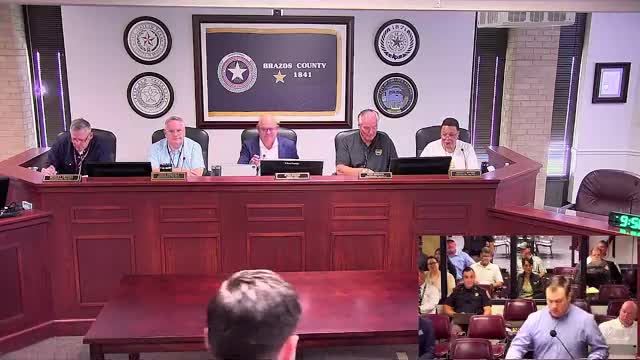
Summary
Brazos County’s treasurer requested up to $50,000 in hotel-occupancy-tax funds for a collection portal and software to identify and bill short‑term rental properties; treasurer said state remittances lack property-level detail and staff expect the software to pay for itself.
Christian, Brazos County’s treasurer, asked the Commissioners Court on Aug. 11 for up to $50,000 from the county’s hotel‑occupancy‑tax (HOT) fund to buy collection and identification software for short‑term rentals.
"The request for was for 50,000. That request includes both the payment portal and the identification of short term rentals," Christian said, adding that the legislature permitted counties to use HOT revenue for such software and that the funds would come from the HOT fund rather than the general fund.
Christian told the court there are about 225 registered HOT taxpayers in the county but roughly 1,000 short‑term listings visible on platforms such as Airbnb and Vrbo. He said platforms do not provide property addresses when they remit state-collected amounts, and the state’s quarterly remittance reports list only dollar totals without property-level detail, so the county cannot reliably identify units that have not remitted local HOT.
Christian and commissioners discussed city approaches and vendors: County staff have talked with vendors used by the cities — GovOS (used by the City of Bryan) and Deckard (used by College Station) — but Christian said the county would still need its own site and would go out for an RFP to determine the best product. He said the initial quote from a vendor about a year ago was under $50,000 and that the current price may be closer to $40,000.
Christian also clarified the tax breakdown: the county receives 2% of the collected tax, with an additional 0.75% remitted to Texas A&M under an interlocal agreement to fund Caulfield Reconstruction, for a total of 2.75% on the record.
No formal procurement decision was made at the work session; staff said the HOT fund can be used for the software and that an RFP will be pursued. Commissioners expressed support for the investment given the county’s difficulty identifying and collecting HOT from short‑term rentals.