Get Full Government Meeting Transcripts, Videos, & Alerts Forever!
Get email alerts on the Agritourism Zoning topic
No spam. Unsubscribe anytime.
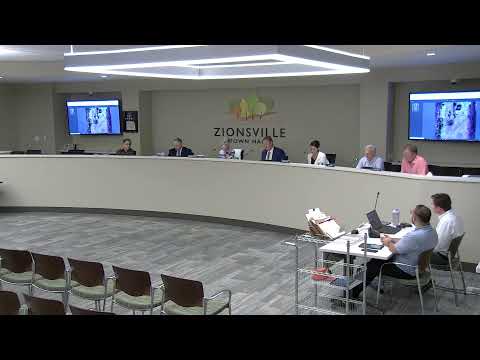
Zionsville BZA continues variance requests from Willie's Wagyu after hours of public comment
Summary
The Board of Zoning Appeals continued three variance requests from Willie's Wagyu — two use variances (outdoor events and retail) and a development-standard variance for signs — to the September meeting after extensive public comment, staff concerns and requests for clearer limits on events and retail items.
The Board of Zoning Appeals in the Town of Zionsville voted to continue three variance requests from Willie's Wagyu to the board's September meeting, after staff raised objections to some aspects of the petition and neighbors offered a mix of support and concern.
Staff planner Jonathan Smith told the board that staff does not support two requested use variances — one to allow an outdoor recreation facility for events and one to allow general retail on property zoned R-2 — because the proposal, as currently described, could increase noise and traffic and would not, in staff's view, meet several criteria required for a use variance under the town's zoning ordinance. Smith said staff is, however, willing to support a development standards variance to allow wall-mounted, non-illuminated signs if the board approves either use variance.
The petitioner, Tim Wilson, introduced himself as owner of Willie's Wagyu at 9015 East 200 South and described the farm as a 20-acre working Wagyu operation that hosts limited educational fundraisers for Purdue University, sells freezer beef and offers value-added farm products. "We are not seeking permission to host commercial entertainment," Wilson said. "The events we host are rooted in education, animal science and community outreach." He said events have been capped at about 25 attendees and that retail space is under 200 square feet.
The nut graf: The board halted action to allow more specificity after residents and nearby property owners expressed concerns about the breadth of the requested relief — which would permit retail sales beyond on-site agricultural products and allow outdoor events — and after board members said they needed concrete operational limits (a plan of operations, a product list and attendance caps) to evaluate impacts and whether the legal standard of "unnecessary hardship" is met.
Board members asked for a tighter description of the proposed uses. Several said they could be willing to consider a constrained approval but not the open-ended permissions requested. "Standing there and saying, 'I'm only going to have 25 people' is not sufficient for us to grant the use variance," one board member said during deliberations, urging specifics to be written and enforceable.
Public comment spanned supportive neighbors and residents opposed to expanding retail and events. Supporters said the farm provides local food access, educational opportunities and community value. Dr. Bethany Funnel, clinical associate professor at Purdue University and Wilson's herd veterinarian, described the farm as a valuable teaching site and said additional marketing mechanisms help farmers remain economically sustainable. Neighbors who opposed the variances said the requests were overly broad and could pave the way for larger events, more traffic, and commercial encroachment into a low-density residential area; they urged the board either to deny the requests or to continue so firm limits can be devised.
Staff and several board members described possible pathways: if retail is limited strictly to locally produced farm products (fruits, vegetables, freezer beef, eggs and similar items), it may not require a retail use variance and could be handled administratively; broader retail (apparel, non-farm goods) would require the variance and likely trigger site-plan requirements such as parking and buffer yards. Smith told the board he had tried to identify a produce-only option that could avoid a formal retail variance but said he had not received a definitive product list from the petitioner.
After discussion, the board voted by roll call to continue each docket to the September meeting so staff and the petitioner could refine a plan of operation and a specific list of retail items and event limits. The board recorded unanimous votes to continue the three dockets to September 9.
Votes at a glance - Docket 2025-22-UV (use variance: outdoor recreation/events) — Continued to September 9 — Roll-call: Josh Fedora, Amanda Miller, Jim Hurst, Josh Martin, Kathy Posselwey — Aye (unanimous). - Docket 2025-23-UV (use variance: general retail) — Continued to September 9 — Roll-call: Josh Fedora, Amanda Miller, Jim Hurst, Josh Martin, Kathy Posselwey — Aye (unanimous). - Docket 2025-24-DSV (development standards variance: signs) — Continued to September 9 — Roll-call: Josh Fedora, Amanda Miller, Jim Hurst, Josh Martin, Kathy Posselwey — Aye (unanimous).
The board asked the petitioner to work with staff on a defined operational plan that would include a product list for retail items and clear, enforceable limits on event frequency and maximum attendance. The board also reminded Wilson that if the variances were granted later, development standards such as parking and lighting could be required and could trigger additional planning approvals.
Wilson said he would work with staff to provide a product list and event parameters and indicated willingness to limit event sizes, and Smith and several board members noted that a continued hearing will allow staff and petitioner to draft enforceable conditions for the board to consider.
The item will return to the board at its September meeting.