Get Full Government Meeting Transcripts, Videos, & Alerts Forever!
Get email alerts on the Ethics Subpoenas topic
No spam. Unsubscribe anytime.
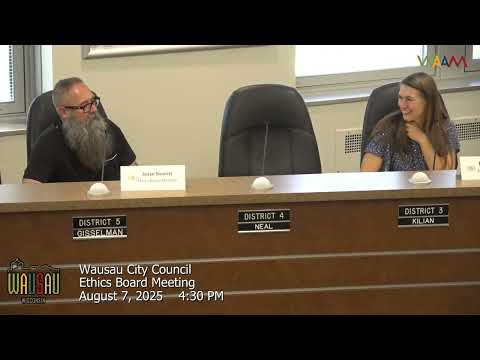
Wausau ethics board grants motion to compel, approves subpoenas for mayor-deposition hearing
Summary
The Wausau Ethics Board granted a respondent’s motion to compel depositions in the complaint against Mayor Doug Denny and approved subpoenas for nine individuals, while declining to subpoena two others; the board said depositions are necessary to protect the respondent’s discovery and due-process rights despite an ongoing DOJ inquiry.
The Wausau Ethics Board voted unanimously to grant a motion to compel depositions in the pending ethics complaint against Mayor Doug Denny and approved subpoenas for multiple city employees and contractors to appear before the board prior to the hearing.
The move followed a reading of the board’s determination that cited the city ethics code and state discovery law and concluded that taking depositions is necessary to allow the respondent to “exercise full discovery rights.” Board member Robin, who moved to grant the motion, read the determination and said the board “hereby grants the respondent’s motion to compel and would order the city clerk [and] city attorney … to sit for a deposition prior to the date of the hearing at a date and time agreeable to all parties.”
Why it matters: The board framed the action as a due-process step. The determination rejects the argument from the city clerk and city attorney that they could not sit for depositions because of an ongoing criminal investigation by the Wisconsin Department of Justice. In the board’s view, that separate investigation — and a February denial of a records request — were “unpersuasive” reasons to deny the respondent the opportunity to depose potential witnesses.
Most important outcomes - The board granted the respondent’s motion to compel depositions and ordered that depositions of the city clerk and the city attorney occur before the hearing. - The board approved subpoenas for Ashley Klein (City Clerk’s Office), Matthew Barnes (Police Chief), Eric Lindman (Public Works director), Leo Gao (facilities manager), Lisa Rasmuson (Common Council president), Gerard Klein (IT director), contractor Kyle Osmitz, Anne Jacobson (City Attorney), and Caitlin Bernardi (City Clerk). Votes on those subpoenas were reported as unanimous. - The board voted not to subpoena finance director Mary Anne Groat and Cody Hart; that motion passed 3–1.
Discussion and board reasoning The board’s written finding, read into the record, cited the city ethics code’s discovery provisions (identified in the reading as section 2.03.0.08) and state discovery rules (identified in the reading as chapter 804 of the Wisconsin statutes) as the legal basis for allowing depositions. The reading emphasized enumerated respondent rights in the city code, including the right to “exercise full discovery rights, including adverse examination of witnesses who will testify at the hearing,” to be represented by counsel, to request subpoenas, and to confront adverse witnesses.
The board explicitly addressed the city attorney’s and city clerk’s contention that participation in depositions would be constrained by a separate DOJ criminal inquiry. The determination said that the DOJ matter is “a separate and distinct matter” and that the DOJ’s denial of a records request in February was “not relevant and insufficient to deny the respondent his due process rights to depose potential witnesses.”
On subpoenas, board members reviewed a list of potential witnesses and discussed relevancy and overlap. The board declined to subpoena Mary Anne Groat and Cody Hart after members concluded they were unlikely to provide material information beyond what other witnesses could offer; that motion passed 3–1. By contrast, the board approved subpoenas for several witnesses who either were identified in email exchanges with the mayor or whose testimony could clarify undocumented communications about the absentee ballot drop box. Board members noted those depositions were expected to be briefer where correspondence already exists.
Procedure and next steps Board members noted attorney Larson is pursuing a possible uncontested stipulation of facts with counsel for the respondent; if the parties reach an agreed statement of facts before the scheduled hearing, the board said it could release some witnesses from subpoenas at a later meeting. The board’s next scheduled meeting was identified as August 25 (to rule on dispositive motions), at which the panel may revisit and refine subpoenas based on any stipulation or dispositive rulings.
What the board did not decide The board did not conflate the DOJ criminal inquiry with its own administrative hearing and did not find that any witness was barred from testifying simply because of the separate investigation. The panel also did not adopt or reject factual claims about the absentee ballot box beyond saying depositions were necessary to develop the record.
Ending note The board adjourned after completing the subpoena votes and confirming the list of individuals to be subpoenaed and the schedule for further procedural action.