Get Full Government Meeting Transcripts, Videos, & Alerts Forever!
Get email alerts on the Levy Planning topic
No spam. Unsubscribe anytime.
Pasco School District board narrows levy planning to mid‑range option, asks staff for detailed impacts
Summary
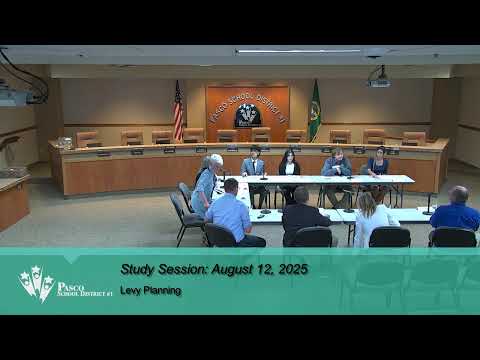
At a study session, Pasco School District directors reviewed three EP&O levy scenarios and by consensus asked staff to develop detailed impact analyses for Option B and a middle option between B and C (called "B‑2"), with timelines for board decisions in October and November.
Pasco School District directors on Tuesday reviewed three proposed EP&O (enrichment, programs and operations) levy scenarios and by consensus directed staff to prepare more detailed fiscal and program‑level analyses for the midrange option (Option B) and a variant between B and C (referred to by the board as “B‑2”).
The request came during a study session in which Dr. Castilleja, presenting district levy planning, told the board, “This is a conversation around the replacement EP and O levy. We are heading into our last year of the current levy. The current levy will collect through 2026.” The presentation outlined three four‑year scenarios (all buildable as 1–4 year asks) and used a conservative 6% annual assessed‑value growth assumption for projections.
Why it matters: The district’s local levy pays for many services the state does not fully fund, including extracurricular programs, enhanced transportation, technology refresh, safety staffing and supplemental teaching positions. Board members repeatedly emphasized protecting classroom and student services while also balancing voter acceptability of a tax increase.
Board discussion and context
Dr. Castilleja told the board the district faces a different context than in the last levy cycle: a multiyear slowdown in assessed‑value growth (the presentation cited prior years of 17.8%, 18.7% and 25.4% growth and a recent correction of roughly 3.4%), flatter enrollment (variation of roughly 50–60 students year to year versus prior annual hundreds of new students) and ongoing operating cost pressures. The presentation noted district staffing costs have recently increased about $4.5 million per year.
Option A was presented as a conservative ask that holds the total levied dollar amount nearly flat (examples given: a round $35 million ask growing modestly into the high‑$30 millions across four years). Under the assumptions used, option A produced estimated EP&O rates per $1,000 of assessed value in a range roughly from $1.99 down to $1.83, but the presenter cautioned rates are estimates and “you cannot predict them.” Staff said option A would require program reductions and would not close the staffing‑cost gap.
Option B was described as a middle path focused on preserving most current services while requiring prioritization. The presentation showed Option B moving levy collections from the current $34.13 million (2026) to about $36.0M (2027), $37.2M (2028), $39.0M (2029) and $41.5M (2030), producing estimated rates “hovering right around a little bit tighter to $2” per $1,000 under the 6% growth assumption. Directors heard that B would still leave a funding gap but would be less disruptive than A.
Option C was framed as the scenario that most closely maintains current programs and staffing, with levy collections illustrated rising into the high $40 millions across the multi‑year window and estimated rates into the low $2.20s per $1,000 under the 6% assumption. The presentation noted an upper legal cap exists on advertised rates (staff cited $2.50 per $1,000 as an upper county cap for the ballot table).
Board direction and next steps
Multiple board members said they could not support Option A and requested more granular impact analysis comparing Option B and a middle option between B and C (the board used the label “B‑2” or “B 0.5”). Director Phillips summarized the majority position: “If we can fit within B, let's just do B. If we need a little bit more then let's consider adding 5 to 10¢.” Another director stated, “I cannot support option A, even with the general language about reductions.”
By consensus the board asked staff to prepare the following for the next presentations: (1) a detailed, program‑level analysis showing what would be reduced or preserved under Option B and under the intermediate B‑2 scenario; (2) a visual comparing the levy dollar asks to inflation over time; (3) student‑experience impacts tied to the scenarios so students and parents can see likely changes; and (4) the board’s preferred term guidance (members signaled interest in a 2‑year ask or possibly a 2–3 year cadence rather than automatically choosing a 4‑year term). Dr. Castilleja confirmed the staff can produce the requested work for upcoming meetings.
Timing: The district intends to focus on determining the levy amount on Oct. 14, present an action item to direct staff to prepare a levy resolution on Oct. 28, and bring a resolution for board approval on Nov. 11. Staff told the board the final timeline may require the board to be “really clear” about the levy amount and term by Oct. 28 so levy documents can be prepared.
What was not decided
No final levy amount, term (1–4 years), ballot wording or formal resolution was approved at the study session. Board members asked staff for more granular calculations of specific program reductions tied to each scenario before committing to a final proposal. A previously mentioned projection of “200 teaching positions” was clarified by staff as a generalized staffing‑attrition planning target and not a finalized or enumerated layoff plan.
Ending
Staff said they will return with the requested comparative analyses and student‑impact visualizations at the board’s next scheduled discussions. Board President Brown closed the meeting thanking staff and saying the board wants to present a clear, community‑facing levy ask once the impacts are fully analyzed.