Get email alerts on the Budget Compensation Study topic
No spam. Unsubscribe anytime.
Brazos County workshop holds many pay requests pending while pushing forward compensation study
Summary
At a Commissioners Court budget workshop, staff presented dozens of staffing and pay requests — including a proposed full-time public communications officer, an ADA coordinator and multiple law-enforcement pay changes — while county officials said a formal compensation study will guide most final decisions.
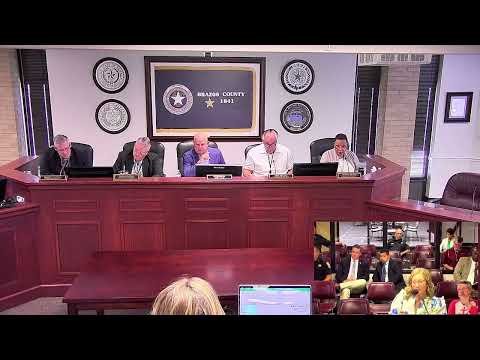
Miss Payne, a county staff member, told the Brazos County Commissioners Court during a budget workshop that she had prioritized department staffing requests and was seeking the court’s direction to finalize the proposed 2026 budget.
The discussion centered on dozens of personnel requests and pay changes — several tied to recent state law language — and the county’s plan to complete a compensation study before approving most individual salary adjustments. "So, now we're gonna prioritize all this wonderful request that we have heard by each department, and what I am needing help with is to find, to make the budget kind of final," Payne said.
Why it matters: commissioners repeatedly said they want a market-based, standardized approach to pay decisions to avoid ad hoc raises that could force reversals later or create unfairness across departments. Multiple commissioners urged the court to approve and implement a compensation study before approving large, individual increases.
What the court heard and considered
Staff presented a long list of personnel changes and new positions, and assigned many to a priority level for inclusion in the proposed budget. Specific requests called out during the workshop included: - converting a part-time public communications officer to full time at an estimated cost of $72,000; - creating an ADA coordinator position with a total cost of $100,008 described by staff as directed by the commissioners' court; - creating project-management roles (project coordinator salary range discussed at $65,000–$77,000, with a department request noted as higher); - multiple court-related salary-grade changes tied to "Senate Bill 293" that staff said required pay adjustments for judges and related court staff; and - a range of sheriff's-office requests, including moving recruiting specialists at no net cost, proposed raises for lieutenants and detention officers, and reorganization of jail medical staff into a new Jail Correctional Medicine division.
Several specific dollar figures were discussed in the workshop: a proposed transfer of $153,000 from the general fund to a grant fund to cover a grant match; an estimated $90,000 of grant funding the sheriff's office expects to roll into the next year for a human-trafficking grant; a $20,005.90 increase tied to changing a juvenile-court referee from a grade to a stipend; and an itemized total county request figure of about $2,300,000 for 2026 compared with roughly $1,000,052.60 already reflected in the budget packet.
Compensation study and timeline
Marcy Turner, first assistant county auditor, Precinct 1, told the court the county is close to recommending a vendor. "I just want you to know that we are very close to being able to recommend, an award in the next couple of weeks," Turner said. Jennifer Salazar, human resources, Precinct 1, added that the committee has "selected a finalist" and that purchasing would begin contract negotiations before the study is returned to the court for approval.
Multiple commissioners argued that the compensation study should be the primary tool to set ranges and avoid piecemeal decisions. One commissioner said the study could take a year to two years to implement fully and warned county staff and departments to be patient as the county phases changes.
Requests held or directed
Staff said several requests would not be included in the proposed budget as presented. Payne told the court: "So, for the, for all the requests for first 70 second will not be in the proposed budget." Commissioners agreed to hold many of the individual increases pending the compensation-study results; several departments were asked to provide additional supporting data, including time studies or caseload numbers, before any final approvals.
Other workshop notes and next steps
- Departments will present general-fund budgets in detailed sessions beginning the next day, starting with general government functions; budgets and worksheets showing proposed decreases and redlines were placed in commissioners' packets. - Commissioners asked departments to provide time studies or case-load data to justify new or upgraded positions, and to bring additional documentation for statutory changes tied to court-related pay items. - Grant awards received by the county (including TIDC-related mental-health funds and other grants) will be presented at a subsequent meeting so the court can review match or absorption implications.
Quotations and attributions in this article come from remarks recorded in the budget-workshop transcript. Where speakers’ official titles were stated on the record, those titles are used. Several commissioners and judges were identified by last name only in the transcript; the workshop record did not supply full given names for every elected official on the dais.
The court did not adopt final budget ordinances during the workshop; instead, commissioners and staff agreed to use the upcoming compensation study and additional departmental documentation to inform final 2026 budget decisions. The county scheduled more departmental presentations and follow-up items for the next meeting day.
AI generated
The text on this page is AI generated. Summaries, highlights, analysis, and video transcripts are all produced from the original source material.
AI can make mistakes, so if you spot one, and we will fix it for everyone.
Note: the source content is unaltered by us. Any content source we link to, be it a video, an audio recording, or a document, is presented exactly as its publisher released it. That publisher is usually a government body, sometimes an individual official or another organisation.