Spokane County updates hazard mitigation plan: wildfire risk rises to leading hazard, ash fall removed
Loading...
Summary
County planning staff presented a five‑year update to the Natural Hazard Mitigation Plan that removes volcanic ash fall from the hazard list, raises wildfire risk score to 3.75 (highest) and increases earthquake vulnerability due to new fault modeling; public comment period and a September presentation are planned.
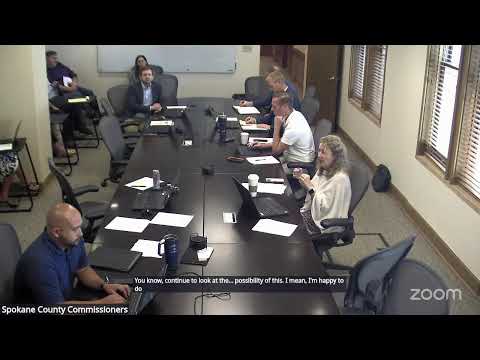
Spokane County planning staff briefed commissioners on Aug. 12 on a five‑year update to the county’s Natural Hazard Mitigation Plan. The packet the board received includes a revised risk ranking and a substantive narrative the office said totals roughly 205 pages.
Planner Tamara (identified in the briefing) told the board that one change was removing volcanic ash fall from the list of primary hazards because its score fell “less than 1.” Wildfire rose to the county’s leading hazard with a calculated score of 3.75, up from 3.3 in the prior iteration. Earthquake risk also rose from 2.85 to 3.05, staff said, after updated modeling of the Lataw Creek fault and because the county’s inventory of unreinforced masonry buildings increases vulnerability.
Tamara said the risk changes are driven by updated exposure and vulnerability data: the wildfire score rose largely because development is increasing in the wildland‑urban interface, increasing the county’s vulnerability to wildfire. The earthquake increase is tied to new local fault‑modeling results and an inventory of older unreinforced masonry structures.
Staff noted that the hazard mitigation plan update follows the Disaster Mitigation Act and FEMA guidance; the risk ranking and narrative are required parts of a FEMA‑approved mitigation plan. Once the plan is finalized the county will hold a 30‑day public comment period; staff also scheduled a risk‑ranking presentation for the board’s Sept. 17 quarterly workshop and said the full narrative will be provided to commissioners on request.
Commissioners asked how the ranking affects mitigation work; staff replied the ranking drives priorities and grant applications — for example, higher wildfire ranking can strengthen community wildfire defense grant applications and will shift staff work toward wildfire outreach, collaborative programs with local fire districts and public education. Tamara also said the county lacks regulatory authority to compel private property mitigation in many places and therefore relies heavily on education programs and voluntary programs such as Firewise.
Staff said the plan update is managed by a contractor using historical data and current science; the contractor produced the risk‑ranking matrix and narrative under county supervision. The next step is to finalize the draft, open the 30‑day public comment period, and then submit the plan for any required federal or state approvals.