Get Full Government Meeting Transcripts, Videos, & Alerts Forever!
Get email alerts on the Public Finance topic
No spam. Unsubscribe anytime.
Spokane County staff to pursue $30M campus bond and separate $20M financing for Shrek operations
Summary
County commissioners discussed issuing up to $30 million in bonds for campus infrastructure and a separate approximately $20 million financing request tied to Shrek operations; staff were directed to refine scenarios, run alternatives and return with resolutions and interlocal language for repayment safeguards.
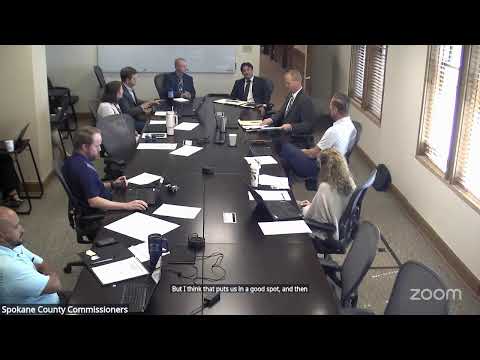
Spokane County commissioners directed staff to refine financing scenarios this week after a presentation showing how a $30 million bond for county campus infrastructure and a separate roughly $20 million bond for Shrek-related facilities could be structured. The board did not take a vote to issue bonds but agreed to return with specific resolutions and a recommended financing schedule.
The matter matters because the county faces aging campus systems (boilers, electrical switchgear and related upgrades) and Shrek has asked for help financing a building remodel, new telephone and console systems and microwave links between towers. County staff and financial advisor Scott Bauer of Northwest Municipal Advisors presented sample debt schedules, repayment approaches and legal safeguards for the Shrek portion.
Bauer told the commissioners the sample 20‑year financing for the $30 million campus bond results in an all‑in true interest cost of about 4.94 percent (including a half‑point market cushion) and roughly $2.4 million in annual debt service, producing about $48 million of total debt service over 20 years. For the Shrek portion, staff showed two options: a 20‑year and a 30‑year structure. The longer term reduces annual payments but increases total interest costs (staff estimated roughly $8.9 million higher total debt service for a 30‑year structure versus 20‑year in their scenario). Bauer also noted outstanding callable county LTGO issues that could be considered for refinancing if savings materialize.
Staff described the repayment approach for Shrek financing as a contract (interlocal agreement) between Shrek and the county: Shrek would be expected to reimburse the county from its pledged revenues (including communications sales tax receipts and any 9‑1‑1 excise tax revenues Shrek chooses to pledge), and the county’s LTGO pledge would remain the underlying credit in the bond market. County staff said the interlocal language would serve as a contractual backstop if Shrek revenues are insufficient.
County staff gave a breakdown of Shrek needs: the presenters said Shrek has already used cash for building purchase and is seeking roughly $12 million for remodels and outfitting and about $8 million for microwave and connectivity projects the next three years, for a total near $20 million. Staff also cited significant system costs such as a replacement telephone system estimated at $7–9 million and a CAT system cost near $5.7 million.
Commissioners pressed staff on timing, market sensitivity around the November midterm elections, the effect on reserve balances and how bond sizing would interact with other capital choices such as an Almentum tax parcel system replacement estimated near $10 million. Staff said bond issuance would likely be after election day under the proposed schedule, with a roughly three‑month financing timeline from documentation to closing, and that they would include options in a draft resolution to allow adjusting principal amounts and delegating sale authority later.
On other financing details, staff reported combined remaining REIT (REET as presented) capacity of about $4.7 million across two funds and noted recent legislative changes that allow new flexibility to use a portion of REIT for maintenance and operations, which commissioners said will factor into prioritization.
Direction to staff: commissioners agreed they wanted bond scenarios run for multiple sizes (e.g., $30M, $40M, $45M) and to explicitly model adding the $10M Almentum/treasurer system replacement; to show separate series for county and Shrek (the board favored keeping the county series and the Shrek series distinct so liabilities and repayment are clear); and to return with draft resolutions, interlocal agreement language and refined schedules for consideration in October.
No formal financing resolution was adopted at the meeting. Staff said they will bring a bond resolution and supporting materials (including rating‑agency briefing materials) back to the board once scenarios are refined.
Ending: The board asked staff and the county’s advisors to produce the detailed schedules and draft documents so the commissioners can consider formal authorization this fall. Commissioners also asked staff to include clear cost and reserve impacts in the materials and to show legal limits and contingencies in the interlocal agreement for Shrek repayment.