
Decatur County BZA denies Genex/Cobia commercial solar special-exception request
Get AI-powered insights, summaries, and transcripts
Sign Up Free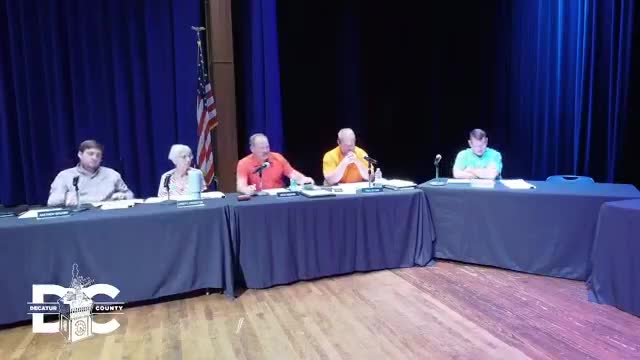
Summary
After hours of public comment and testimony for and against the proposal, the Decatur County Board of Zoning Appeals voted 5-0 on Aug. 6 to deny a special exception for G Nex/Cobia Solar to build a commercial solar facility, citing community concerns despite an economic development agreement offered by the developer.
The Decatur County Board of Zoning Appeals on Aug. 6 denied a special-exception request from G Nex Solar (Cobia Solar) to construct a commercial solar energy facility, voting 5-0 against the petition.
The board voted "no" for petition BZA 2024-8: Janie Levinson — no; Scott Smith — no; Andrew Brunei — no; Rick Hoey — no; Paul Stone — no. The motion presented to the board would have approved the project subject to several agreements and conditions, including an economic development agreement, a road-use agreement, a decommissioning agreement, a master agricultural preservation agreement, a fire-safety and emergency-response agreement, compliance with the county stormwater ordinance and technical-review conditions, and a requirement that panels be recycled at end of service. The board denied the application.
Why it matters: The proposed Cobia Solar project would have covered multiple parcels across thousands of acres of farmland in Decatur County and generated contested estimates of local fiscal benefit and costs. Supporters argued the project would bring direct payments to the county and landowners and include agrivoltaic provisions such as sheep grazing; opponents said the facility would consume agricultural land, harm property values and rural character, and raised concerns about decommissioning and long-term disposal of panels.
Public comment and objections dominated the meeting. Jason Kuchme, an attorney representing a coalition of county property owners opposed to the project, told the board he represented “Decatur County Citizens Stop Industrial Solar And Wind LLC” and argued the board’s prior findings in a separate Greensburg solar matter required denying the current application. Kuchme presented studies and appellate excerpts he said supported expected negative impacts on property values, and he argued that the county comprehensive plan and zoning ordinance discourage commercial alternative energy development that consumes agricultural land.
Many nearby residents and local organizations testified against the project. Speakers raised concerns about property value declines, increased traffic during construction, damage to local drainage and flooding, possible impacts to cultural and archaeological sites, and toxic waste at end of life. Larry Heger, Susie Dean and other residents described a desire to preserve the county’s agricultural character. Jessica Harmeyer, identified as a resident near the proposed site, urged the board to apply Indiana zoning and nuisance standards when considering nonparticipating neighbors’ rights.
Supporters, including landowners who signed leases, offered a counter-narrative: Donnie Kasper, vice president of development with G Nex Solar, said the company had executed an economic development agreement that “solidifies $16,500,000 in economic development payments for the county” and cited a third‑party estimate and a county-conducted review that the project would generate taxable revenue. Kasper and company witnesses described commitments they said would limit county risk: a 30% floor for valuation in the economic-development agreement, a road‑use agreement with pre- and post‑construction surveys, a decommissioning bond sized at 150% of estimated decommissioning cost, a master agricultural preservation agreement with screening and pollinator plantings, and an emergency-response plan.
David Hall, a commercial appraiser with Integra Realty Resources, testified for the petitioner that the Kirkland report — a market‑value study prepared for the project — found no impact on home values where projects are “properly screened and buffered.” Hall told the board his firm had reviewed Kirkland’s sources and methods and found them consistent with accepted appraisal practice.
Landowners and their attorney, Brianna Schroeder of Janssen Schroeder Agricultural Law, testified the chosen landowners voluntarily signed leases, view the project as a revenue and farm-preservation strategy, and emphasized agrivoltaic elements the developer proposed, including sheep grazing and pollinator plantings. Representatives from a grazing operator detailed a grazing model that would aim for roughly two ewes per acre and described the scale and logistics of introducing thousands of sheep to the project over time.
Board members questioned the petitioners about multiple technical and financial details: how estimates accounted for declining module cost and assessment; how economic payments and timing relate to construction and the first county payment; the mechanics of decommissioning and whether recycling of module materials would be required; road‑use bonds and interim repairs during construction; the transferability of commitments to future owners; and who would verify that land restoration and screening met county standards. Petitioners said the EDA, decommissioning and other agreements would be transferable and that surety would be posted before construction. They also agreed to add or clarify language giving the county an approval role in decommissioning acceptance and in certain landowner negotiations.
The motion to approve the petition that was presented to the board included the conditions listed above and the single explicit environmental condition added by the board during discussion — that panels be recycled rather than sent to landfill at the time of removal — but the motion failed when the board members voted no. After the vote the chair thanked staff, the public and the petitioner for their participation and adjourned the meeting.
Context: The project had been the subject of previous hearings and a prior related denial of another commercial solar petition in the county was repeatedly cited by opponents. County consultant materials (including a Baker Tilly presentation) and multiple technical reports were part of the public file and were referenced during testimony. Several speakers also referred to state legislation (SEA 1) and to appellate decisions and studies from outside Indiana when making their case, but the board’s decision reflected the local hearing record.
The board’s denial ends the petition before the BZA; any further administrative or legislative steps (for example, a zoning ordinance change or a new application) would be separate processes.