Get Full Government Meeting Transcripts, Videos, & Alerts Forever!
Get email alerts on the Public Housing Redevelopment Funding topic
No spam. Unsubscribe anytime.
Charlottesville housing authority details redevelopment progress and asks city for predictable funding
Summary
City and the Charlottesville Redevelopment and Housing Authority reviewed redevelopment projects, weaknesses in the city-funded SISRAP rental assistance program and a request for recurring city support to maintain public housing and resident services.
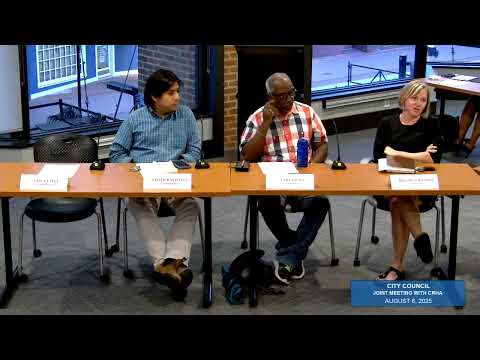
The Charlottesville Redevelopment and Housing Authority and city staff updated the City Council on Aug. 6 about ongoing redevelopment work, gaps in the city-funded supplemental rental assistance program (SISRAP) and a formal request for predictable annual city support to maintain public housing.
At a joint special meeting, James Friess, Deputy City Manager for Operations, said “affordable housing is 1 of our top priorities here in the city,” and described CRHA as “arguably our most important partner” for delivering subsidized units. Friess told council and CRHA commissioners the city is investing more than $38,000,000 in CRHA redevelopment projects and that staff had prepared a joint report recommending clearer milestone calendars, better information-sharing and a revised program agreement for the SISRAP rental assistance program.
The report the city and CRHA developed divides next steps into three tracks: advancing redevelopment projects, revising the SISRAP program agreement and improving routine coordination and communications. Friess said the council had previously “approved an extension of the current agreement, carrying the current funding through [December],” and staff plan to use that extension period to rework the SISRAP agreement’s administrative funding and program rules.
John Sales, executive director of the Charlottesville Redevelopment and Housing Authority, described operational changes and capacity growth at CRHA after he joined the agency. “When I got there, it's, like, 30 something employees,” Sales said, and said CRHA has since built a redevelopment team and completed in‑house projects that generated savings. Sales outlined two major ongoing redevelopment efforts: South First Phase 2, a 113‑unit mix of apartments and townhouses with an anticipated first delivery in April 2026, and Sixth Street Phase 1, a 47‑unit apartment building that includes a clinic UVA will lease, a food hub and resident services space. He said all units in those projects will be subsidized to serve households at about 30% of area median income.
City and CRHA staff reviewed scattered‑site renovations (Madison, Riverside, Mickey), an acquisition known as the Dogwood portfolio (roughly 80 units), and site‑specific discussions including potential land‑lease or disposition options for 1016–1020 Coleman Street and 801 Harris Street. Sales said CRHA expects to pursue tax‑credit applications and developer responses to an RFP for additional units on city‑owned parcels while retaining land ownership via land leases in some proposals.
SISRAP, the city‑funded Charlottesville Supplemental Rental Assistance Program, also drew extended discussion. Staff said the program has been operating since 2017 and currently has no time limits on assistance, which contributes to a static client pool and a wait list when funding is fixed. Friess and Sales said the administrative allocation in the program agreement is inadequate to CRHA’s actual administrative needs and that the agreement does not include all potential referral partners the city and other homeless service providers now want to use. Sales said staff will revisit eligibility, waiting‑list rules and staffing/technology needs and return recommendations to council.
CRHA also asked the city for more predictable, recurring support rather than competing for one‑time or competitively awarded dollars each year. Sales presented three recurring requests for city consideration: $1,000 per public housing unit per year for hard capital needs, a capital‑fund project manager position to oversee planned gut renovations, and $500 per public housing unit per year for resident services. Sales said he based calculations on a public housing inventory of 274 units. City staff described options for how that funding could be budgeted, including converting competitive allocations to a larger fundamental agency designation and attaching performance conditions to the funding.
Staff and commissioners discussed program tradeoffs that would follow from expanding SISRAP or targeting funds to sites like Kendallwood (to preserve affordability for relocated residents). Councilors pressed staff on why a reserve and a SISRAP wait list coexisted in prior years; staff explained the reserve had been built during early under‑utilization and that the program’s ongoing annual allocation would not create a new permanent reserve unless the council appropriates ongoing additional funding.
Other updates included language‑access work at CRHA (staff reported 49 public‑housing families now require non‑English services and listed primary languages being tracked), a competitive federal award of $1,500,000 for interior capital upgrades, and technology investments such as resident computer labs and text‑based service requests. Staff also described utility and decarbonization steps — switching gas water heaters to electric and adding solar on some roofs — and said federal HUD capital funding will decline for older units as sites are redeveloped and receive newer construction dates.
The meeting closed without additional formal legislative actions; council members and CRHA commissioners agreed to continue staff‑level work on the revised SISRAP agreement, the compliance/calendar items in the joint report, and follow‑up proposals for predictable city funding. The board then moved to adjourn the joint session.