Get Full Government Meeting Transcripts, Videos, & Alerts Forever!
Get email alerts on the Labor Contracts topic
No spam. Unsubscribe anytime.
Evergreen staff and union leaders press board to resolve stalled contract talks as mediation continues
Summary
Custodians, paraeducators and union leaders urged the Evergreen Public Schools board on Aug. 12 to reach a contract with bargaining units, warning that stalled talks and low pay harm students and drive turnover; the superintendent said the district is in mediation but cited budget constraints.
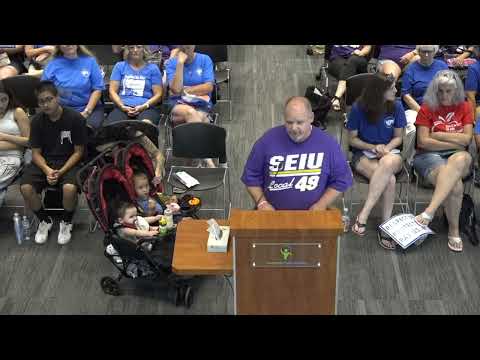
Dozens of Evergreen Public Schools employees and parents urged the school board on Aug. 12 to resolve ongoing contract negotiations, saying delayed agreements and low pay for paraeducators and custodians harm students and force experienced staff to leave. Public commenters included custodial staff, paraeducators and the president of the Evergreen Public Schools Council (PSC), who said bargaining has stalled two weeks before the start of the school year.
The speakers said the dispute affects student services and could disproportionately harm students with greater needs. ‘‘I don't want to deal with the strike because it would affect, it affects our vulnerable populations, special needs kids,’’ said a virtual commenter, Mr. Smith, who asked board members to accelerate work on the PSE contract. Melinda Trofer Cooper, identified in public comment as Evergreen PSC president, told the board that bargaining repeatedly left members ‘‘devalued and disrespected’’ and warned she would not accept talks that do not produce a fair and equitable contract.
The superintendent, Dr. Mahoney, told the board that the district is in mediation with the PSC large group and with the Evergreen Administrators Association (EAA). Mahoney said district negotiators and mediators are working toward new agreements but that decisions will be constrained by the district's financial situation. Chief Financial Officer Jennifer Jacobson presented a budget briefing later in the meeting and described significant fiscal pressures, including declining enrollment and reduced state funding per pupil.
Several custodians described household-level hardship and pay comparisons with other districts. Terry Grenier, a day lead custodian employed by ABM at Endeavor, said after two decades with the district he earns $21.10 an hour and that many custodians rely on food banks or second jobs. A commenter who spoke on behalf of Josh Richardson described Richardson as a 15-year ABM employee and a four-year day custodian at Union High School; the commenter said Richardson would earn roughly $4 more per hour working in commercial accounts than as a long‑service school custodian.
Paraeducators also described the effect of turnover on students. Samantha Voller, a special education para at Illehi Elementary, said she makes less than $2,000 a month and that frequent staffing changes prevent the consistent relationships students need. ‘‘When we don't have paras to cover the needs of our student minutes, those kids are losing out on the education and social emotional needs that they have,’’ Voller said.
Commenters and union leaders cited bargaining history and district choices on spending and contracting. Trofer Cooper referenced a previous bargaining cycle in which PSC members worked without a contract for much of the school year and criticized the district’s reliance on outside agencies to fill para positions, saying that approach was more expensive and did not solve retention problems. Board members asked questions but did not take formal action on collective bargaining during the meeting.
Discussion versus decision: the public comment period and superintendent remarks were recorded as discussion only; the transcript shows the district is in mediation but contains no board vote or formal settlement. Several speakers requested that the board prioritize contract resolution before school starts; the superintendent reiterated mediation and cited budget limits as a constraining factor. The board did not direct staff to adopt or change bargaining positions at the Aug. 12 meeting.
The board acknowledged the comments and expressed appreciation for the speakers. Mahoney said the district hopes to reach agreements ‘‘sooner rather than later’’ but emphasized that all financial decisions must support the district’s overall fiscal health. The public record for Aug. 12 contains multiple detailed accounts of pay rates, comparisons with neighboring districts, and descriptions of how staffing shortages affect student services.