Get Full Government Meeting Transcripts, Videos, & Alerts Forever!
Get email alerts on the Ethics Complaint Dismissal topic
No spam. Unsubscribe anytime.
Ethics board dismisses complaint over homelessness services, says allegations fall outside its authority
Summary
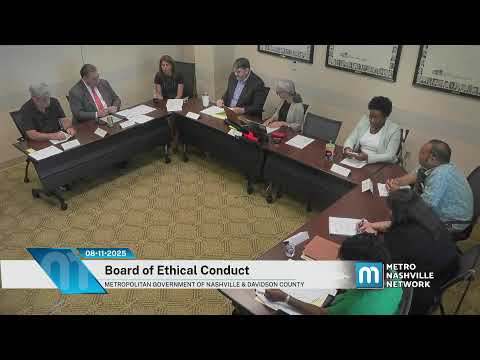
The Davidson County Board of Ethical Conduct voted unanimously Aug. 11 to dismiss an ethics complaint filed by Justice Patterson against the Office of Homeless Services, the Metropolitan Development and Housing Agency (MDHA) and Strobel House after the county Department of Law told the board the named parties and the allegations do not fall within the board’s statutory jurisdiction.
The Davidson County Board of Ethical Conduct voted unanimously Aug. 11 to dismiss an ethics complaint filed by Justice Patterson against the Office of Homeless Services, the Metropolitan Development and Housing Agency (MDHA) and Strobel House after the county Department of Law told the board the named parties and the allegations do not fall within the board’s statutory jurisdiction.
Board members said the decision rests on two legal limits: the board can take complaints only against individual elected officials or appointed members of boards, commissions or authorities, and the county’s ethics code lists specific misconduct the board may investigate. Department of Law counsel summarized that the entities named in the filing are not “proper parties to an ethics complaint because they do not qualify as elected officials or members of a board or commission.”
The complaint, which the board said alleges discriminatory practices, procedural roadblocks and systemic inequities affecting people with lived homelessness experience, contained multiple exhibits and requested actions including audits and monetary remedies. Board members repeatedly told the complainants and the public that those remedies appear to be operational and statutory matters for other forums rather than ethics violations the board can address.
Adam, a Department of Law attorney who summarized the memo to the board, told members the Metro Ethics Code requires a complaint to name a named elected official or a member of a board or commission and that many of the grievance claims are operational in nature. "The Office of Homeless Services, MDHA, and Strobel House are not proper parties to an ethics complaint because they do not qualify as elected officials or members of a board or commission," Adam said.
At the meeting a person who identified themself as experiencing homelessness told the board, "I'm homeless on the street, so I didn't know that there was an ethical thing about being homeless," and urged officials to listen to the lived experiences in the submission. The board said publicly filed materials will remain available online and that dismissal is a legal determination that the board lacks the power to act, not a judgment on the underlying concerns.
A board member moved to dismiss the complaint; the motion was seconded and carried by roll call. The board chair called the roll; the recorded votes were recorded as yes from each voting member present, and the motion passed unanimously. The board said an order explaining the dismissal will be emailed to filers and that the complaint materials will remain posted on the board’s web page.
Board members and legal counsel noted other procedural details for filers: after a contested hearing a party may appeal to the chancery or circuit court of Davidson County by filing a writ of certiorari within 60 days, and parties are advised to seek independent legal counsel to meet deadlines and procedural requirements. The board also reviewed scheduling and membership details for upcoming meetings, and members were reminded to confirm reappointments or term expirations ahead of the next meeting.
The board did not take any further investigative actions on the complaint. Members urged those with operational or statutory claims to pursue other administrative or judicial avenues because the Board of Ethical Conduct’s authority is limited to specific, code-defined ethics violations.