Get Full Government Meeting Transcripts, Videos, & Alerts Forever!
Get email alerts on the Emergency Communications topic
No spam. Unsubscribe anytime.
Bill would let broadband fund support early-warning and interoperable emergency communications
Summary
House Bill 18 would expand permissible uses of the Broadband Infrastructure Fund to include early-warning systems, interoperable radio and emergency communications equipment; Comptroller and broadband office representatives described the competitive grant process and the fund balances available for such uses.
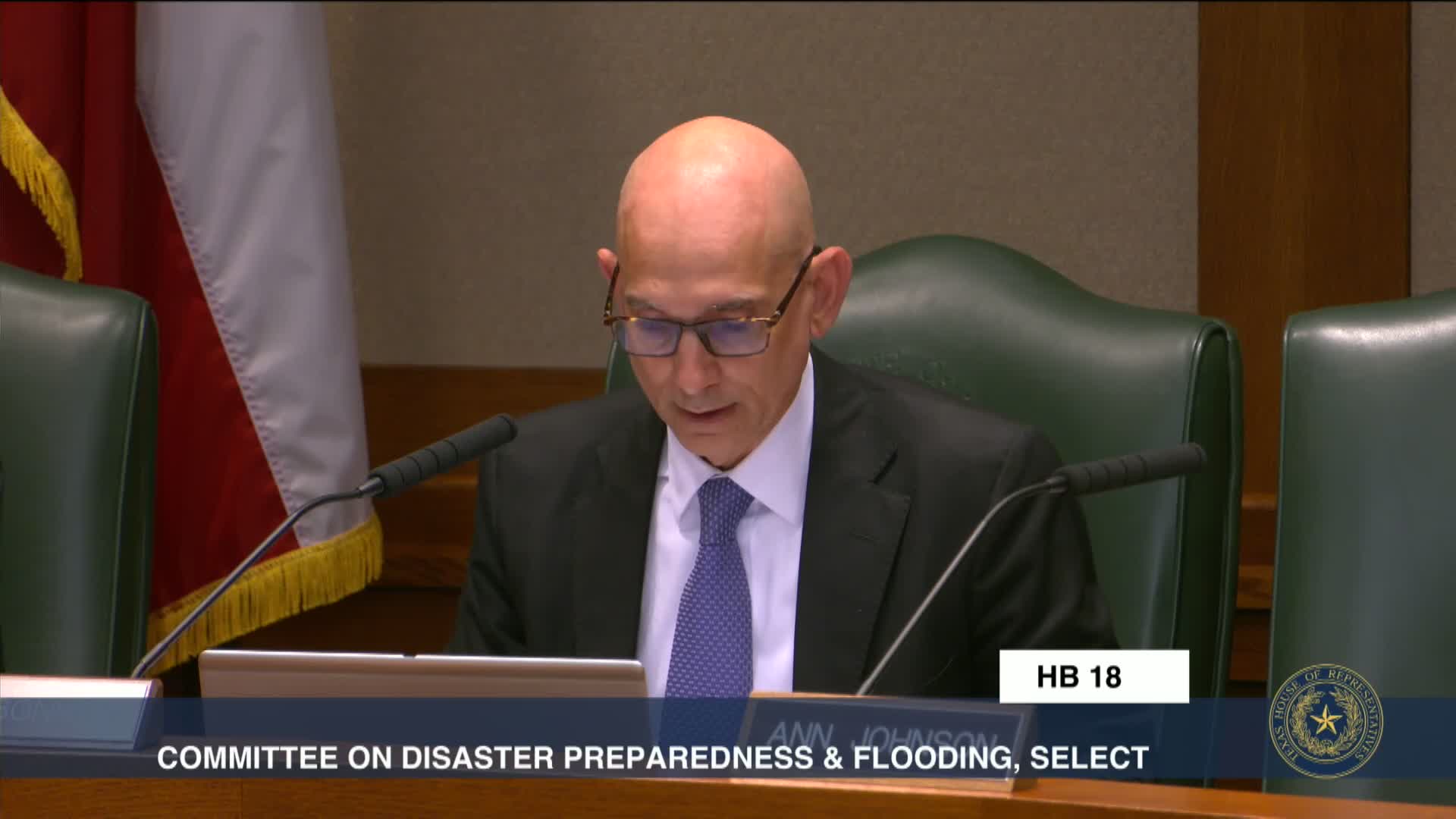
House Select Committee members heard House Bill 18, which would amend the Government Code to expand allowable uses of the Broadband Infrastructure Fund (BIF) to include early-warning systems and interoperable emergency communications infrastructure.
Doctor Bonham, who presented the bill, described BIF as a $1.5 billion fund created by House Bill 9 and funded in part by voter-approved Proposition 8 in 2023. He told the committee the fund’s current state balance is roughly $1.36 billion and noted additional federal allocations in the broadband program accounting for about $3.3 billion in federal funding for broadband strategies in the current and upcoming biennium. “The Broadband Infrastructure Fund is a 1,500,000,000 fund that was created in House Bill 9 during the 88th legislative session and it was funded with voter approval by Proposition 8 in 2023,” Bonham told the committee.
Under the bill as explained, the Broadband Development Office and the comptroller could use grants, contracts, low-interest loans and other incentives to support early-warning and interoperable communications projects. Sponsors said the intent is to leverage an existing administrative structure to expand investment into emergency preparedness while preserving technology-neutral procurement.
Greg Conte of the Comptroller’s Office explained how BIF awards have been made: competitive notices of funding availability, published rubrics, application windows and evaluation periods typically run on a 30–60 day schedule. He told the committee the Office has used competitive grants for most broadband awards and has the capacity to publish scoring metrics in the NOVA (notice of funding availability). The comptroller described past uses of contracts and federal funds alongside state dollars.
Witnesses stressed implementation details. Committee members raised concerns about ongoing maintenance costs in rural counties, and some suggested prioritizing grants (not loans) for volunteer or small jurisdictions without ratepayer bases. Kenneth Flippen recommended focusing on low-water crossings and other identified, high-risk infrastructure to get the most immediate safety benefits.
The committee left the bill pending for technical corrections and to allow further work on eligibility, prioritization and coordination across agencies and federal funding rules.