
Commission split on initiating Hemet-area general plan amendment for mixed-use and assisted-living proposal
Get AI-powered insights, summaries, and transcripts
Subscribe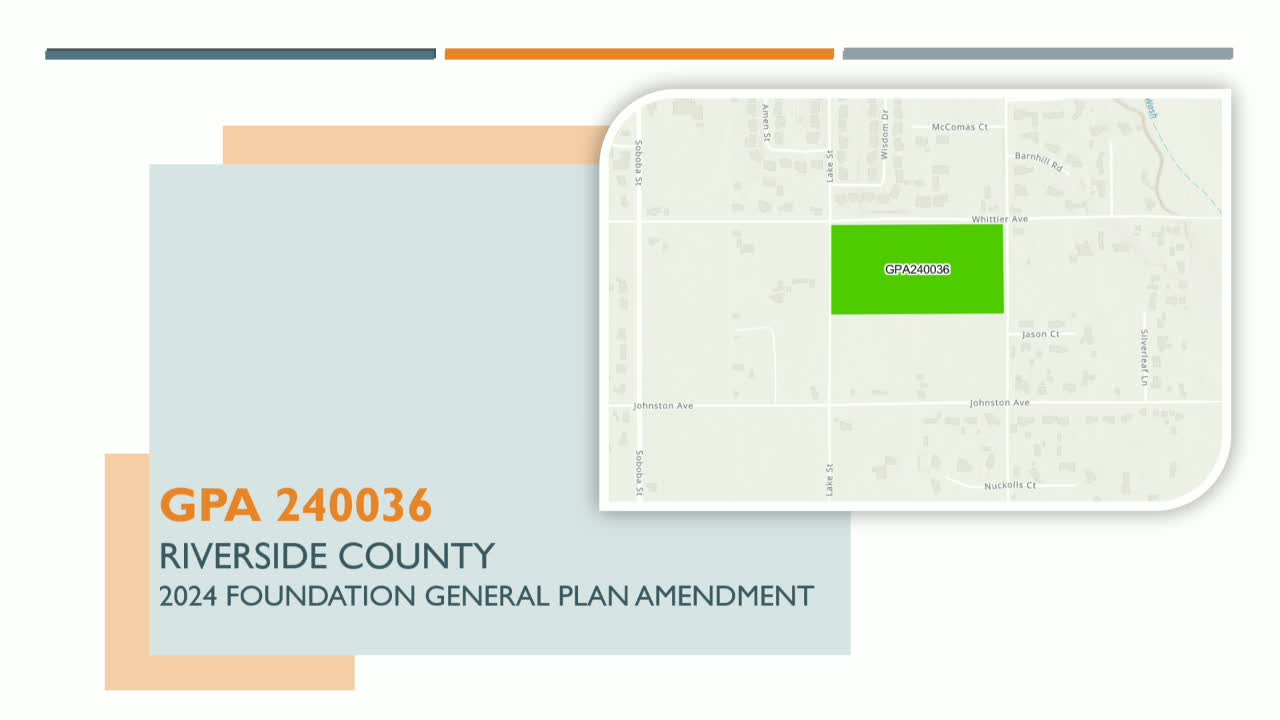
Summary
A proposed general plan amendment to reclassify an approximately 18-acre parcel near Whittier and Lake Street in the San Jacinto Valley to allow mixed-use and assisted-living development split the Riverside County Planning Commission on July 30, resulting in no majority recommendation to initiate the change.
A proposed general plan amendment to reclassify an approximately 18-acre parcel near Whittier and Lake Street in the San Jacinto Valley from Rural Community Low Density Residential to Community Development (Mixed Use with Low Density Residential) produced a split Planning Commission on July 30.
The applicantteam described a revised vision that would preserve a roughly five-acre estate on the site (including a large residence, pool and recreational features) as a community center while allowing an assisted-living or lifecycle housing facility and new low-density residential lots on the remainder of the property. Brandon Barnett, representing the applicant, said the estate house is approximately a 28,000-square-foot residence and that the application is intended to provide lifecycle housing options (independent living, assisted living, memory care as potential uses) while maintaining open space and neighborhood-scale lot sizes in buffer areas.
Barnett told commissioners the applicant modified an earlier, higher-density concept after community input and now proposes tentative-tract map-sized lots consistent with adjacent tract sizes (18,000-square-foot minimum lots in Tract 31264) to create a transition between proposed uses and the adjacent residential area. He said the estate and its garden and recreational amenities would be preserved and possibly used as a community amenity.
Local farmers and residents strongly opposed the change at the hearing. Victor Marabella of Marabella Farms, which farms about 20 acres abutting the site's south property line, said the area is commercial citrus country and that farming activities include noisy wind machines, pesticide spraying, forklifts and semi-trucks during harvest. Grower Lena Schafer cited statewide trends in farmland loss and warned that the Hemet Valley produces a large share of California grapefruit: "If farmers are forced out by development, we lose our local food source," she told the commission. Other commenters raised concerns about traffic, water and sewer infrastructure, and the potential for the change to trigger further density increases in the citrus-growing area.
Commissioners were divided. Two commissioners said they would support initiation and the chance to study the change further, noting potential benefits in lifecycle housing and that the applicant had reduced density from earlier proposals; two commissioners said the areaparticularly the agricultural character and adjacency to citrus grovesshould be preserved and that infrastructure and compatibility concerns weighed against initiation. Planning staff reminded the commission that initiation is the first of multiple discretionary steps; if initiated the project would still require subsequent environmental review, specific entitlements such as tentative tract maps and conditional use permits, and further public hearings.
The commission did not reach a majority in favor of initiation: the tally reported on the record was 2 in support and 2 opposed, leaving no recommendation to approve at this stage. The matter will proceed in the county process as a file and can be considered by the Board of Supervisors if the formal initiation is advanced later in the process.