
City holds public hearing on Muskogee Comprehensive Plan 2045; staff recommends adoption
Get AI-powered insights, summaries, and transcripts
Sign Up Free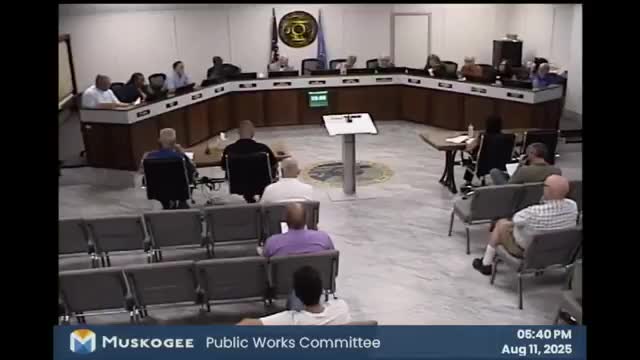
Summary
City planning staff presented the draft Muskogee Comprehensive Plan 2045 and future land use map at a public hearing. Staff recommended approval; the item will return to city council for final consideration. Residents asked that health, safety and infrastructure be prioritized and raised questions about tiny homes and annexation.
City planning staff opened a public hearing on Aug. 11 to present the draft Muskogee Comprehensive Plan 2045 and a proposed future land use map, recommending the council adopt the plan and to revisit it at regular intervals. The plan, described by planning staff as a 20-year blueprint, outlines four guiding themes—Advancing Muskogee, Thriving Muskogee, Livable Muskogee and Resilient Muskogee—and proposes policies on growth, connectivity, public spaces, economic development, housing and natural-resource resilience. Miss Winkle, planning department, told the committee the draft includes a future land use map, provisions for periodic review, and action items such as affordable housing, community preservation and infrastructure improvements. She said the full plan is available on the planning department webpage under the “Comprehensive Plan” link and that staff recommends approval of the draft for council consideration. During the hearing, several residents urged the city to prioritize health, safety and infrastructure before new development. Mike Gregg, a resident who reviewed the draft, said health and safety and infrastructure should be “one, two and three” in the sequence of projects and raised recurring streetlight outages as an example of deferred maintenance. He asked how leftover funds from other line items are tracked and spent. A second commenter, Miss Hughes, asked why the draft does not reference tiny homes and noted a zoning code that sets minimum lot sizes. Miss Winkle responded that the minimum buildable-lot ordinance is older, that the standard single-family lot size is 7,200 square feet under current code, and that planning staff is drafting a new ordinance to allow tiny homes and reduced buildable-lot sizes with specifications and standards to govern them. Pete Kerouard, another resident, urged careful design of smaller housing clusters so they resemble traditional subdivisions rather than RV-style parks and stressed the need for infrastructure (water, sewer, drainage) and appropriate lot layout. On annexation, Councilor Stepp and other council members asked whether the plan contemplates forced annexation. Miss Winkle said annexation applications are typically initiated by the property owner or a petition and are not being pursued as a city-initiated forced annexation at this time; she also said the draft notes that currently the city believes there is sufficient land to accommodate the housing the plan proposes without immediate annexation. This hearing was informational; no final action was taken. Planning staff said the item will return to the city council for consideration on the council agenda.