Get Full Government Meeting Transcripts, Videos, & Alerts Forever!
Get email alerts on the Historic Depot Renovation topic
No spam. Unsubscribe anytime.
St. Louis County approves bonds to fund $16.5 million Depot HVAC and MEP renovation
Summary
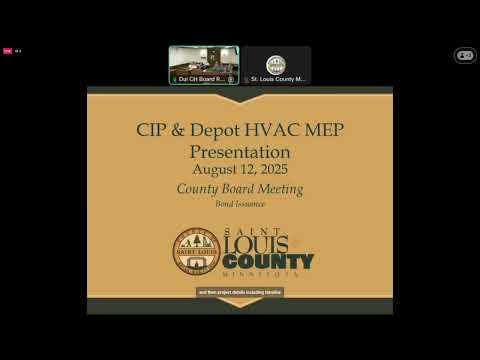
County commissioners unanimously approved an amended capital improvement plan and the intent to issue up to $19.5 million in general obligation capital improvement bonds, with $16.5 million targeted to replace aging HVAC and mechanical systems at the historic St. Louis County Depot.
St. Louis County commissioners voted unanimously Aug. 12 to update the county five‑year capital improvement plan and to move forward with bond issuance that will fund a major renovation of the historic St. Louis County Depot.
County administration described the depot project as a whole‑building heating, ventilation and air‑conditioning (HVAC) and mechanical, electrical and plumbing (MEP) replacement intended to protect artifacts, improve air quality and enable continued public programming. Director Tennis said, “The total cost for this project is estimated at $16,500,000,” and described the work as shovel‑ready and phased to limit nonprofit disruption.
The vote amended the capital improvement plan and approved a notice of intent to issue general obligation capital improvement bonds in two series not to exceed $19,500,000 in the aggregate: Series 2025B (up to $16,500,000, targeted to depot HVAC/MEP work as tax‑exempt qualified private activity bonds because of 501(c)(3) tenants) and Series 2025C (up to $3,000,000 for other CIP projects). Commissioners moved and approved the CIP amendment and intent to issue bonds after a public hearing that included tenant and community support.
Why it matters: County staff and commissioners said the depot, placed on the National Register of Historic Places in 1971, houses eight arts and cultural tenant organizations and hosts frequent public events. Administration and the depot director argued the current mechanical systems are antiquated, have failed in recent years and pose risks to collections and tenants’ operations. Coordinator Thalen and other staff highlighted metrics used to prioritize the project: the depot’s energy use intensity (EUI) was described as 98 (high relative to updated county facilities) and its facility condition index (FCI) at about 0.4, with staff warning that deferred maintenance can cause costs to grow exponentially.
Project details and timeline: Administration presented a predesign and design timeline beginning in fall 2022 and said a complete permit set is in hand. Construction was described as slated to begin in November 2025 with a phased approach and an estimated two‑year construction window; staff emphasized they intend to keep portions of the building open and to provide limited “swing space” on the fourth floor for tenant operations. County staff said the project includes HVAC replacement, critical MEP renovations, energy‑efficiency measures and controls upgrades that will reduce operating costs and carbon footprint.
Public testimony and partnerships: Ken Buehler, executive director of the Lake Superior Railroad Museum and general manager of the North Shore Scenic Railroad, testified in support of the bond plan and thanked the county for stewardship. A resident, Kathy Peterson, offered public comment in support, citing long personal ties to depot programs.
Funding history and procurement notes: Staff recounted prior state bond requests and work with a legislative lobby team: the project received $1.5 million from a 2020 state bonding special session that paid for envelope and life‑safety work. Administration said other state bonding requests over multiple sessions were unsuccessful and framed the county bond issuance as necessary to keep momentum and avoid emergency repair costs as market prices rise. Bond counsel and county finance staff were present to answer legal and fiduciary questions; staff noted the issuance will follow TEFRA (private activity) requirements because of nonprofit tenants.
Vote and next steps: After the public hearing, the board voted unanimously to approve the CIP amendment and the bond issuance resolution. Administration signaled it will bring specific projects for board approval as bond funds are allocated. Construction contracts and final procurement will be subject to the county’s RFP and purchasing rules.
County staff and commissioners said the award marks a key step in protecting a regional cultural asset while trying to limit tenant disruption during construction.