
RCA staff details MSHCP implementation; property owners press board on notice, options and transparency
Get AI-powered insights, summaries, and transcripts
Subscribe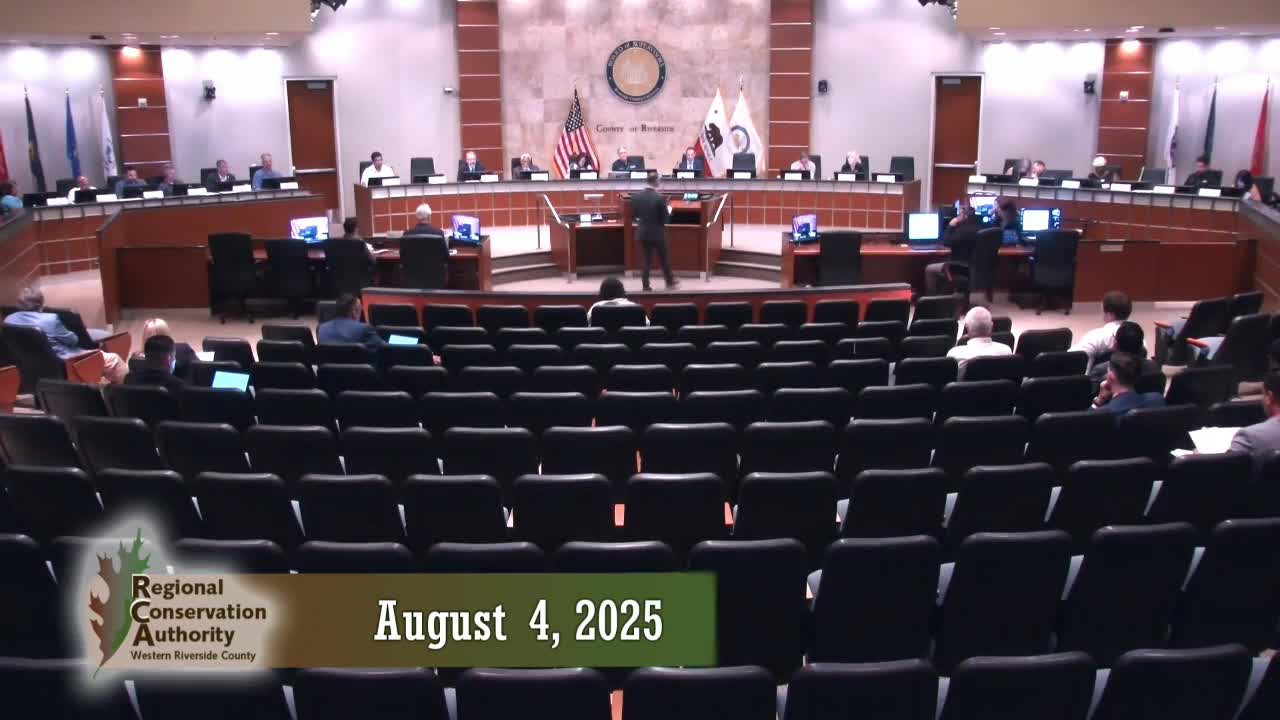
Summary
RCA Director Aaron Gabbie presented an MSHCP 101 overview of development review, JPR/HANS acquisition steps, and criteria refinements; public commenters and several directors pressed for better outreach, clarification of options for affected landowners and a public workshop on the Strategic Improvement Assessment and Action Plan.
Aaron Gabbie, Director of the Western Riverside County Regional Conservation Authority, gave the third installment of an MSHCP 101 series on Aug. 4, outlining how cities and the county process discretionary development under the Multiple Species Habitat Conservation Plan, the RCA’s role in review and acquisition, and the criteria-refinement pathway for property owners.
Gabbie told the board that the RCA reviews only projects in MSHCP criteria cells (the areas identified for reserve assembly) and that once an application is routed through a joint project review (JPR), the RCA has 14 calendar days to review it; wildlife agencies then have 10 working days to comment. If a project in a criteria cell is subject to acquisition, the RCA begins a 120-day negotiation period and may have up to four years from signing a purchase-and-sale agreement to close an acquisition. Gabbie emphasized the RCA does not use eminent domain to acquire properties.
The presentation described how reserve-assembly requirements operate at the cell, cell-group and sub-area plan scale and summarized the criteria-refinement process, which allows shifting conservation obligations to replacement land of equal or greater biological value but cannot reduce the overall acreage designated for the reserve. Gabbie said the criteria-refinement review generally takes about 90 days and must be completed before JPR and included in a project’s CEQA documentation.
Public commenters and some board members focused on how property owners learn they are affected by MSHCP criteria and what options they have. Several speakers said property owners sometimes discover constraints only during the HANS/JPR process and that the RCA does not routinely notify buyers at purchase. “A property owner could own a property for multiple years before they even know that their property is conservation land,” a director noted during the discussion, and Gabbie confirmed RCA does not proactively notify purchasers at time of sale; the agency fields calls during escrow and depends on jurisdictions’ due diligence.
Garrett Sauls, representing Sauls Company, urged that the RCA make the Sept. 5 workshop on the Strategic Improvement Assessment and Action Plan (SIAP) open to the public so property owners can view consultant recommendations. “My recommendation and my ask from all the property owners that I represent is that that September 5 meeting be open to the general public,” Sauls said.
Ed Sauls, who said he helped create the plan, told the board he supports the MSHCP but urged better opportunities for landowner participation in negotiations and better communication. “Our concern is only that we try and improve it in a way that is positive win wins and doesn't put us at legal further risk,” he said.
Directors and staff discussed outreach steps. Gabbie previewed recommendations that will be presented at the Sept. 5 RCA workshop, including increased engagement with city and county planning staff to improve early awareness among applicants and prospective land buyers. The board public notice at the meeting said the Sept. 5 workshop at the Temecula Creek Inn will be open to the public and is a Brown Act meeting.
The presentation also referenced prior analyses of program benefits: a 2008 RAND study and earlier RCA estimates that the program streamlined permitting and delivered time and cost savings for transportation projects; RCA staff cited an estimated $390 million in early-project-delivery savings from 2004–2013. Board members urged staff to include property-owner outreach, notice practices and the feasibility of expanding criteria-refinement use in the SIAP recommendations.
Separately, the board reported out from closed session that it approved acquisition of the Hadley Holdings parcel: approximately 152 acres for $1,215,000. The public report did not include a formal vote tally.
The RCA plans to present SIAP findings at the Sept. 5 workshop; directors asked staff to circulate materials to member jurisdictions and interested landowner groups ahead of that workshop.