
RCA board approves clerical change limiting third appraisals in MSHCP conflict process, 13-4
Get AI-powered insights, summaries, and transcripts
Subscribe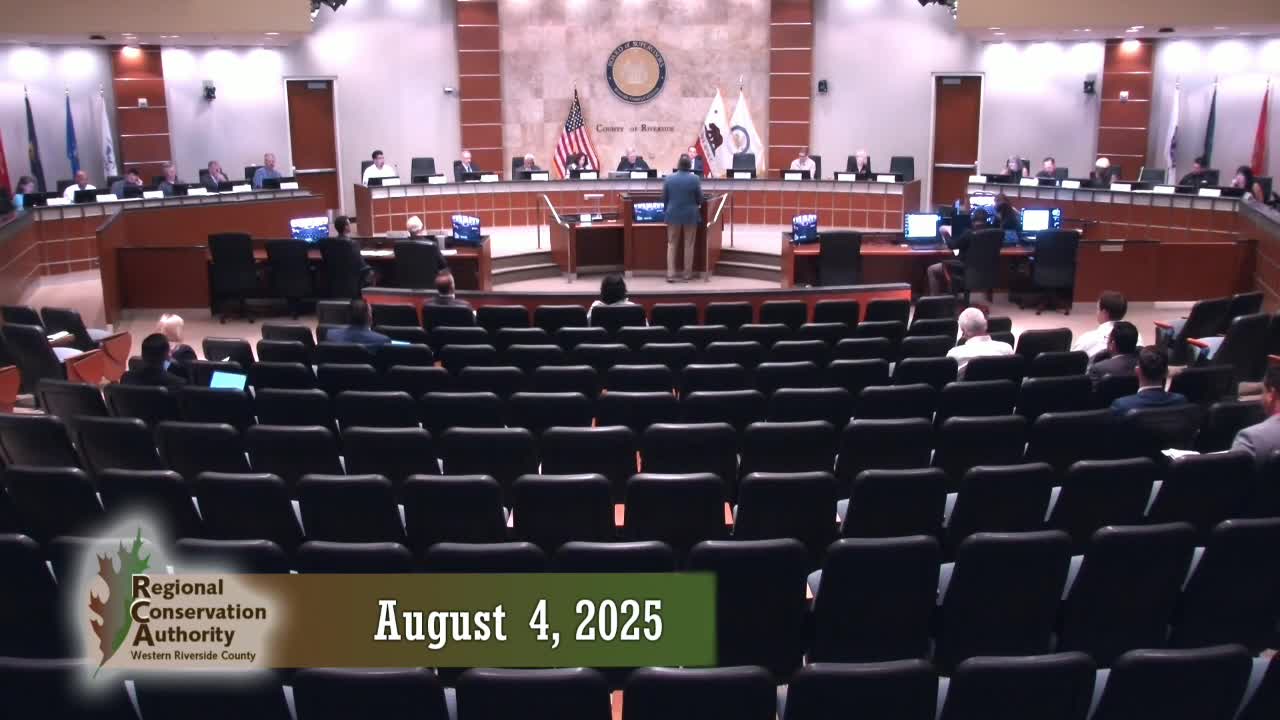
Summary
The Western Riverside County Regional Conservation Authority on Aug. 4 approved a clerical change to the Multiple Species Habitat Conservation Plan conflict-resolution language intended to keep the value established by a third appraisal within the range of the first two appraisals.
The Western Riverside County Regional Conservation Authority on Aug. 4 approved a clerical change to the Multiple Species Habitat Conservation Plan (MSHCP) conflict-resolution language intended to keep the value established by a third appraisal within the range of the first two appraisals.
Board members adopted a resolution approving the clerical change by a 13–4 vote after public comment and a prolonged discussion about legal risk and appraiser practice.
The change, introduced by Ward Simmons, General Counsel for the RCA, would clarify that when a property owner requests a third review appraisal in the HANS (Habitat Evaluation and Acquisition Negotiation Strategy) acquisition process, the value established during conflict resolution must fall within the range set by the owner’s appraisal and the RCA’s appraisal. Simmons told the board the amendment is intended to fix ambiguous language about the third-appraiser role that staff say has created uncertainty.
The rationale given by staff was procedural clarity: under the plan RCA orders an independent appraisal according to applicable standards and, if the owner disagrees, the owner may obtain a second appraisal; if the parties still cannot agree, a third review appraiser may be engaged and the clerical change would limit that reviewer’s selection to the range between the first two appraisals.
Public commenters and several board members urged caution. Ed Sauls, who said he helped draft the plan, recommended against the change, arguing it risks curtailing an appraiser’s professional opinion and could increase the plan’s legal vulnerability. “At best, they should be disclosing that in their appraisals and that frankly makes the plan more vulnerable to litigation,” Sauls said. He told the board he did not believe the original drafters intended a strict range limit.
Board members voiced related concerns. A speaker identified as Director (City of Canyon Lake) questioned whether a licensed appraiser could accept an assignment that effectively required an appraisal to fall inside a pre-set range and suggested checking with the state appraisal board. Others said the limit is analogous to jury instructions used in eminent domain cases but acknowledged eminent domain differs from the voluntary acquisition process used by the RCA. Ward Simmons said the eminent-domain jury-instruction analogy was only an example of a legally defensible approach and not a statement that RCA would pursue eminent domain.
Proponents on the board defended the change as common-sense dispute resolution. A Director (City of Murrieta) said the approach preserves the parameters of the original dispute and prevents market fluctuations during prolonged negotiations from altering the outcome. Director (City of Corona) moved to approve the language and a Director (City of Temecula) seconded; the motion passed 13–4.
The board record shows staff recommended adopting the clerical change to “protect the rights of the property owner and to establish a clear and fair purchase price for the RCA.” The change was characterized as clerical — limited to clarifying the dispute-resolution procedure in chapter text — and not requiring a formal amendment to the MSHCP permits or implementing agreement.
Items discussed but not altered in the motion included suggestions to: consult the California appraisal licensing authority before finalizing assignment language; clarify time windows for appraisals so older appraisals are not disadvantaged by market shifts; and ensure the third-appraiser selection process does not create perverse incentives for appraisers to perform full new appraisals rather than limited reviews.
The board did not vote to change any purchase deadlines or appraisal standards themselves. Several directors asked staff to continue consultations with legal counsel and, where appropriate, external state authorities before implementing the new wording.
Less-critical details from the meeting: the RCA’s HANS process generally starts with an RCA-ordered appraisal that must follow federal appraisal standards (the Uniform Appraisal Standards for Federal Land Acquisition, commonly called the “Yellow Book”); property owners may obtain independent appraisals; and the RCA negotiates acquisitions with a 120-day negotiation period and has up to four years from signing a purchase-and-sale agreement to complete a purchase.
For follow-up, directors asked staff to provide the board any additional legal guidance or opinion from state appraisal authorities before the language takes effect.