Get Full Government Meeting Transcripts, Videos, & Alerts Forever!
Get email alerts on the Safe Harbor Alternative Health topic
No spam. Unsubscribe anytime.
Dozens testify for Safe Harbor bill to protect complementary and alternative practitioners; board‑licensed clinicians raise scope concerns
Summary
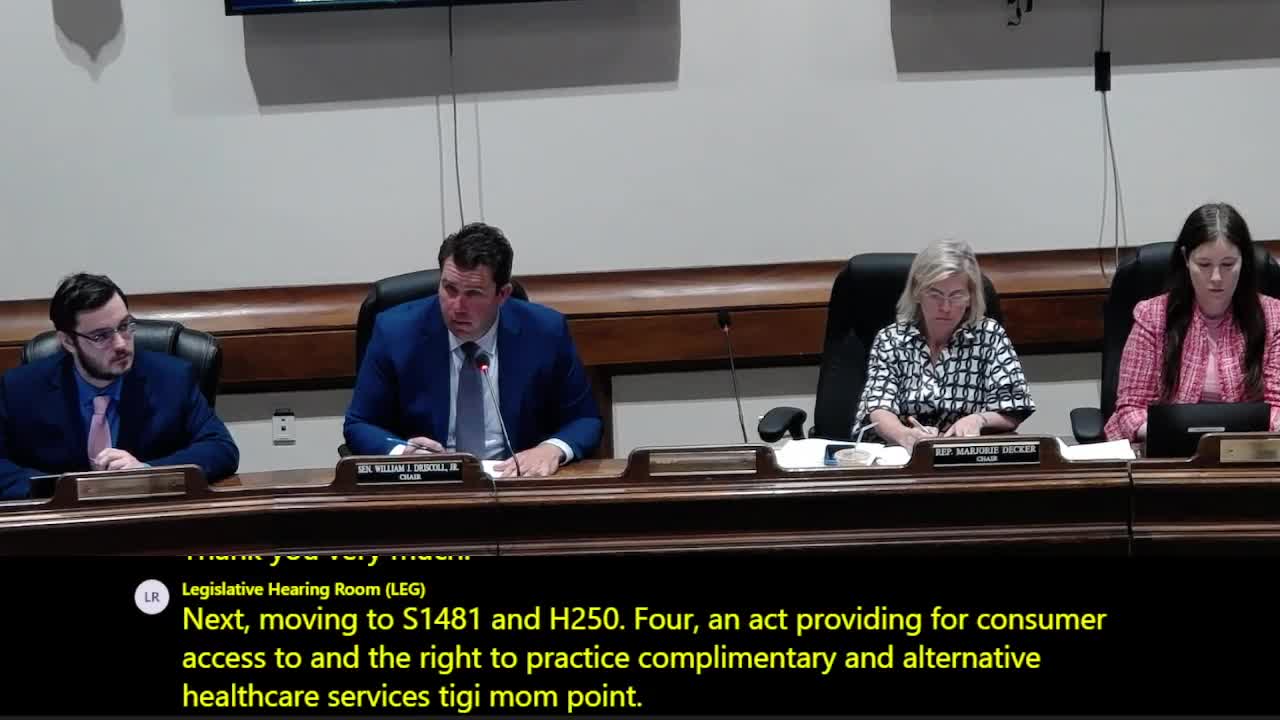
Supporters urged the Joint Committee on Public Health to pass H2504 and S1481, Safe Harbor bills intended to protect noninvasive complementary and alternative practitioners who provide disclosures and avoid prohibited medical acts.
Supporters of H2504 and S1481, the so‑called “Safe Harbor” bills, told the Joint Committee on Public Health that the legislation would protect consumer access to broadly used, noninvasive complementary and alternative health services while imposing disclosure requirements and a list of prohibited acts to protect public safety. Dozens of practitioners, educators and patients described therapies including Reiki, homeopathy, life activation and other energy‑based or manual approaches that, they said, are low‑risk, widely used and provide cost‑effective help that complements conventional care. Testifiers said the bills would require practitioners to provide a plain‑language disclosure about their credentials and to avoid explicitly medical acts such as prescribing drugs, performing surgery or puncturing the skin. Proponents including Keisha Jennifer Montpointe, Loretta Lamont, Abby Beal and others recounted personal and client stories—describing improved quality of life and lower cost of care—and asked the committee to let Massachusetts join the list of states with safe harbor protections. Witnesses said many practitioners already use disclosure forms and that the legislation would provide legal clarity for small businesses and solo practitioners. Opponents or cautionary witnesses included licensed provider representatives who raised concerns that the draft bill as presented may not clearly exclude practices already subject to professional licensure. Dr. Amy Mager, a licensed acupuncturist and board member of the Acupuncture Society of Massachusetts, told the committee that the bill in its current form lacked adequate engagement with licensed stakeholder groups and that, in prior iterations, licensed practices such as acupuncture were expressly excluded from the safe‑harbor protections; she asked that the bill explicitly avoid exempting practices for which there are existing state licenses. Supporters countered that the bill includes prohibited acts—such as puncturing the skin—so licensed acupuncture would remain regulated by the Board of Registration where applicable, and they urged a favorable report on the bills. National and state organizations supporting safe‑harbor models told the committee that 11 states had enacted similar laws and reported no systemic public‑safety harms in those jurisdictions. The committee heard a high volume of testimony both for the measure and requesting clarifying amendments to ensure safe‑harbor protections do not conflict with licensure statutes already on the books.