Get Full Government Meeting Transcripts, Videos, & Alerts Forever!
Get email alerts on the Rural Infrastructure topic
No spam. Unsubscribe anytime.
RCRC outlines broadband, housing and forest-resiliency programs for rural counties
Summary
Craig Ferguson, senior vice president of the Rural County Representatives of California, reviewed RCRC's 2025—27 strategic plan in Plumas County and described affiliated programs for broadband fiber, homeownership assistance and forest-resiliency wood processing that RCRC and its joint-powers authorities are pursuing.
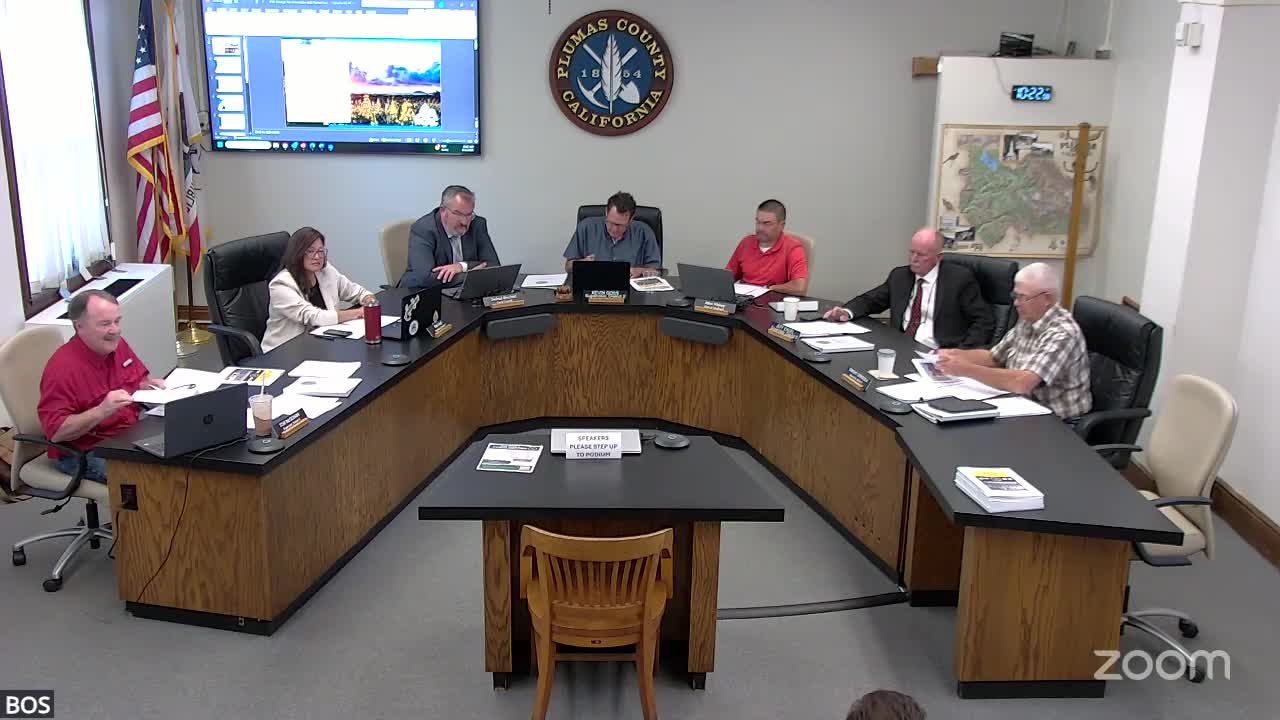
Craig Ferguson, senior vice president of the Rural County Representatives of California, told the Plumas County Board of Supervisors on Aug. 12 that RCRC's 2025—27 strategic plan prioritizes equitable access to broadband, housing and health services and increased forest resiliency for rural counties. "RCRC is the premier advocate and innovative service provider for rural counties in California," Ferguson said during a presentation to the board.
The plan covers state and federal advocacy, forest health and wildfire resilience, water and drought response, broadband deployment, and housing finance. Ferguson described several affiliated programs: Golden State Finance Authority (GSFA), a joint powers authority that provides down-payment assistance and homeownership financing; a broadband joint powers authority modeled on Utopia Fiber that would be owned by participating counties and offer open-access fiber; and a Golden State Natural Resources entity aimed at turning forest residue into marketable chips or pellets.
Ferguson said GSFA has helped thousands of families nationwide and described a down-payment assistance product aimed at recruiting and retaining county employees. On broadband, he said RCRC plans to issue bonds of roughly $100 million and that the California Public Utilities Commission has approved a $50 million backstop to support initial financing. "We're gonna issue debt," Ferguson said. "We're gonna dig in the ground." He described the broadband model as an "open access" network in which multiple service providers would lease capacity and consumers could choose among providers.
On forest resiliency, Ferguson said the earlier plan to build pellet-production facilities has been adjusted because global pellet prices fell; the program is now considering local chip production as a potentially more viable near-term option. He said RCRC and its affiliates are pursuing CEQA approvals and other steps to move facilities forward.
Board members and attendees asked how the programs would reach sparsely populated counties and how Plumas County could access services and financing. Ferguson encouraged local officials and department heads to contact RCRC for program details and noted some programs require partnerships with lenders, contractors and grant funders.
The presentation included questions and comments from county supervisors and members of the public that reflected local concerns about workforce retention, the state's role in last-mile broadband, and recycling and solid-waste regulations. Ferguson said RCRC is working on grant funding and partnerships and invited local leaders to pursue the programs through RCRC's affiliated JPAs and nonprofit entities.
The board did not take any formal action on the presentation; the item was informational.