County board denies Lightstar Renewables permit for 5-megawatt solar near Brisbane Road interchange
Loading...
Summary
The Grundy County Board voted to deny a special-use permit for a proposed 5-megawatt, ground-mounted solar installation on a 37-acre parcel near the Brisbane Road interchange after municipal opposition, economic-development concerns and legal questions about siting rules were raised.
The Grundy County Board voted to deny a special-use permit for a proposed 5-megawatt community solar array on a 37-acre portion of a 49-acre parcel in Aux Sable Township, rejecting the request by Lightstar Renewables in a roll-call vote that county staff recorded as 16–0 in favor of denial.
The proposal, presented to the board by county planner Al McDonald and by developer representatives, would have installed single-axis tracking PV modules, a central transformer pad and an overhead ComEd tap on a site the county found to meet setback and drainage requirements. The developer, Kyle McAdam of Lightstar Renewables, told board members that “one of the things that, you know, we really look for when we develop solar projects, is proximity to the electric grid,” and that an interconnection agreement with ComEd made the site “financially viable for this project.”
Board members and multiple outside speakers — including the Grundy Economic Development Council, the Grundy County Chamber and State Senator Sue Resin — argued the parcel is intended for highway-oriented industrial and commercial use around the I‑80 Brisbane interchange. Nancy Norton, president and CEO of the Grundy Economic Development Council, told the board, “Why would we build a $25,000,000 interchange to put solar development right next to a major national highway?” and described industrial development as producing substantially greater property-tax revenue and permanent jobs than a solar array.
Attorney Jim Hirsch, representing Lightstar, advised the board that the statutory language on siting and the so-called LaSalle factors are the subject of ongoing legal dispute and varying court rulings. Hirsch said the statute explicitly addresses regulation for commercial wind energy facilities and that courts have split on whether counties may apply the same LaSalle compatibility factors to solar projects; he urged the board to consider that legislative language and pending case law.
Several municipal leaders and business-organization representatives presented formal opposition. County staff noted the village of Manuka had filed a formal letter of opposition citing prior local planning and a decade-plus investment aimed at attracting “high-impact” industry at the Brisbane interchange; staff also summarized a letter from state Senator Chris Balcoma (as described to the board) that cited over $25 million of prior public investment intended for commercial/industrial use.
During board discussion members weighed landowner rights against long-term planning. Developer representatives said the parcel owner supported the solar lease (a 20-year lease with a five-year extension option) and that interconnection upgrades tied to the project would be required and could be beneficial for other uses. Several board members and speakers, including Senator Sue Resin, said they supported solar generally but opposed installation at this particular interchange site because it would conflict with decades of local planning and public investment.
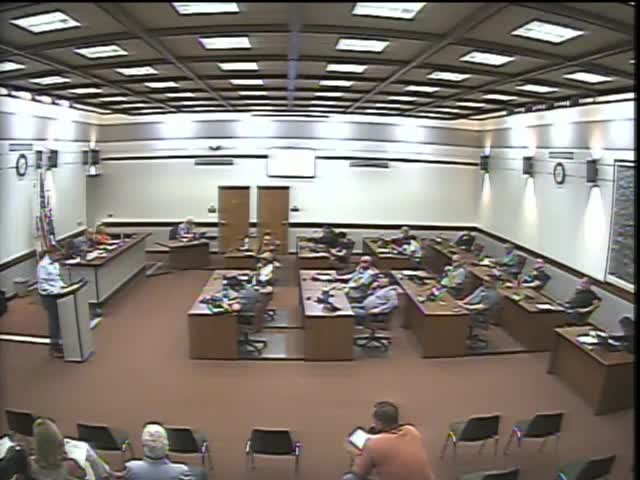
Motion and vote: County board member Chavoni moved to deny the special-use permit; a board member identified in the transcript as Deb seconded the motion. The clerk conducted a roll call; the record supplied to the board shows the motion to deny carried by a 16–0 vote. The denial was a formal board action; the transcript indicates the Zoning Board of Appeals had earlier issued a negative recommendation (4–0) while the county land-use committee had forwarded a positive recommendation to the full board (3–2). The denial this evening is the board’s final decision on the permit request at this meeting.
What the denial does and does not do: The board’s denial stops this permit application at the county level for this parcel; the transcript records that legal challenges or appeals have been filed in prior solar-related cases in the county and that competing court decisions exist in other jurisdictions. Attorney Hirsch noted litigation is a possible next step; Senator Sue Resin said she is pursuing legislation aimed at creating additional local controls for designated zones. The denial does not change zoning on the landowner’s other holdings nor does it preclude the owner from pursuing annexation, alternative siting, or other future proposals.
The county planner’s packet and the developer’s submittals were cited during the hearing and are retained in the county record; those materials included an interconnection agreement with ComEd, environmental reviews, a pollinator-friendly revegetation plan, and a road‑use agreement. Several municipal officials and economic-development organizations asked the board to preserve the interchange site for industrial/commercial development and to protect prior public investments.