
Planning commission continues two Friendly Hills variance applications to Sept. 15 for additional reports
Get AI-powered insights, summaries, and transcripts
Subscribe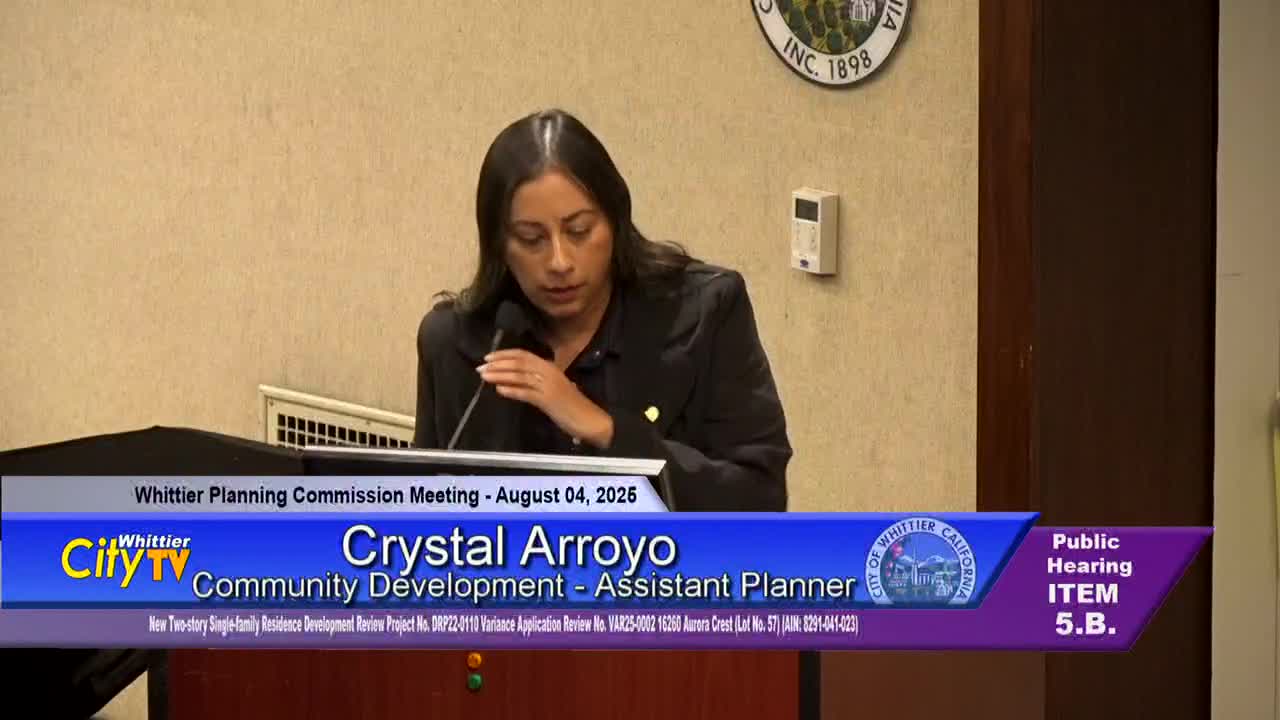
Summary
The commission continued development-review applications for two adjacent lots in Friendly Hills Estates that seek height and floor-area-ratio variances, citing a late attorney letter and need for technical reports; both items were continued to a date certain for additional review.
The Whittier Planning Commission continued two development-review and variance applications for adjacent lots in the Friendly Hills Estates gated community to a date certain, citing a late attorney letter and the need for additional technical reports.
Why it matters: The projects request deviations from Whittier’s development standards for height and floor-area ratio (FAR); because of the scale and the potential for precedent-setting variances in a hillside neighborhood, staff recommended additional analysis before the commission acts.
Staff presentation and project summary: Assistant planner Crystal Arroyo presented two side-by-side applications. Case DRP22-0110 and VAR25-0002 (Lot 57) proposes a three-story single-family residence with a finished basement and attached two-car garage; the overall height measured from the highest roof point to the lowest adjacent grade was listed as 41 feet 10 inches, while the façade as viewed from Aurora Crest Drive would present near 30 feet 11 inches. Staff presented floor-area details for Lot 57 showing the finished basement (2,164 sq ft), ground floor (2,828 sq ft) and second floor (2,496 sq ft), and staff said an updated plan revision corrected a previously reported FAR; staff reported the revised FAR for Lot 57 would be about 69% (the prior plan set showed 77% and staff said that number was incorrect).
A second application for Lot 56 (DRP/VAR 5c / VAR25-0001) requested similar height deviations and included a variance request (applicant-amended) to increase the allowable FAR (the applicant requested FAR increases on the revised plans). Staff noted the architect later revised plans to convert portions of the basement to an ADU/Jr. ADU in one iteration, which affects FAR calculations; staff recommended continuation to allow time to review those revisions and additional technical reports. Staff also said it had received a late 11‑page letter from Matrix Oil Corporation raising issues requiring professional review; that letter was a primary reason for the recommended continuance.
Public comment and applicant response: The architect (identified in the transcript as David Kaye/Key) confirmed setbacks and clarified that the rear setback is 10 feet (the transcript shows the architect said the “approximate” notation was a typo). Public commenters raised concerns unrelated to technical project specifics (a number of attendees repeated the earlier public-comment complaints about Vice Chair Quirk and immigration-enforcement issues); one commenter urged the commission to focus on community protection from ICE activity rather than development items. Another public commenter and a caller in the web queue said the city should rely less on variances and consider code amendments if variances are frequent.
Action: The commission moved and seconded motions to continue both items to the September 15 meeting date certain. Roll-call votes were recorded in favor of the continuances (commissioners listed in the transcript voted yes), and both items were continued to 2025-09-15 for additional review and reports.
Discussion versus decision: The transcript records detailed staff information and commissioner questions about FAR calculations, rear setbacks and how the proposals relate to neighborhood massing. No approvals or denials were made; the decisions recorded in the transcript were continuances to allow time for supplemental materials and technical review.