Get Full Government Meeting Transcripts, Videos, & Alerts Forever!
Get email alerts on the Annexation topic
No spam. Unsubscribe anytime.
Council debates annexation and sphere-of-influence expansion; no action taken
Summary
Staff outlined how annexation and sphere-of-influence changes work, including LAFCo review, environmental analysis under CEQA, and likely landowner-driven costs; councilors expressed interest but generally agreed to defer detailed work until after near-term priorities such as roads are addressed.
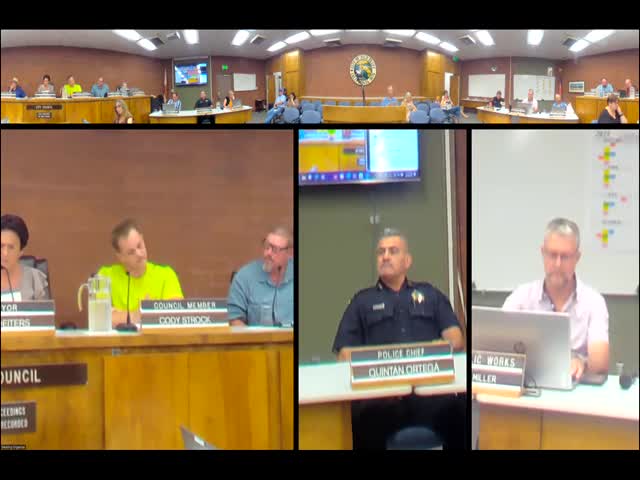
City Manager Westbrook briefed the Red Bluff City Council on Aug. 1 about annexation basics, the sphere of influence (SOI) and the practical steps the city must follow to bring new territory into city limits.
Westbrook said annexations must be contiguous to existing city boundaries and be inside the adopted SOI. He explained that most annexations are initiated by landowners seeking municipal services for development, that the local agency formation commission (LAFCo) reviews reorganization proposals, and that environmental analysis under the California Environmental Quality Act (CEQA) may be required; the scale of analysis ranges from a negative declaration to a full environmental impact report depending on the project.
He told council members that the city’s existing SOI likely provides capacity for several decades and that expanding the SOI or pursuing annexation would typically involve environmental review and, in many cases, costs borne by landowners unless the city initiated the annexation. Westbrook cautioned that LAFCo and affected voters can influence or block an annexation: landowners may initiate proposals and voters in the affected area can oppose annexation via the voter-removal provisions described.
Council members discussed potential focus areas mentioned during the meeting—Antelope Boulevard, the area south of the airport and pockets of county-managed neighborhoods adjacent to city streets. Speakers said annexation could make it easier to attract businesses if the city signaled it was “open for business,” but several councilors and the mayor said they wanted to prioritize other projects (notably street repairs) and did not want to commit staff to costly annexation studies immediately.
No motion or vote was taken; council members generally supported reserving the issue for later study. Several members suggested returning to the subject after the first of the year or after progress on the city’s road funding efforts, so the council can tie any annexation outreach to demonstrated infrastructure investment.