Planning commission approves 40‑lot Byrd small‑lot subdivision at 5291 Concord Boulevard
Loading...
Summary
The Concord City Planning Commission adopted resolution 25‑11PC, approving a 40‑lot small‑lot subdivision (Byrd Subdivision) with required open space, bioretention, tree removal and design conditions; commissioners and residents debated drainage, parking, and Helena Drive access under SB 330 constraints.
The Concord City Planning Commission voted 5–0 to adopt resolution 25‑11PC, approving the Byrd Subdivision: a 40‑lot small‑lot residential development on a roughly 5‑acre parcel at 5291 Concord Boulevard. The approval includes a vesting tentative map, a planned development use permit under the city’s small‑lot rules (Chapter 18.155), design and site review, and a tree removal permit for eight protected trees.
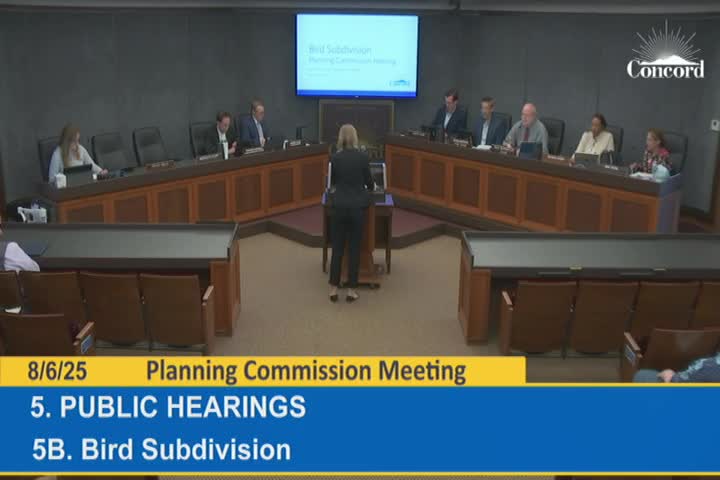
Staff planner Meredith Repp opened the public hearing by highlighting the constraints of the state Housing Accountability Act (SB 330), which the city must apply to projects with two or more residential units. “This law states that projects that meet all objective design standards cannot be denied unless there are specific adverse health or safety impacts,” Repp said, noting that the project was submitted with full elevations in February 2024 and was deemed complete in August 2024. Staff found the project consistent with the general plan density (10 units per net acre), the small‑lot development chapter, and the general plan EIR; staff recommended approval with conditions, including a revised condition requiring the homeowners association (HOA) to secure and maintain the narrow strip between a retaining wall and rear‑yard fences for Lots 34–40.
Why it matters: the proposal adds 40 single‑family small lots in an area of northeastern Concord zoned RS‑10, bringing state law (SB 330) limits on discretionary review into play. The project is intended to increase housing supply and follows the city’s small‑lot standards intended to produce smaller, family‑oriented homes with private yards and shared open space.
Project highlights and conditions - Site and yield: approximately 5 acres at 5291 Concord Boulevard; vesting tentative map creating 40 small single‑family lots and private internal streets. - Density and housing mix: roughly 10 units per acre; four two‑story floor plans ranging from about 1,800 to 2,100 square feet; two deed‑restricted affordable units required by city inclusionary policy. - Lot sizes: three lot type templates with average lot size about 3,700 square feet (range provided in staff packet; developer materials show individual lot sizes between roughly 3,300 and 5,000 square feet). - Open space and stormwater: a required 7,000‑square‑foot common open space with playground and picnic facilities; approximately 0.44 acres of bioretention for stormwater treatment adjacent to Concord Boulevard. - Parking and circulation: staff reported 172 on‑site parking spaces plus 20 new on‑street spaces along Concord Boulevard (total 192); the applicant presented an alternate breakdown (145 garage/driveway spaces, 27 on‑street within the community, and 12 on Concord Boulevard). The transportation analysis estimated about 32 morning peak‑hour trips and 42 evening peak‑hour trips added by the development. - Trees: eight protected trees proposed for removal, with 28 replacement trees proposed against a required 24 replacements. - Access: primary vehicular access from Concord Boulevard; Helena Drive would be limited to emergency access (bollards preferred by staff over a full gate) — the applicant previously proposed a gate but staff noted city preference for bollards and that final details require coordination with engineering and fire and coordination with third‑party landowners for the Helena frontage. - Conditions of approval: include engineering checks on drainage and sewer capacity, TIA recommendations (stop signs/markings, ADA ramps and crosswalks), DRB conditions (downspouts, materials termination, architectural treatments on side elevations, short‑term bicycle parking and waste receptacles in common open space), HOA maintenance responsibilities, and a revised condition requiring the HOA to secure and maintain the narrow area adjacent to Lots 34–40 with locked gated access.
Traffic, drainage and state law context Transportation staff explained the trip‑generation methodology using the Institute of Transportation Engineers trip generation rates and concluded that the project’s added trips would not cause studied intersections to exceed the city’s standard of acceptable operation. Transportation consultant Aaron Elias said the study distributed the project trips across nearby arterials and reviewed two intersections; he described the added load as small enough not to warrant a new traffic signal.
Engineering staff said that stormwater and sewer capacity checks are required as permit conditions. Assistant civil engineer Elizabeth Callahan noted the project ties into the nearest accessible storm drain on Concord Boulevard and that the applicant must submit drainage calculations for a 10‑year storm so the city can confirm the downstream storm system will not be overwhelmed. Repp and engineering staff told the commission that if sewer or storm capacity were inadequate, the applicant would be required to upsize lines or make other improvements as part of permit compliance.
Public comments and applicant response Neighbors raised concerns about drainage, local traffic patterns and the Helena Drive emergency access point. Resident Dale Meyer asked explicitly, “Where’s this stormwater gonna go?” and urged written engineering confirmation because the neighborhood has a history of drainage problems. Several residents living on or near Helena Drive and Paul Lane said they feared spillover parking, increased traffic, and safety risks for children in that dead‑end neighborhood.
Developer representatives and counsel said they sought to avoid a new traffic connection into the adjacent neighborhood and that they had accepted staff’s recommendation to use bollards for emergency access at Helena Drive rather than a vehicle gate. Applicant representative Carrie Watt (DeNova Homes) said the development “is designed for families” and emphasized the project's private streets and common open space; she also said the developer would provide HOA contact information to adjacent neighbors for maintenance and access questions.
Commission discussion and outcome Commissioners asked technical questions about drainage, sewer capacity, parking enforcement in garage versus driveway, lighting spill, and maintenance of the narrow area between the retaining wall and the rear‑yard fencing for Lots 34–40. Repp proposed revised language (condition 40) requiring HOA maintenance and a locked gate to secure that narrow area; the applicant agreed to provide an HOA contact for adjacent neighbors. Legal counsel reminded the commission that under the Housing Accountability Act, denial must be based on a high evidentiary bar — specific, adverse and unavoidable impacts to public health or safety tied to objective written standards — and staff concluded the findings for approval were met.
A motion to adopt resolution 25‑11PC carried on a 5–0 vote. No commissioner recorded opposition.
What happens next The entitlement approval allows the applicant to proceed to final map, construction drawings and building permits, subject to engineering plan checks, sewer and storm calculations, and the design review follow‑ups required in the conditions. City staff said technical documents and the traffic impact analysis are available in the project public record and in the staff report packet.
Notes: quotes and attributions in this article are drawn from the planning commission hearing record. Where the transcript recorded different numeric breakdowns (staff vs. applicant) those figures are noted with their source.