Get Full Government Meeting Transcripts, Videos, & Alerts Forever!
Get email alerts on the Biomass Policy topic
No spam. Unsubscribe anytime.
Lawmakers pressed to close biomass loophole, citing air‑quality and public‑health risks in Springfield
Summary
Sen. Adam Gomez and municipal and public‑health witnesses told the Joint Committee on Telecommunications, Utilities and Energy that woody biomass should be removed from clean‑energy incentives and from municipal greenhouse‑gas accounting to avoid subsidizing polluting facilities and to protect air quality in environmental‑justice communities.
State and local officials, public‑health experts and environmental groups urged the Joint Committee on Telecommunications, Utilities and Energy to remove woody biomass from Massachusetts' clean‑energy incentives and municipal greenhouse‑gas accounting, saying the fuel produces harmful particulate emissions and can be used to finance polluting facilities.
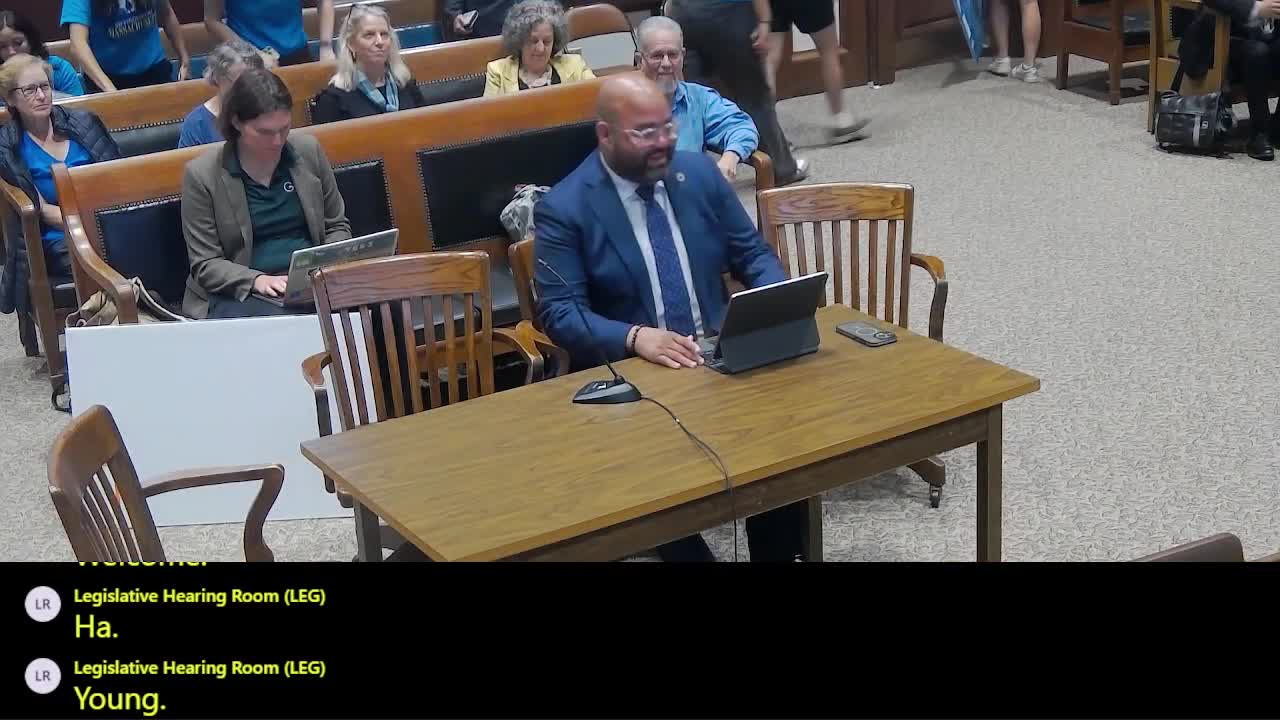
"This is not an abstract policy issue. This is about air our children breathe," Sen. Adam Gomez told the committee while urging passage of S.2288 and companion bills. Gomez said the 2021 climate roadmap law created a municipal lighting plant greenhouse‑gas standard but, he said, a loophole currently allows woody biomass to be treated as a non‑carbon emitting source unless the Legislature acts before Jan. 1, 2026.
Local officials described long fights with developers over a proposed Palmer Renewable Energy biomass facility in East Springfield. Michael Fenton, president of the Springfield City Council, said Springfield has opposed the project for more than a decade and that the city and its residents "suffer from some of the worst air quality standards" in New England. Fenton and Councilor Tim Allen told the panel that a biomass facility in East Springfield would worsen public health in a city they said already experiences high asthma rates.
Public‑health witnesses documented particulate matter concerns. Jessica Collins, executive director of the Public Health Institute of Western Massachusetts, said PM2.5 exposure is linked to asthma, chronic obstructive pulmonary disease and cardiovascular disease and that Springfield has among the state's highest PM2.5 monitor readings. "Biomass burning facilities emit high concentrations of particulate matter," Collins said.
Environmental groups and frontline organizers argued the bills would protect environmental justice communities. James McCaffrey of Mass Power Forward described urgency tied to a pending 2026 deadline: if the statutory classification stands, municipal utilities could enter long‑term power purchase agreements that would effectively subsidize woody‑biomass facilities.
Proponents cited state and federal sources: the 2021 climate roadmap, the Alternative Energy Portfolio Standard (APS) and the Renewable Portfolio Standard (RPS) as existing statutes under which biomass remains problematic, and data from the U.S. Environmental Protection Agency and the American Lung Association on PM2.5 and asthma prevalence were cited by witnesses. Catherine Lang of the Conservation Law Foundation summarized the bills: S.2288 would prevent municipal light plants from counting woody biomass toward the MLP greenhouse‑gas standard; S.2287 would bar commercially scaled wood‑fueled systems from eligibility under the APS.
Not all witnesses opposed all forms of wood energy. Chris Egan of the Massachusetts Forest Alliance said modern pellet boilers and chip systems with electrostatic precipitators emit far less particulate matter than older wood stoves and argued that properly controlled systems and incentives for emissions controls should be considered; he said the APS proposals would primarily affect a relatively small number of systems and estimated the ratepayer cost as minimal. Egan's testimony framed a narrower policy approach to incentivize emission controls rather than blanket bans.
Supporters asked the committee to report the bills favorably and quickly; sponsors emphasized protecting public health and preventing the public financing of a project in Springfield. Opponents urged careful drafting to avoid unintended effects on modern wood‑heating systems and to account for forest management and small system economics.
The committee record contains scientific and public‑health testimony, municipal accounts of long local fights over siting and repeated calls for legislative action before statutory deadlines take effect.