Get Full Government Meeting Transcripts, Videos, & Alerts Forever!
Get email alerts on the Battery Storage topic
No spam. Unsubscribe anytime.
Students and industry push Massachusetts to study grid battery storage and expand distributed storage programs
Summary
High school students and industry witnesses urged the Joint Committee to back S.2325, a Clean Energy Center-led study of battery storage, and to authorize programs that would better deploy distribution-connected batteries to reduce outages and lower peak-driven costs.
High-school students, developers and grid analysts told the Joint Committee on Telecommunications, Utilities and Energy that Massachusetts should accelerate planning and programs for battery energy storage to strengthen reliability and lower costs.
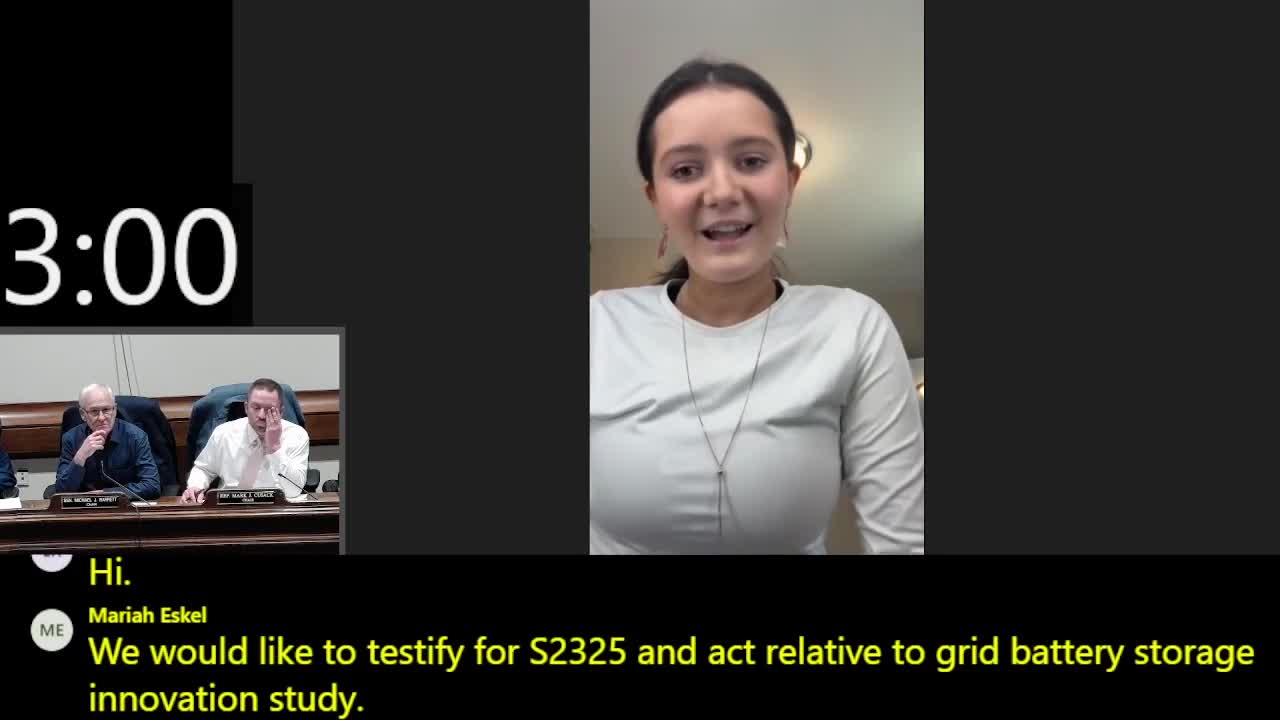
Two students who said they helped develop S.2325 asked the committee to authorize a formal study, led by the Massachusetts Clean Energy Center, to identify technologies and strategies for deploying grid-scale and distributed battery storage, including input from researchers, utilities and private industry. "Battery storage allows us to store excess electricity when generation is high and deliver it when it's most needed," Mariah Eskel said, urging the committee to support the bill.
Industry witnesses described near-term opportunities for distribution-connected batteries — smaller, local storage systems that can shave peaks on the distribution network — and urged the committee to adopt a retail-level procurement or incentive option. Jessica Robertson, director of policy and business development at New Leaf Energy, said distribution-connected storage can “smooth out those peaks within the distribution system more locally before we start drawing on the transmission system,” producing rate-payer savings by reducing transmission and capacity-related charges.
Sean Burke, a developer, told legislators that a program modeled on existing retail incentives could dispatch batteries specifically during peak hours and deliver immediate savings; he estimated that a single five-megawatt distribution battery could have produced roughly $1 million in system savings during the year’s peak events if dispatched to reduce transmission and capacity costs. Robertson and Burke noted that the Clean Peak program and the 83E storage procurement provide foundations, but that additional retail-focused mechanisms could better capture benefits from distributed assets.
The committee heard that a coordinated study (S.2325) would guide policy and investment choices and that tailored procurement tools — including an option in H.3542/S.2282 to create a retail storage program — would help capture the unique value of distributed storage.
No vote was taken; members asked for written comments and for staff to show which provisions in the sponsor bills were unique and which overlapped with the governor’s affordability package.
Why it matters: as intermittent resources and electrification increase demand, battery storage — both grid-scale and distributed — can reduce outages, blunt price spikes and create local jobs. A state-led study and targeted retail procurement could accelerate deployment and better align incentives to local grid needs.
What’s next: the committee requested written testimony and a section-by-section comparison of overlapping provisions.