Get Full Government Meeting Transcripts, Videos, & Alerts Forever!
Get email alerts on the Taxpayer Protection Act topic
No spam. Unsubscribe anytime.
Unions and public engineers push bills to strengthen Taxpayer Protection Act and curb outsourcing
Summary
State employees, union leaders and the organization MOSES urged the committee to strengthen enforcement of the Taxpayer Protection Act and to expand it to include engineering and design services, citing the 2023 UMass Amherst privatization of advancement positions and recurring outsourcing costs in public construction.
State employees, unions and public‑sector engineering groups urged the Joint Committee on State Administration and Regulatory Oversight to strengthen the Taxpayer Protection Act and to expand its reach to include engineering, design and other services currently outsourced to private consultants.
Multiple witnesses described the 2023 privatization at UMass Amherst, where more than 100 state positions in advancement were privatized despite a May 11, 2023 letter from the state auditor advising the university that the proposed privatization violated the Taxpayer Protection Act. Jason Johnson, a UMass employee and union steward, said the state auditor’s final determination (issued May 31, 2024) confirmed that UMass violated the law. Johnson urged S.2104/H.3380, which would add enforcement mechanisms and remedies to ensure the law can be enforced when agencies attempt privatization.
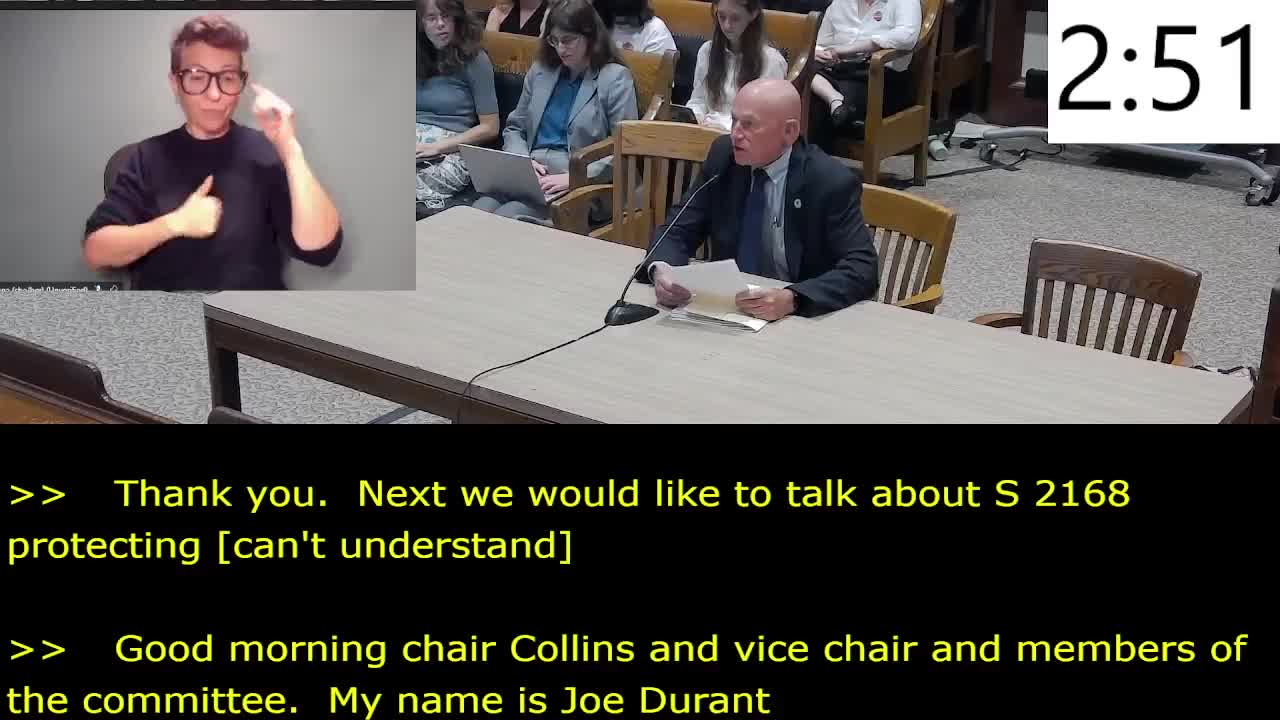
Representatives of MOSES (the union for Massachusetts public engineers and scientists) and public‑sector maintenance and trades unions urged the committee to support Senate Bill 2168 (and related proposals) to explicitly include engineering and design services under the Taxpayer Protection Act. Joe Durant, representing MOSES, said the Commonwealth spends more than $150 million a year on outsourced engineering and design services and that outside consultants sometimes charge three times the in‑house cost. He argued that insourcing many engineering tasks could save taxpayers millions.
Union witnesses described the human effects of sudden privatization: months of uncertainty, lost benefits and disrupted careers. Kyle Chambers and Andrew Gorey, representing UMass staff unions, said privatization proceeded despite auditor warnings and that current law lacks teeth to restore jobs or impose penalties when agencies ignore the auditor’s findings.
Committee members asked about enforcement pathways and remedies; witnesses urged statutory change to provide explicit remedies, oversight and penalties when agencies violate the law. No committee vote was taken; supporters provided written exhibits and recommended statutory language for enforcement and expanded scope.
Why it matters: Testimony framed the bills as protecting taxpayers and preserving institutional capacity in public colleges, transport and construction oversight; advocates said expanded oversight would lower long‑term costs and reduce reliance on expensive private consultants.
Next steps: Committee staff may request copies of the auditor’s determination and cost comparisons used by MOSES and UMass unions to develop model enforcement language.