Get Full Government Meeting Transcripts, Videos, & Alerts Forever!
Get email alerts on the Vehicle Miles Tax topic
No spam. Unsubscribe anytime.
Economists Tell Revenue Committee a Vehicle‑miles Tax Could Stabilize Massachusetts Transportation Revenues
Summary
Researchers from MIT and Tufts presented analysis showing a revenue‑neutral swap from the gasoline tax to a vehicle‑miles traveled (VMT) tax could stabilize transportation funding while affecting regions and income groups differently; they recommended pairing a VMT charge with enhanced EV subsidies to avoid discouraging electrification.
BOSTON — Economists and transportation experts told the Joint Committee on Revenue that a vehicle‑miles traveled (VMT) tax could replace eroding gasoline tax revenue and produce a more stable funding base for roads and transit, but they urged pairing a VMT charge with stronger electric‑vehicle incentives to preserve climate goals.
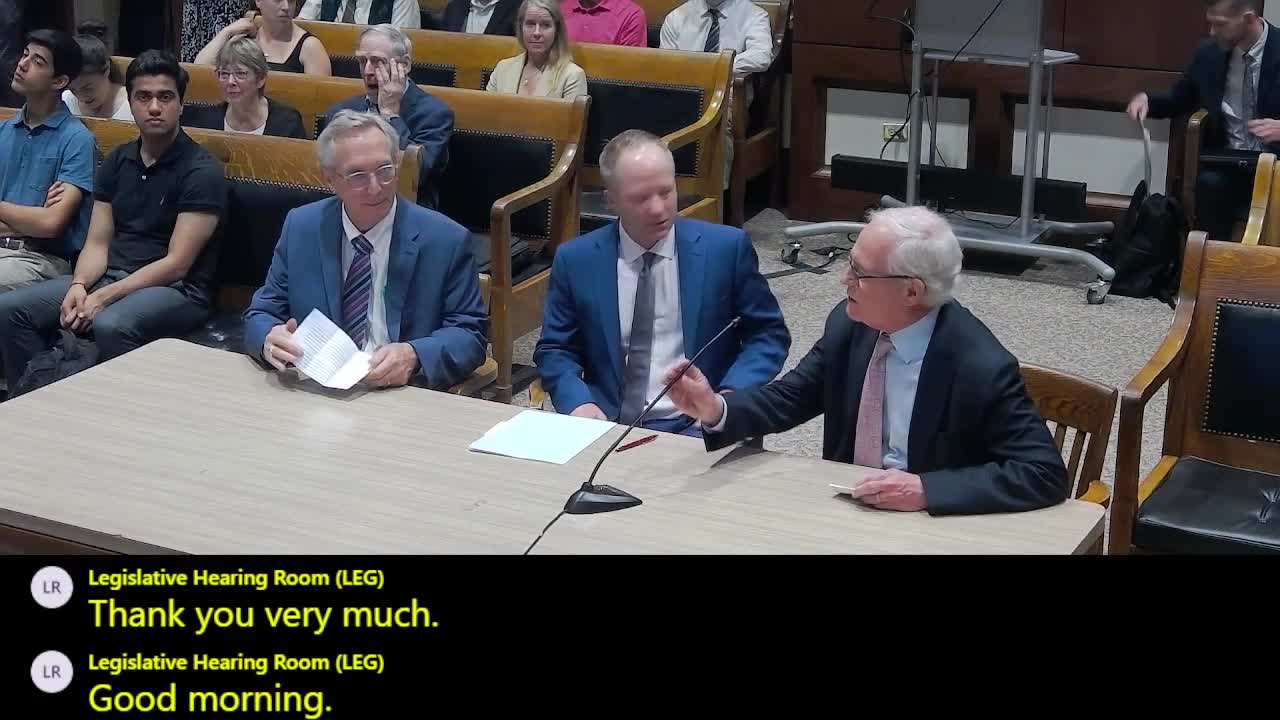
Senator Mike Barrett introduced the witnesses, including Professor Max Auffhammer (note: testimony included Professor Metcalfe and Professor Christopher Knittel), who explained that rising fuel economy and electric‑vehicle adoption have reduced gasoline tax receipts. Professor Metcalfe said vehicle miles driven better align benefits and road wear with taxation and that, on balance, a broad‑based VMT tax can be justified both on a “user pays” basis and because many driving‑related externalities scale with miles driven.
Professor Knittel and Metcalfe presented modeling, saying a revenue‑neutral swap from the state’s 24‑cent gasoline excise to a VMT tax would have modest net impacts statewide but uneven local effects. Their analysis indicated lower‑income households in many census tracts could gain under a swap because wealthier households tend to own more fuel‑efficient cars; northern and western Boston suburbs and some urban tracts could pay more, while rural Central and Western Massachusetts could benefit.
Committee members raised concerns about administration — which agency would collect mileage charges, how to measure miles for out‑of‑state drivers, privacy and billing shocks to EV owners who today pay little or no fuel tax. Witnesses said Massachusetts’ annual vehicle inspection system offers an administrative vehicle for mileage reporting, and recommended smoothing payments over time and pairing VMT with larger EV purchase subsidies to protect electrification goals.
Witnesses noted pilots in other states (Oregon, Hawaii) provided lessons and that Massachusetts could design a phased system with exemptions or credits for low‑income households. No vote or action was taken.