Get Full Government Meeting Transcripts, Videos, & Alerts Forever!
Get email alerts on the Unsolved Homicides topic
No spam. Unsubscribe anytime.
Survivors and advocates push statewide office, task force to review unsolved homicides
Summary
A coalition of survivors, the Louis D. Brown Peace Institute and students from Northeastern urged the committee to create an Office of Unsolved Homicides and a statewide task force (S.2177/S.2174) with petition processes, a toll‑free tip line, a public database and funding.
Boston — Survivors of homicide victims, the Louis D. Brown Peace Institute and law‑student researchers urged the Joint Committee on State Administration and Regulatory Oversight to back S.2177 and S.2174, legislation to establish a statewide Office of Unsolved Homicides and a corresponding task force.
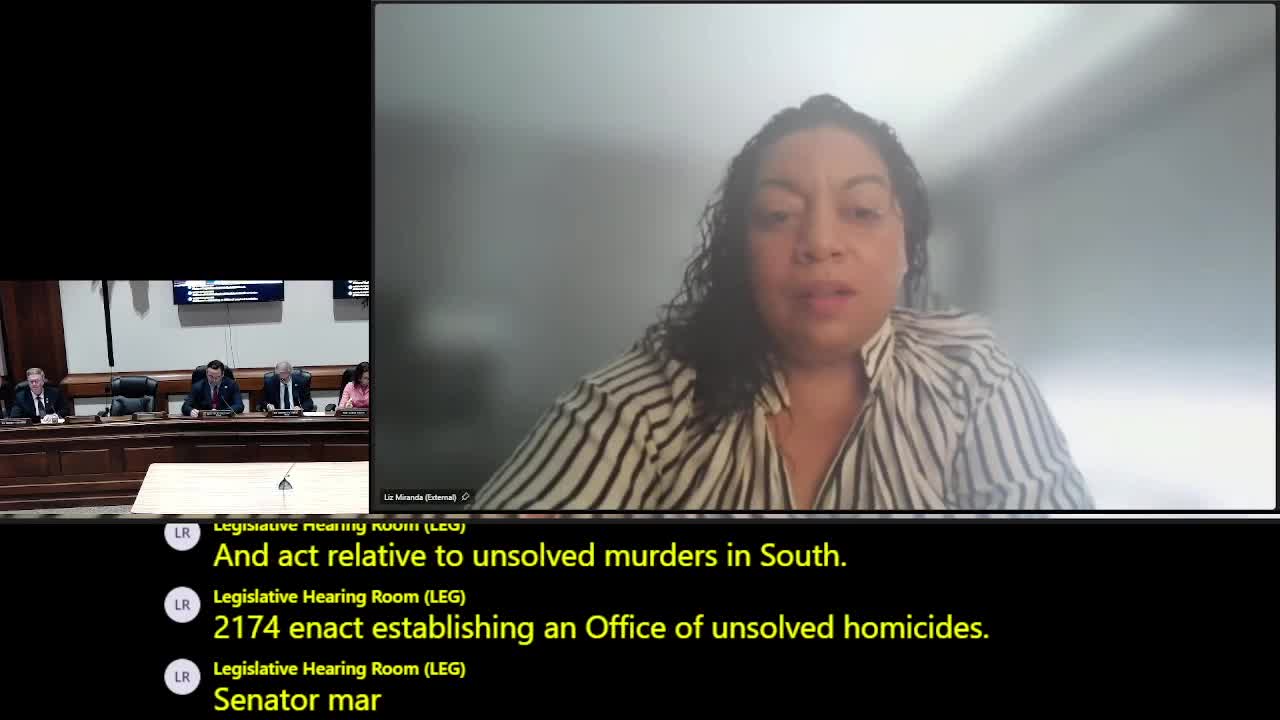
Senator Liz Miranda, sponsor of S.2177, framed the bills as measures to provide accountability, review and resources for the more than 1,000 unsolved homicides in Boston and thousands statewide. “This is not an abstract policy. It's about real people and real families,” she said, outlining a petition process that would permit families to request a case review after three years of inactivity and receive a written response within 90 days.
Representatives of the Louis D. Brown Peace Institute described survivors’ experiences of inconsistent communication and limited resources. Alexandra Sherry Durellis said the institute’s survivor “ambassadors” meet regularly and that a Northeastern Law student study found Boston’s unsolved case squad had fewer than 10 officers to handle more than 1,700 cases.
Law students from Northeastern presented research that identified three recurring problems: inconsistent communication with families, limited transparency and uneven investigative attention — with cases involving forensic evidence (DNA) prioritized in practice. Their report recommended a statewide database, regular reporting, formal family petition rights, regional teams to collaborate on reinvestigations and an initial fund to support task‑force work.
Survivors gave emotional testimony. Natasha Carrington described how her son’s 2008 homicide remains unsolved and said she was not informed when the city moved the case to “cold case” status after 10 years. Arminda Baptista and others described ongoing grief compounded by lack of answers; the witnesses called for a survivor‑centered process and resources to sustain investigative efforts.
Supporters proposed an initial $10 million appropriation to seed the unsolved‑homicide task force fund, a statewide anonymous tip line and an online public database of unsolved cases to promote transparency and generate leads. Public‑safety advocates argued the proposals could also serve as a violence‑prevention strategy by addressing unresolved harms and rebuilding public trust.
Ending — The committee heard extensive testimony from survivors, advocates, municipal stakeholders and law students. No committee vote was recorded during the hearing; sponsors requested a favorable report and additional funding consideration from the legislature.