Get Full Government Meeting Transcripts, Videos, & Alerts Forever!
Get email alerts on the Military Emergency Management topic
No spam. Unsubscribe anytime.
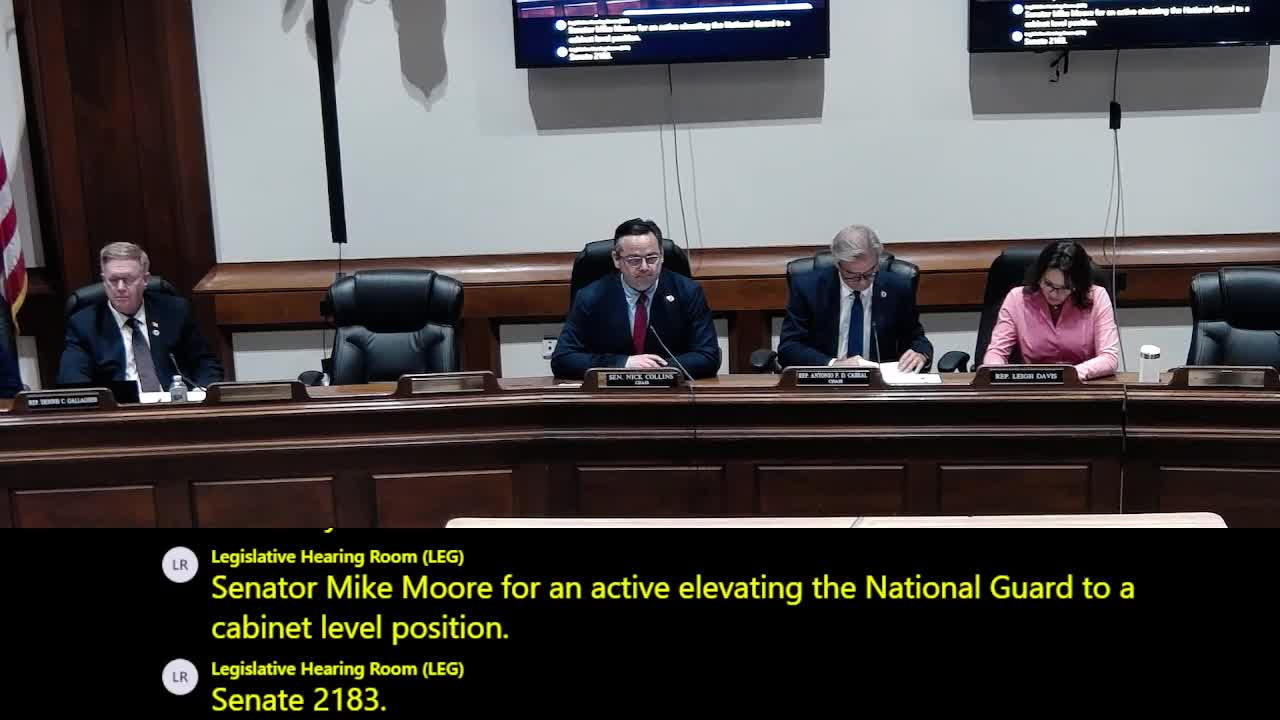
Senators and National Guard advocates press committee to elevate Guard to cabinet post
Summary
Senators Mike Moore and John Vilas and representatives of the Massachusetts National Guard Association urged the committee to advance S.2183 to make the adjutant general a cabinet‑level official reporting directly to the governor.
Boston — Two senators and the Massachusetts National Guard Association urged the Joint Committee on State Administration and Regulatory Oversight to report S.2183 favorably so the Massachusetts National Guard’s adjutant general reports directly to the governor.
Senator Mike Moore described S.2183 as “elevating the National Guard to a cabinet level position” and argued that direct reporting to the governor would remove a bureaucratic layer and improve speed and transparency in emergencies. “Out of 50 states, Massachusetts is sadly the only state that doesn't have the National Guard as a direct report to the governor,” Moore said.
Senator John Vilas, who also testified in favor, recounted operational and humanitarian missions the Guard has performed and described past communication breakdowns between local officials and Guard leadership. Vilas referenced the aftermath of outbreaks at soldiers’ homes and said a lack of timely information had “haunted” him: “We never got that request,” he told the committee about a prior plea for Guard assistance in a crisis, arguing that such failures point to the need for a clearer chain of command.
Matthew McKenna, executive director of the Massachusetts National Guard Association and a retired Guard member, presented organizational context and data. He said the current reporting structure — in which the adjutant general reports through the Executive Office of Public Safety and Security (EOPS) and a state homeland‑security adviser — places two administrative layers between the Guard and the governor. McKenna noted most states (52 of 54 Guard/territory organizations) have the adjutant general report directly to the governor and added the Guard’s budget is predominantly federally funded.
Committee members asked technical questions about federalization of Guard forces (Title 10 vs. Title 32) and whether a reporting change would affect federal control. Senator Vilas and others discussed the difference between state‑activated and federally‑activated Guard missions and said federalization remains possible under existing law; proponents argued the bill addresses state‑level readiness, coordination and planning rather than federal authority.
Ending — Witnesses asked for a favorable report; the committee did not record a vote during the hearing and signaled it plans follow‑up conversations, including with the governor’s office and Guard leadership, to clarify operational details.