Get Full Government Meeting Transcripts, Videos, & Alerts Forever!
Get email alerts on the Infrastructure Sewer Separation topic
No spam. Unsubscribe anytime.
Lowell officials ask committee to approve Article 97 easements to speed $160M sewer‑separation project
Summary
City of Lowell and state witnesses told the committee H.4183 is needed to grant easements across state parkland so Lowell can secure SRF funding and proceed with a central sewer‑separation project estimated at $160 million.
Boston — City officials and their lawyers told the Joint Committee on State Administration and Regulatory Oversight they need a narrowly drawn Article 97 authorization so the city of Lowell can complete permitting and obtain state SRF loans for a central sewer‑separation project.
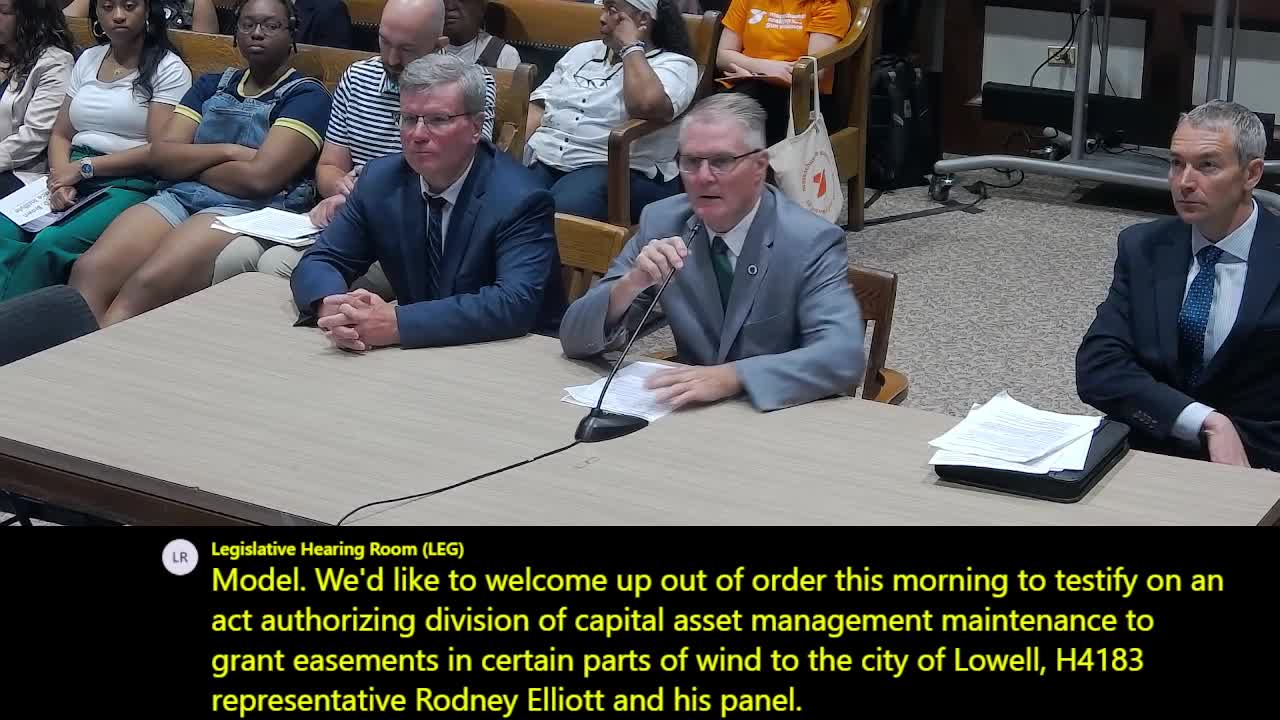
Representative Rodney Elliott, who sponsored H.4183, said the bill authorizes the Division of Capital Asset Management and Maintenance to grant easements to the city of Lowell to locate an outfall and other drainage infrastructure in limited state‑managed parkland. “We need these easements in order to proceed with… applications for state SRF money,” Elliott said.
Aaron Fox, director of the Lowell Regional Wastewater Utility, described the project as a multi‑phase effort with a total estimated cost of $160,000,000 for central sewer separation. He told the committee the project would reduce combined sewer overflow (CSO) discharges to the Merrimack River by about 59,000,000 gallons per year from one highly urbanized neighborhood and help the city meet a federal consent decree.
“As you know, state property, there's different divisions that has control,” said John McKenna, first assistant city solicitor for Lowell, describing the Article 97 process and the need to coordinate with the Department of Conservation and Recreation (DCR) and other state agencies. McKenna said the easement is for underground pipe outfalls and that appraisal work and proposed Riverwalk improvements will accompany any Article 97 approval.
Committee members probed environmental and community impacts. Senator Kennedy and others asked whether the outfall would require removing or impairing public park access; witnesses said the Riverwalk would remain and that the easement footprint is narrow (roughly a 10‑foot width where the outlet crosses a walkway).
Vice Chair Tyler and other members pressed the city on equity and minority‑business participation in construction. Fox said the project team had engaged the neighborhood through multiple public meetings and would meet minority‑business requirements in the construction procurement process under Chapter 30B; the city’s vendor and contracting priorities were described as a high local priority though specific subcontracting terms were not finalized until funding and contracts are secured.
Supporters emphasized the project is on a critical path to avoid federal enforcement penalties under the consent decree, protect downstream communities, and improve water quality and waterfront recreation value across the Merrimack River corridor.
Ending — Committee members indicated they would consider the Article 97 request carefully; H.4183 was presented for committee consideration and no final committee vote was recorded during the hearing.