Get Full Government Meeting Transcripts, Videos, & Alerts Forever!
Get email alerts on the Property Tax Relief Seniors topic
No spam. Unsubscribe anytime.
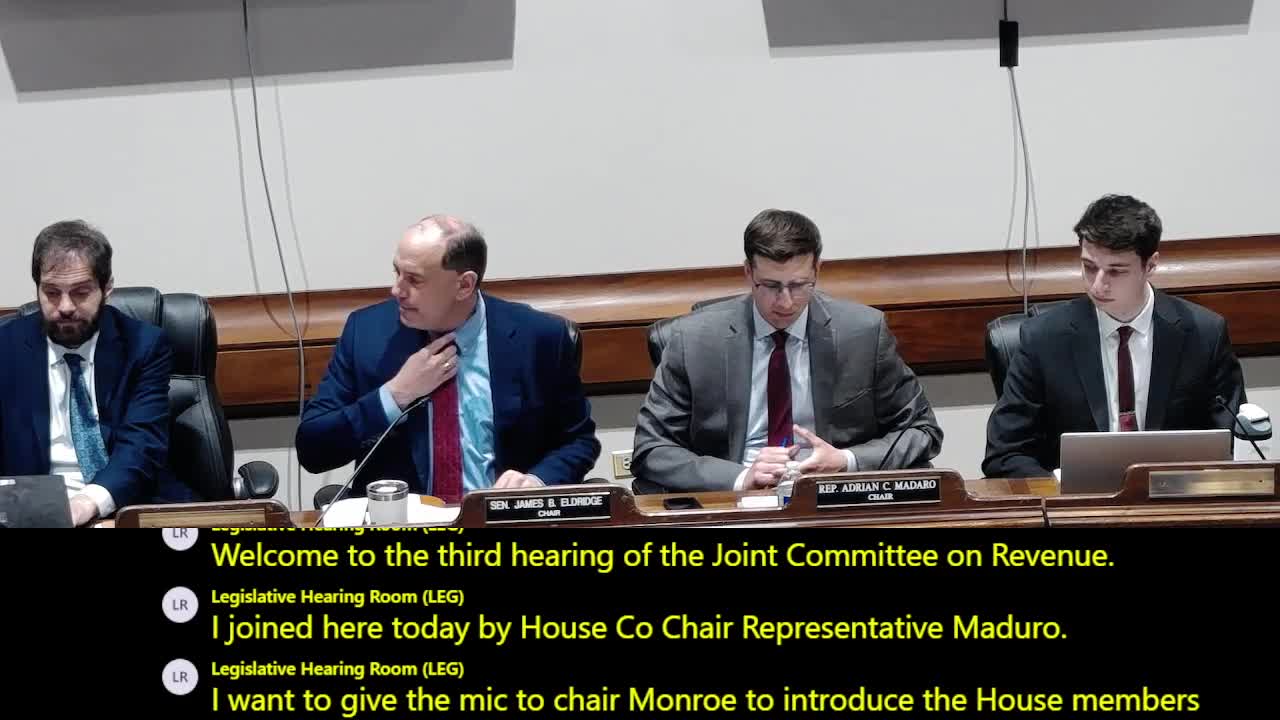
Joint Committee on Revenue hears proposals to ease property-tax burden for seniors and people with disabilities
Summary
Lawmakers, municipal officials and senior advocates on the Joint Committee on Revenue heard testimony on a slate of bills meant to reduce property-tax and fee burdens for older adults and people with disabilities, including measures to stop annual refiling for exemptions, raise circuit-breaker eligibility limits and expand local options for exemptions or deferrals.
Boston — Lawmakers, municipal officials and senior advocates on the Joint Committee on Revenue heard testimony on a slate of bills meant to reduce property-tax and fee burdens for older adults and people with disabilities, including measures to stop annual refiling for exemptions, raise circuit-breaker eligibility limits and expand local options for exemptions or deferrals.
The committee accepted oral testimony and invited written testimony by email; the chair said the deadline for written submissions on the bills is Monday, June 30. Committee members also asked witnesses questions about program integrity and implementation.
Why it matters: Witnesses said rising home values in Greater Boston and across the Commonwealth are outpacing many seniors’ fixed incomes, pushing some homeowners toward financial insecurity or the prospect of leaving long-established neighborhoods. Proponents called the bills a set of practical tools to help older adults remain in their homes.
What was proposed and who testified: Representative Bill McGregor filed House Bill 3,968, which would eliminate the requirement that seniors and people with disabilities refile annually for certain property-tax exemptions, making exemption status permanent unless changed. Representative John Moran filed House Bill 3,198 to raise the home-valuation cap used in the senior circuit-breaker tax credit from $1,100,000 to $1,500,000 and to index income and credit limits to the cost of living.
Emily Shea, Age Strong commissioner for the City of Boston, said the two bills would ‘‘keep them in their homes and in their communities that they helped build’’ and described how many older residents bought homes decades ago and now face sharply higher assessments on fixed incomes.
Representative Scanlon described four bills he filed aimed at affordability for seniors, among them a proposal to eliminate the motor-vehicle excise tax for individuals 65 and older with incomes at or below the federal poverty guideline (local option, single vehicle, noncommercial use). Scanlon also urged expansion of local property-tax caps and a statewide senior property-tax deferral program designed in part with the Boston College Center for Retirement Research.
Municipal and assessor perspectives: Dave Kaufman, senior executive and legislative director for the Massachusetts Municipal Association, testified in support of local-option measures that align with the senior circuit-breaker income-tax credit so assessors could administer relief with minimal new administrative burden. Kathleen Caleri, co-chair of the legislative committee of the Massachusetts Association of Assessing Officers, said House Bill 3,102 would expand the local senior exemption (so-called Clause 41C) from the current $500 exemption (with an existing option for up to $1,000) to a local option of up to $2,000, with the local legislative body setting the amount.
Advocates and seniors: Representatives of Mass Senior Action and individual senior homeowners described real-life harm from rising taxes, urging broader tools such as assessed-value freezes for eligible seniors, increased minimums and flexibility in work-off credit programs, and changes to how retirement accounts are counted as assets. One witness cited the UMass Boston Index showing a high rate of elder economic insecurity in Massachusetts.
Implementation and concerns raised: Committee members and witnesses discussed possible abuse or fraud if exemptions become automatic and suggested triggers such as property transactions to prompt reassessment. Witnesses and lawmakers proposed administrative checks (utility bills, assessor audits) and recommended further study of verification and outreach so eligible seniors do not miss benefits. Municipal officials warned communities need options that are administratively feasible and fiscally manageable.
Next steps and how this will affect communities: The measures discussed include a mix of statewide mandates and local-option tools; proponents emphasized local control for budgetary flexibility while seeking state mechanisms (for example, short-term state payments tied to deferral programs) to limit short-term revenue impacts on cities and towns. Committee members offered to accept additional written testimony and follow up with stakeholders on implementation details.
Ending note: No formal votes were taken at the hearing; testimony and questioning concluded with committee staff inviting additional written submissions before the stated deadline and with members thanking witnesses for their testimony.