Get Full Government Meeting Transcripts, Videos, & Alerts Forever!
Get email alerts on the Historical Records Access topic
No spam. Unsubscribe anytime.
Committee hears push to open century-old institutional records, name graves
Summary
Lawmakers and advocates urged the Joint Committee on State Administration and Regulatory Oversight to report out H.3335/S.2102 to allow public access to records from state institutions after 75 years and to identify names for graves of institutional residents.
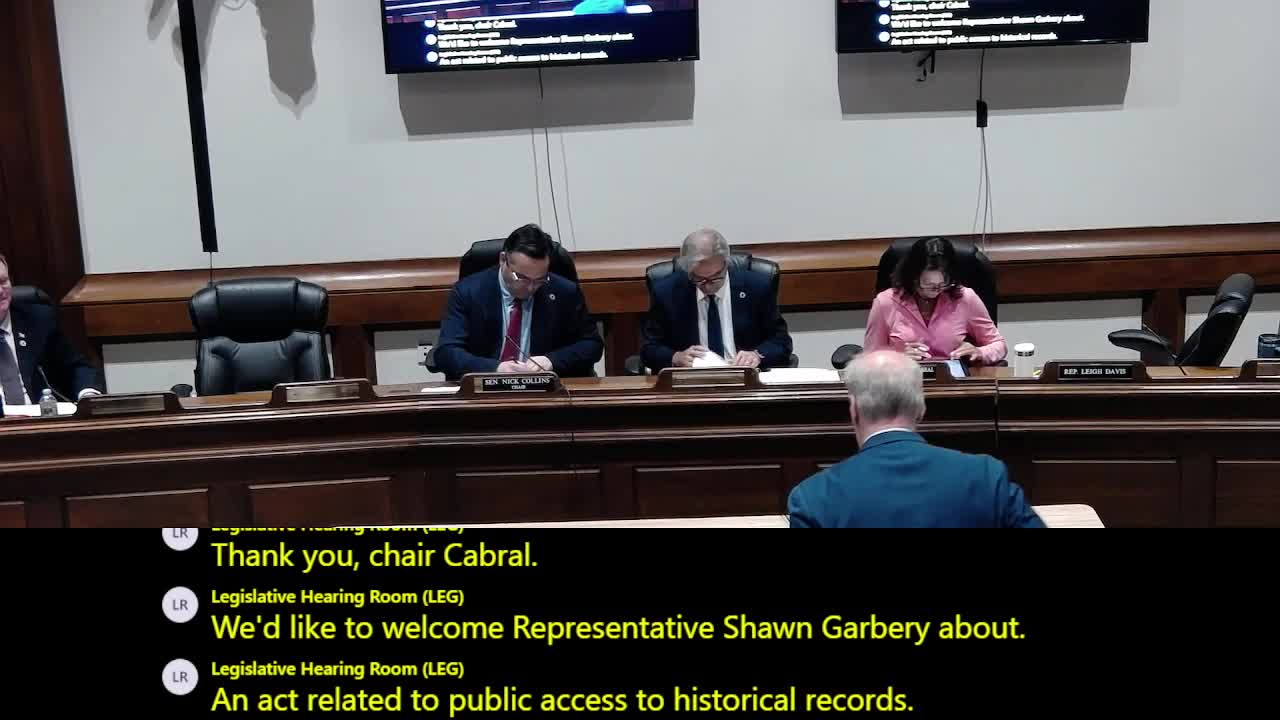
Boston — Lawmakers, advocates and family-members told the Joint Committee on State Administration and Regulatory Oversight on June 24 that the Commonwealth should make records about people who lived in state institutions publicly available after 75 years and take steps to identify names on institutional graves.
Representative (testifier) — identified in testimony as a long-time sponsor — told the committee H.3335 would allow descendants, researchers and the general public to access records now inaccessible without a court order, saying: “Currently, if somebody would want to find out the history of a loved one who lived in the state institution… you would need a court order.”
The bill would limit release to records about state institutions held by the Secretary of the Commonwealth and make them public after 75 years from creation, a period sponsors said balances family privacy and public interest. Supporters framed the change as part of a broader reckoning following a disability-led special commission that recommended the legislation.
“IT IS CRITICALLY IMPORTANT THAT THE PEOPLE OF MASSACHUSETTS KNOW THE COMPLETE HISTORY of the individuals and the actions that took place in our state institutions,” the testifier told the committee, adding that the Secretary of State, who is the custodian of the records, supports the bill.
Committee members asked for implementation details and timeline questions. Chair Cabral noted the committee has reported similar bills favorably in prior sessions and said he would entertain language clarifications; a committee member and the testifier discussed limiting the legislation to records specifically relating to state institutions under the Secretary’s control, not to all records the office holds.
The testifier and several committee members emphasized a related, non‑statutory follow-up: proactively identifying names to place on graves that now bear only codes (for example, “C‑P‑#” for religious designation and a number). One committee member said “every single one of those graves should have a name on it,” urging the state to make the effort to identify buried individuals when records permit.
Supporters pointed to the 75‑year release window as consistent with other historical-record practices and said tightening the bill’s language to limit records to those about state institutions had been added in response to stakeholder concerns. The Secretary of State’s office was cited in testimony as “strongly in favor” of the concept, though committee members indicated they would review precise statutory language and exceptions—such as living‑person privacy, personnel records or other protected categories—before reporting the bill.
Ending — The committee took testimony but did not record a committee decision or a formal vote during the hearing. Sponsors asked the committee to report the bill out favorably, repeating that prior committees had done so in earlier sessions.