Get Full Government Meeting Transcripts, Videos, & Alerts Forever!
Get email alerts on the Tobacco Policy topic
No spam. Unsubscribe anytime.
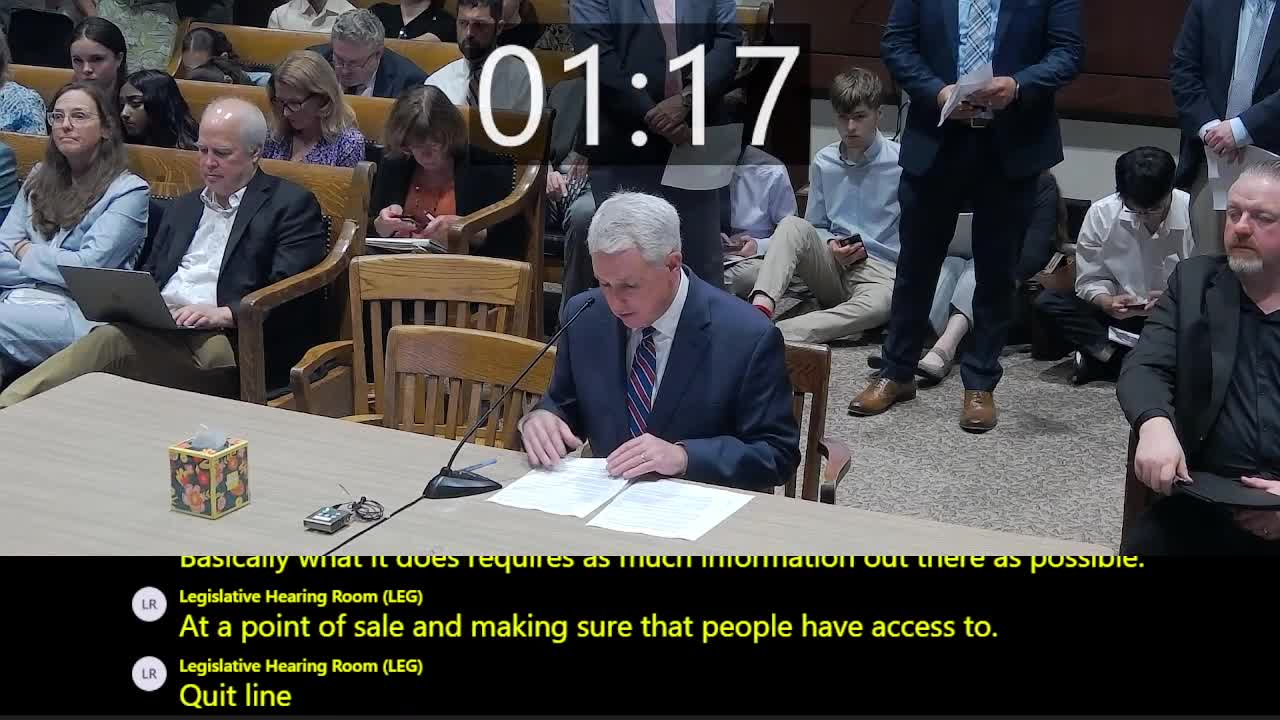
Mixed testimony as committee hears bills on nicotine-free generation, online tobacco sales and flavored-product rules
Summary
The Joint Committee on Public Health heard hours of testimony on competing tobacco-policy proposals including a nicotine-free generation that phases out sales by birth year, a ban on Internet tobacco sales and attempts to weaken or preserve the state's flavored-tobacco rules.
The Joint Committee on Public Health heard hours of testimony on a package of tobacco and nicotine bills that included proposals to create a nicotine-free generation (House Bill 2,562 / S 15-68), ban Internet sales of tobacco (H 2,482), restore menthol sales (S 15-28) and preserve local tobacco authority (opposition to H 2,419).
Advocates for tighter restrictions and the nicotine-free generation emphasized youth prevention and described aggressive tobacco-industry marketing toward young people. Representative Linsky introduced student witness Tracey (Tricia) Chekulam and other speakers who argued online sales let teenagers bypass flavor bans and age checks: "Teenagers were able to go online to these sites, say they were over 21, and buy the product," Chekulam said, describing a test purchase of flavored e-liquid.
Physicians, public-health groups and town health officials backed limits and an online sales ban, saying flavors and online availability undermine decades of progress. "A blanket repeal of the flavor provision would set us back years," Lisa Phillips of Tobacco Free Mass told the committee. Several municipal health officials said local nicotine-free generation ordinances have worked without major enforcement disruptions and recommended statewide adoption to reduce youth initiation.
Retailers and the convenience-store industry opposed the nicotine-free generation and adult-only retail proposals, arguing the approach discriminates by birth year, will drive sales across state lines or online, and will put employees at risk during enforcement. Retail representatives from multiple chains and associations said the existing age-21 law and local enforcement, combined with education and conventional enforcement, are the practical policy tools. "These proposals are discriminatory, anti-consumer choice, anti-small business, and unnecessary in light of existing Massachusetts law," said Ryan Kearney of the Retailers Association of Massachusetts.
Lawmakers also heard a related public-health bill (S 15-54) on placing lung-screening information at points of sale; clinicians urged that signage in tandem with tobacco policy would increase early detection and cessation.
What happened next: the committee received testimony from both sides and did not record votes at the hearing. Sponsors of the nicotine-free generation asked for favorable reports; retailer groups asked the committee to reject the measures.
Ending: The hearing underscored a sharp divide between public-health groups advocating stronger restrictions and retail and business groups warning of enforcement complexity and cross-border substitution; committee members will weigh the competing policy and implementation concerns.