Get Full Government Meeting Transcripts, Videos, & Alerts Forever!
Get email alerts on the Healthworkforce topic
No spam. Unsubscribe anytime.
Funeral directors urge committee to classify them as public‑health workers for vaccine priority
Summary
Funeral directors told the Joint Committee on Public Health they should be classified as public‑health workers so they can receive vaccination priority in future declared emergencies.
Funeral directors from across the state asked the Joint Committee on Public Health to classify their profession as public‑health workers during declared emergencies, testimony showed at the May 29 hearing.
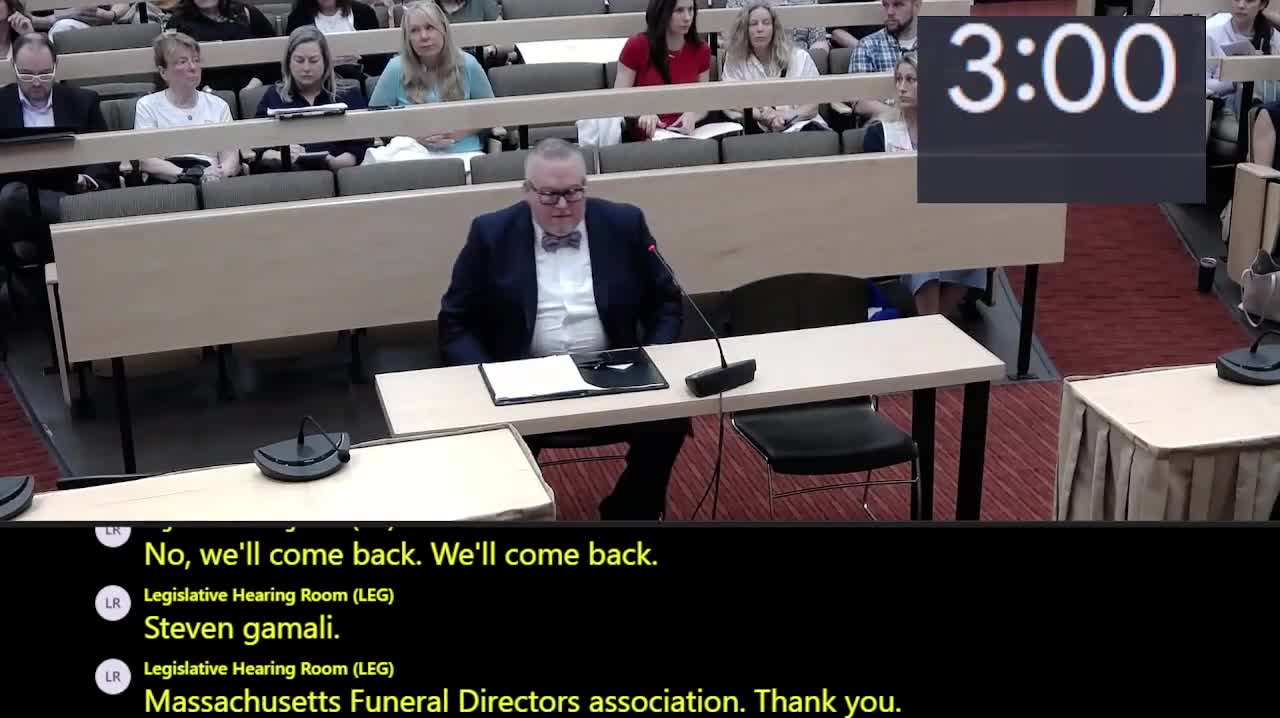
Steven Jameli, first vice president of the Massachusetts Funeral Directors Association and a vice president at Mercadante Funeral Home in Worcester, told the committee that funeral workers routinely enter hospitals, nursing homes, private residences and other settings where they come into contact with infectious remains, contaminated materials and grieving family members. “Funeral directors are the first responders and end‑of‑life healthcare workers 100% of the time when a resident of the commonwealth dies,” Jameli said, urging lawmakers to support House Bill 2463 so funeral workers would be eligible for vaccination priority in a future public‑health crisis.
Why it matters: Jameli and others told the committee that about 1,900 people work in funeral services in Massachusetts and that the classification would create a statutory guarantee that those workers would be treated consistently across future emergency vaccination phases. Supporters asked the Legislature to give the workforce statutory clarity so local decisions on priority would not be made ad hoc.
What supporters said
- Jameli described the typical duties of funeral workers — entering restricted units, handling remains and meeting with family members — and said those activities put staff at risk of exposure in an emergency. He urged an “ought to pass” report for H2463.
- Funeral directors and association representatives said the change would remove ambiguity, help protect both workers and the public and ensure consistent prioritization across agencies in future crises.
What opponents or questioners raised
- Committee members asked logistical and implementation questions but did not record any formal opposition at the hearing.
Hearing outcome and next steps
- The hearing produced no formal vote or committee action on House Bill 2463. Supporters urged the committee to report the bill favorably.
Ending: Funeral‑service representatives told lawmakers the classification would codify a role they say they have served in past emergencies and reduce uncertainty about priority access in future public‑health responses.